

Alphonse Mucha: the artist who put beauty on the street
Posters that put beauty on the street, an epic for a nation, and a record for a reduced version of one Slav Epic canvas
The twenty-fifth article of our series “Great artists” begins with a theater poster that changed Alphonse Mucha's life. But the most interesting part of the story is what he did after it made him famous.
Who was Alphonse Mucha, and how did he find his way to Paris?
Alphonse Mucha was a Czech painter and designer, born on 24 July 1860 in Ivančice, Moravia, then part of the Austrian Empire, who became famous in Paris in the 1890s for his Art Nouveau posters. Before becoming a Parisian celebrity, he worked as a theater scene painter in Vienna and studied art in Munich. He arrived in Paris in 1887, where he continued his training and earned money through illustration.
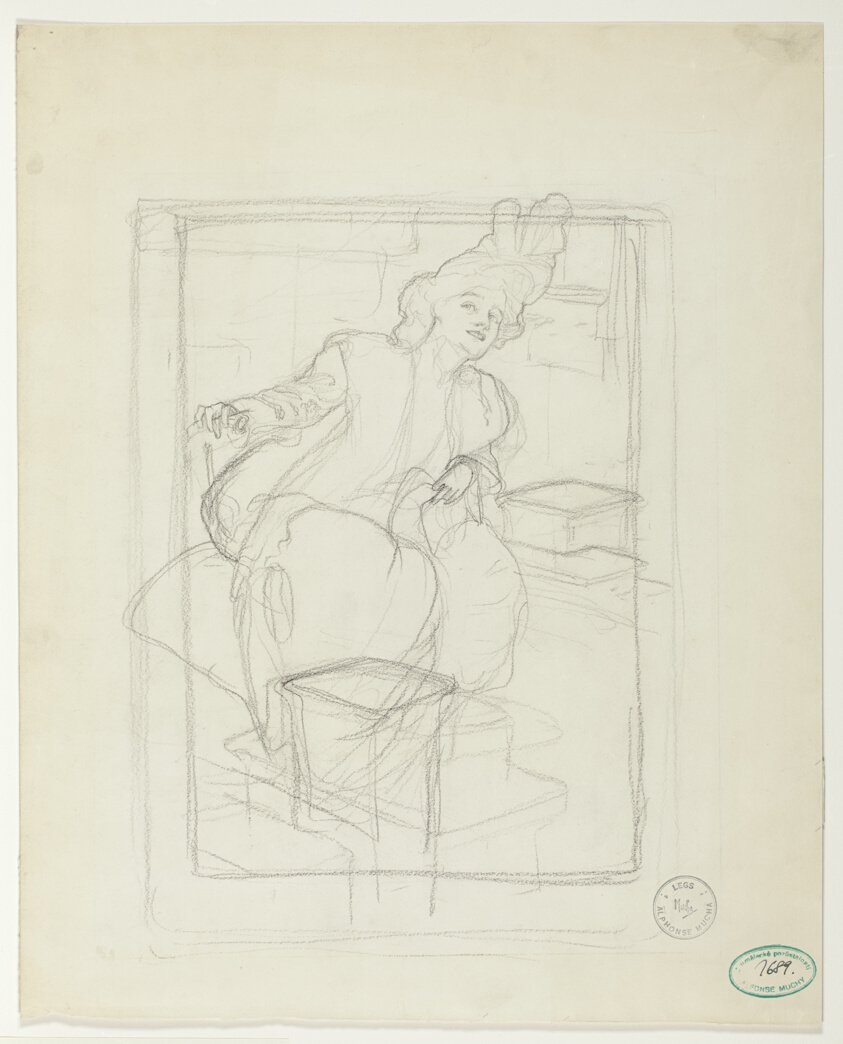
This was not an overnight success story. In Paris, Mucha lived the uncertain life familiar to many artists: finding commissions, working for publishers and looking for a way to make a living through his craft. The years of illustration also gave him practical skills he would later turn into something unmistakably his own.
The opportunity arrived during the Christmas holidays of 1894. Mucha was at the printer Lemercier's when an urgent request came in for a new poster for Bernhardt's production of Gismonda. Other artists were away. Mucha was available.
The resulting design did not look like a conventional theatrical advertisement. It was tall and narrow, with a nearly life-size Bernhardt, a subdued palette, elaborate ornament and an air of ceremonial dignity. The actress liked it. She went on to sign a six-year contract with Mucha, who also worked on costumes and stage designs.
One commission did not create his talent. It gave people a chance to see it.
Why did Mucha's posters become so influential?
Mucha's posters became influential because they turned street advertising into an art of graceful women, flowers, halos and decorative lettering that could be read at a glance. Their forms are graceful, but the designs are also remarkably clear. You can recognize a Mucha image from across a room – or, just as importantly for a poster, from across a street.
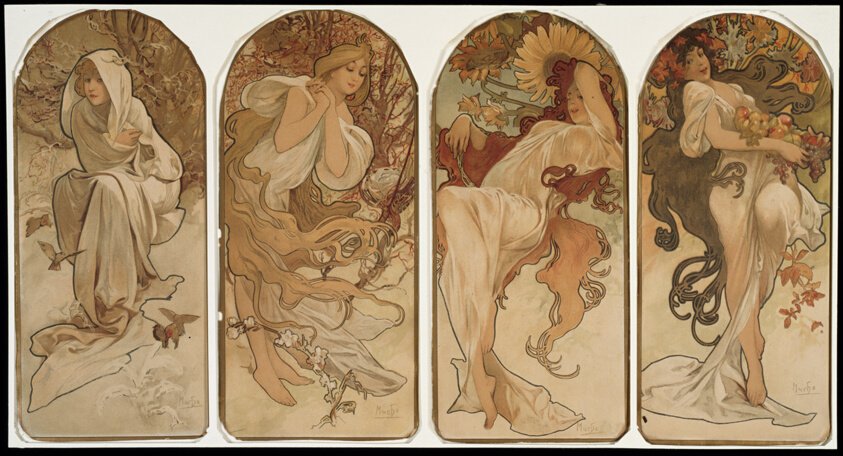
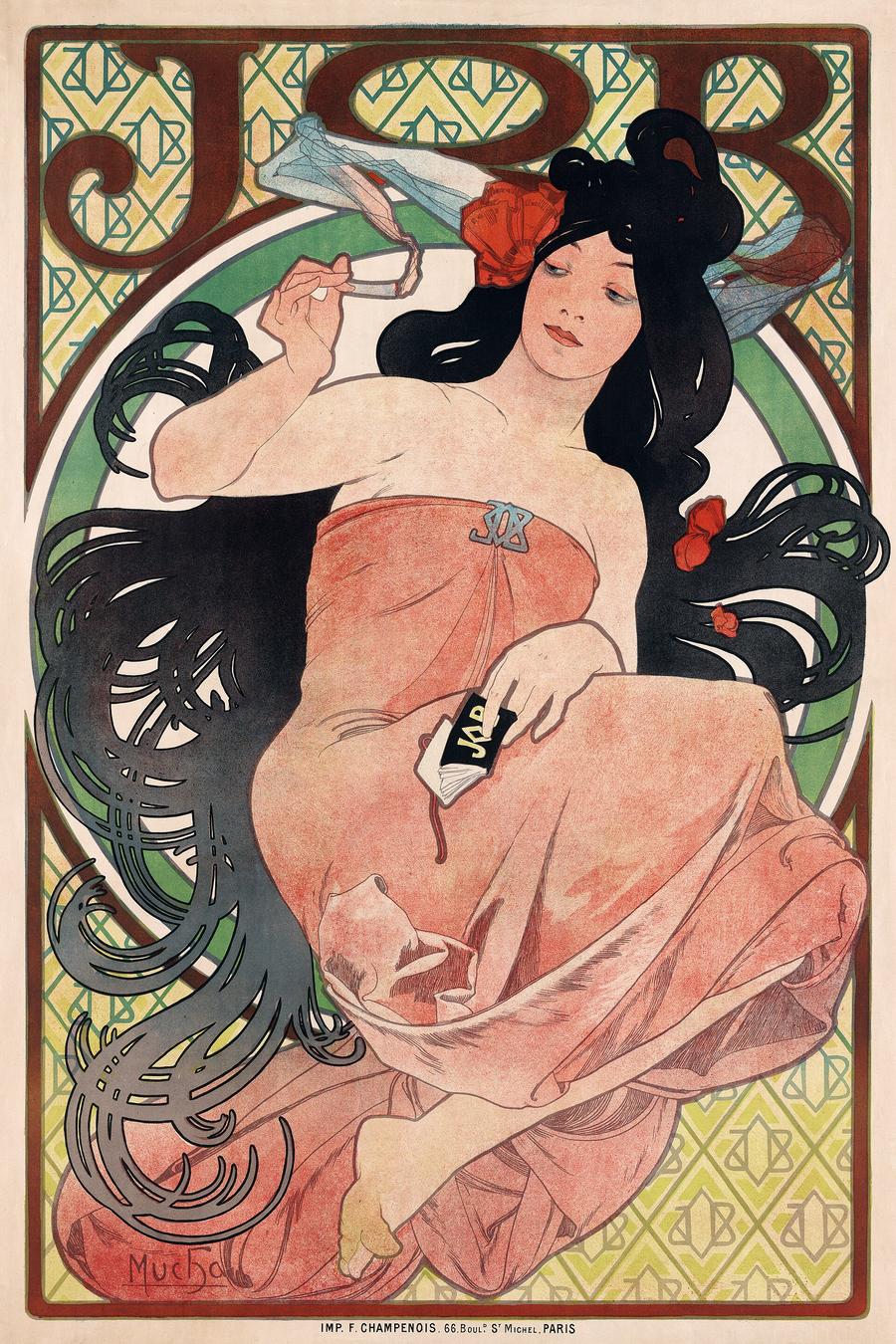
His work appeared in advertising, theater and decorative art. He designed images for products including JOB cigarette papers and created series such as The Seasons. He also worked on jewelry and interiors, including designs associated with the Parisian jeweler Georges Fouquet.
There is an interesting tension here. Today, a surviving historical Mucha poster can be a prized collectible. When it first appeared, it was also mass communication. It was meant to catch the eye of someone walking through a city, not only someone invited into a gallery.
That does not make every reproduction an original print. A historical lithograph, a later authorized edition and a modern reproduction may look similar in an image on a screen, but they are different objects. Their dates, printing history and condition matter. So does the question of what, exactly, a seller is offering.
Mucha was associated with Art Nouveau, although the label can make his career seem narrower than it was. The posters were a brilliant chapter. They were not the whole book.
What is The Slav Epic, and why did Mucha devote so much of his life to it?
The Slav Epic is a cycle of twenty monumental canvases depicting episodes from the history and traditions of the Slavic peoples, which Mucha and his patron Charles Richard Crane presented to the City of Prague in 1928. Some measure more than six by eight meters. For Mucha, the project was a deeply personal expression of cultural identity and a belief in shared history.
The idea developed around the turn of the century. Mucha returned to his homeland and spent years researching and creating the cycle, supported financially by Crane, an American businessman.
The project invites more than one response. Its scale and ambition are extraordinary. Its historical vision is also the vision of one artist, shaped by the politics and ideas of his time. We can appreciate the work's emotional power while asking how its grand narrative represents different peoples and events.
This is one reason I find Mucha more interesting than the familiar phrase “the artist of beautiful women” suggests. His work moved from a poster made for a commercial theater to an attempt to give an entire group of peoples a visual history. The same artist understood both the public street and the monumental canvas.
The later story of the cycle has included debate over where and how it should be displayed. Before planning a visit, check the current exhibition and venue directly: large works do not stay in one place simply because an older travel guide says they do.
What happened to Mucha in his final years?
In his final years Mucha designed for the new Czechoslovak state, and after the German occupation of 1939 he was questioned by the Gestapo; he died in Prague on 14 July 1939. Following the creation of Czechoslovakia in 1918, he had designed postage stamps and other national materials. The artist who had created visual identities for commercial clients now contributed to the visual identity of a country.
He died shortly before his seventy-ninth birthday.
It is tempting to turn a life like this into a simple contrast between glamorous Paris and patriotic Prague. In reality, the two belong together. Mucha's commercial work gave him international reach. His later projects show how much he wanted art to communicate ideas larger than the commission in front of him.
How much have Mucha's works sold for at auction?
Mucha's auction record is $1,472,000 for Reduced version of The Abolition of Serfdom in Russia, a 1920 canvas sold at Christie's New York on 24 April 2006; The Art Newspaper reported it as a record for the artist, although it fell short of its $1.5 million low estimate. This is an independent canvas related to a composition from The Slav Epic, not one of the monumental cycle's twenty canvases. Christie's offered it from the collection of Ambassador Charles R. Crane, the patron of The Slav Epic.
In December 2021, Young Couple from Rusadla, a rediscovered 1920 study, sold for $965,000 including buyer's premium at Toomey & Co. in Oak Park, Illinois, an auction record for a study by Mucha. On 29 November 2025, a bronze and malachite version of La Nature sold at European Arts in Prague for CZK 18,352,000. The auction house described that result as a record for Mucha on the Czech market. A domestic record and an international record are not the same claim.
Posters tell another part of the story. A JOB poster from 1898 sold at Swann Auction Galleries in New York in July 2026 for $2,600 plus buyer's premium, according to LiveAuctioneers. An individual print should be considered on its own details, including edition, condition and provenance.
A figure is only useful when we know which object sold, where, when and in what currency.
What are five facts worth remembering about Mucha?
1. He came from Moravia. Mucha was born in Ivančice in 1860 and studied in Munich and Paris.
2. One holiday commission made his name. His 1894 Gismonda poster launched his collaboration with Sarah Bernhardt.
3. He worked everywhere a picture could go. His designs crossed theater, advertising, publishing, jewelry and interiors.
4. His biggest project fills halls. The Slav Epic consists of twenty monumental canvases, presented to Prague in 1928.
5. His market has three parts. A poster, an original painting and a sculpture each belong to a different part of it.
Where can you see Mucha's works?
You can see Mucha's works in Prague, at the Mucha Museum, and in museum collections in the United States, including the Art Institute of Chicago and the Metropolitan Museum of Art. Availability on display can change, so check before you travel.
Mucha Museum, Prague presents posters, paintings and drawings from across his career.
Mucha Foundation documents the artist's work and the history of The Slav Epic.
The Art Institute of Chicago holds lithographs including The Seasons (1897).
The Metropolitan Museum of Art, New York has Mucha works in its collection, including drawings, prints and photographs.
Why does an object's history matter?
An object's history matters because, with an artist as widely reproduced as Mucha, the date, the printing and the documents are what separate an 1898 lithograph from a modern copy.
At CoArt Market, every object carries a cryptographic certificate of authenticity that records its path from owner to owner, and we are building a market for fractional ownership of Blue Chip art and collectibles, a core part of the system we are working on now.
Mucha believed images could reach people far beyond the walls of a gallery. More than a century later, perhaps that is still the question his work asks us: who gets to live with art, and who gets to take part in its story?
Sources
- Mucha Foundation, Mucha at a glance: www.muchafoundation.org/en/gallery/mucha-at-a-glance-46
- Mucha Foundation, The Slav Epic: www.muchafoundation.org/en/gallery/themes/theme/slav-epic
- Christie's, Reduced version of The Abolition of Serfdom in Russia, catalog entry: www.christies.com/lot/lot-alphonse-mucha-reduced-version-of-the-abolition-4695967/
- The Art Newspaper, “There is so much money in the market now that price seems to be irrelevant” (1 June 2006), the 2006 Mucha record: www.theartnewspaper.com/2006/06/01/there-is-so-much-money-in-the-market-now-that-price-seems-to-be-irrelevant
- Toomey & Co. sale report, reproduced by ArtDaily (December 2021): artdaily.com/news/141730/Toomey---Co--Auctioneers-sells-Alphonse-Mucha-painting-for--965-000-in--Art---Design--on-December-2-
- European Arts, press release on La Nature (November 2025, in Czech): www.europeanarts.cz/download/tz_velk%C3%A1-s%C3%A1lov%C3%A1-aukce_listopad%202025.pdf
- LiveAuctioneers, Mucha poster prices: www.liveauctioneers.com/guides/art/alphonse-mucha-posters-auction-prices/
- The Art Institute of Chicago, The Seasons: www.artic.edu/artworks/97439/the-seasons
- The Metropolitan Museum of Art, Mucha, Two Girls Reading: www.metmuseum.org/art/collection/search/753533