

Amedeo Modigliani: a Paris scandal, a reclining nude and a $170 million record
A scandal in Paris, elongated faces and a reclining nude that sold for $170.4 million in New York
The seventeenth article of our series “Great artists” begins outside a Paris gallery in 1917, where a painting in the window drew a crowd and the attention of the police. Nearly a century later, a reclining nude from the same period sold in New York for $170.4 million.
Who was Amedeo Modigliani?
Amedeo Modigliani was an Italian painter and sculptor, born in Livorno in 1884, whose portraits and nudes became known for elongated forms and an unmistakable sense of line. He died in Paris in 1920, aged 35.
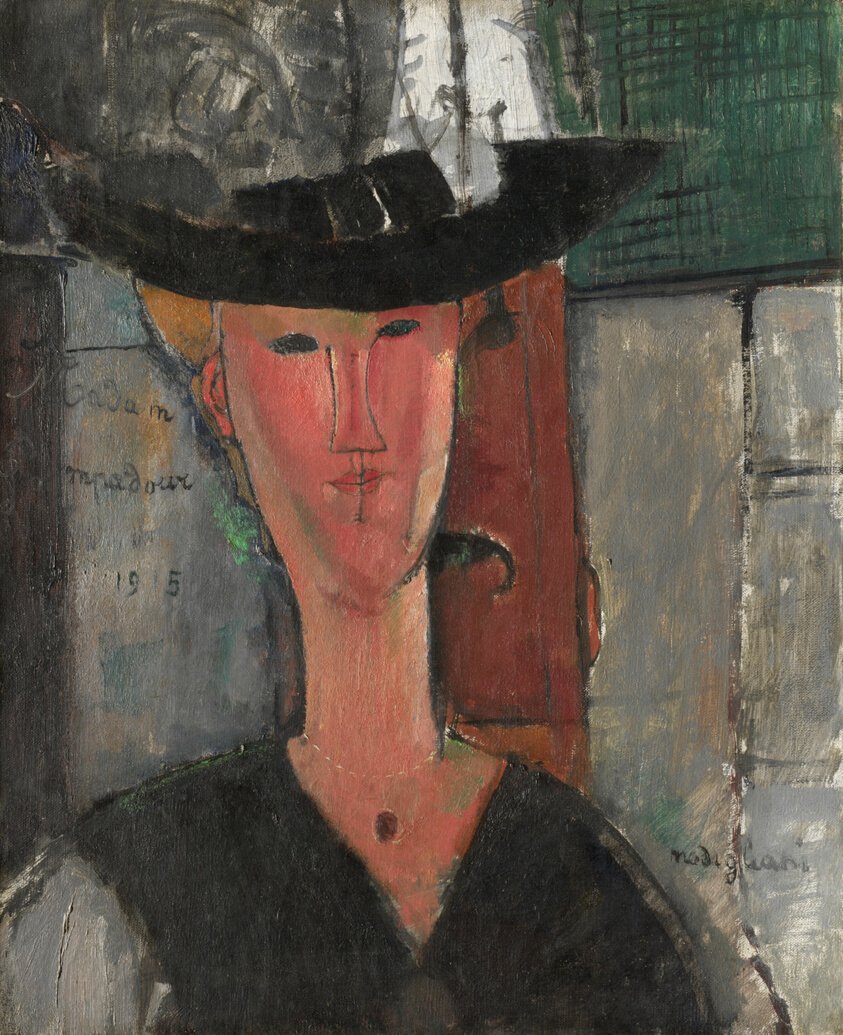
He moved to Paris in 1906 and entered an artistic world that included painters, writers, dealers and models from many countries. He made portraits of people around him and developed a visual language that can often be recognized before a visitor reaches the label.
His life has attracted stories about poverty, illness, alcohol and the Parisian avant-garde. Some are important to understanding his circumstances. Together they can also make it too easy to overlook the artist actually at work.
Modigliani drew, painted and carved. His sculpted heads and painted figures share an interest in simplified shapes, long necks and faces that seem to balance individuality with a strongly controlled style. The surface may look direct. The choices behind it were carefully made.
He died of tubercular meningitis. His partner Jeanne Hébuterne died shortly afterward. Their lives and work deserve more attention than the convenient legend of a glamorous, doomed artist.
Why is Modigliani famous?
Modigliani is famous for portraits, nudes and sculptures in which elongated forms, simplified faces and flowing contours give his subjects a distinctive presence. He drew on several traditions while developing a style that was recognizably his own.
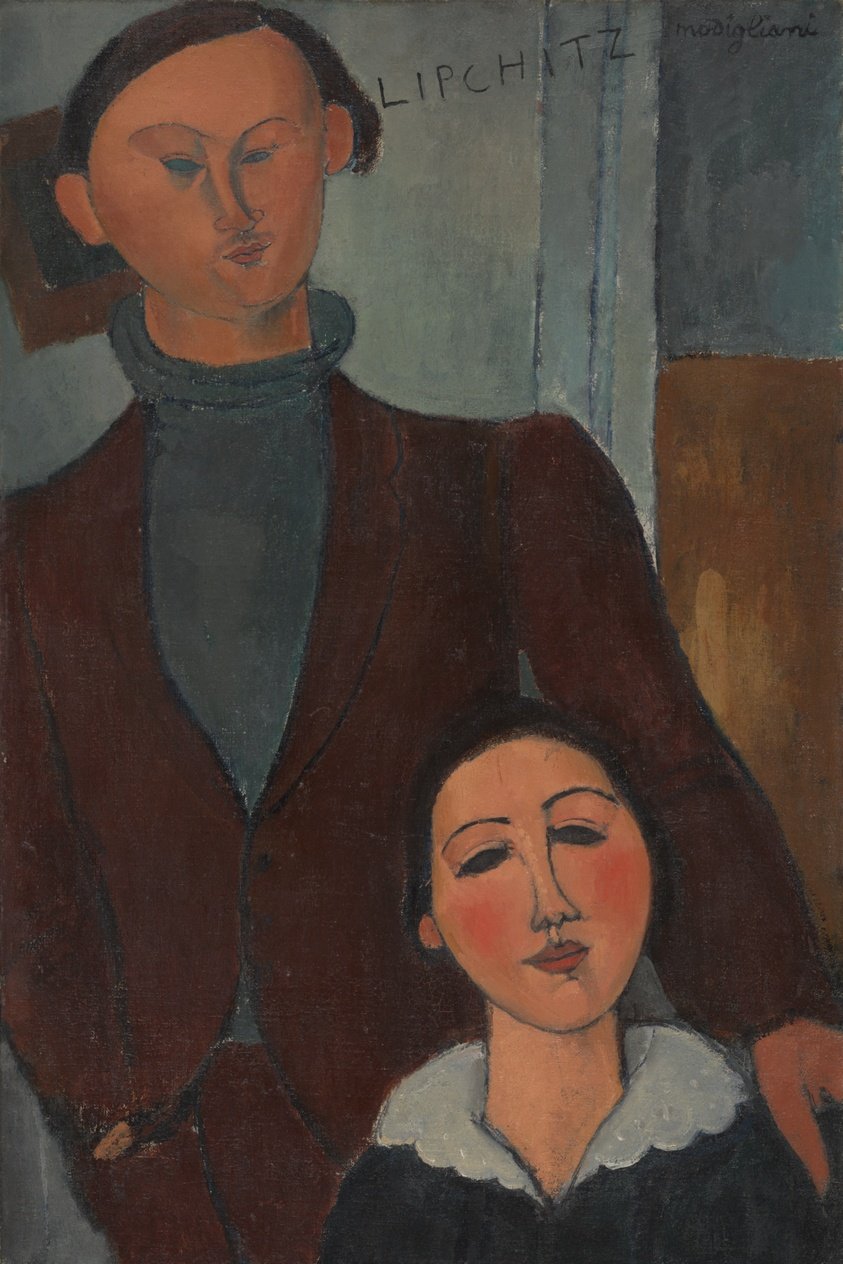
Look at a painted portrait and then at one of his carved heads. A face may become a long oval; a neck stretches; the eyes may be simplified. The treatment is stylized, but the subjects do not all become the same person. A tilt of the head or a particular posture can still give a sitter an individual character.
His interest in sculpture was significant, not a brief footnote before the paintings. Stone heads required different tools, different materials and a different physical relationship with form. Some of the ideas developed there can be seen in the way he later organized faces on canvas.
The paintings of reclining women are also central to his reputation. They are direct, large enough to command a room, and carefully composed. Their later prices make headlines; their first public reception was not entirely comfortable either.
Why did Modigliani's 1917 exhibition cause a scandal?
Modigliani's 1917 solo exhibition at Berthe Weill's gallery in Paris drew police attention because nude paintings were visible to the public, and the exhibition was interrupted. Christie's account describes a crowd gathering outside the window and police demanding closure.
Weill was a dealer who supported modern artists. The exhibition is often described as Modigliani's only solo show during his lifetime. The paintings' directness, and their presence in a gallery window, placed them in front of an audience that did not necessarily share the artist's view of how a body could be represented.
The dealer Léopold Zborowski supported Modigliani and helped provide the materials and models for the series of nudes. A painting is sometimes described as if it appeared without a room, a model, a dealer or a person willing to supply the canvas. Those people were part of the conditions that allowed the work to be made.
I do not want to pretend that every detail of the exhibition is settled by the shortest version of the story. Accounts differ in emphasis on what was removed and how the show continued. The important documented point is clear: the presentation attracted public attention and police intervention.
Nearly a century later, paintings from this period were being discussed in another kind of public room, with a very different audience and much higher numbers.
What is the record-setting Nu couché?
Nu couché is a reclining nude painted by Modigliani in 1917–1918 and sold at Christie's New York in 2015 for $170,405,000 including fees. Christie's identifies it as part of the concentrated series of nudes associated with Zborowski's support.
The figure lies across the canvas, looking outward. Modigliani's line defines the body and gives the composition its rhythm. The background and furniture frame the subject without turning the picture into a fully described room.
Other paintings by Modigliani carry very similar titles. That is not a minor cataloging problem. A second work, Nu couché (sur le côté gauche), sold at Sotheby's in 2018. Both are reclining nudes; they are not the same painting or the same auction result.
The 2015 work had an established ownership history before its New York sale. Christie's reported after the auction that it was purchased for the Long Museum. The painting's movement from an artist's studio through collectors to a museum is a story in its own right.
The 1917 exhibition and the 2015 sale are connected through Modigliani's series and period. We should not claim without evidence that this particular canvas was the one displayed in the gallery window that brought the police. A good story does not need a detail invented to improve it.
What did Modigliani's works sell for?
Modigliani's auction record is $170,405,000 including fees for Nu couché, sold at Christie's New York on 9 November 2015. Christie's identified it as a record for the artist.
A different painting, Nu couché (sur le côté gauche), sold at Sotheby's New York in 2018 for $157,159,000 including fees. Its title and composition distinguish it from the Christie's record work. When the same artist paints a recurring subject, the full title matters.
His sculptures have also produced major results. On 17 November 2026, a limestone Tête of 1911–12 sold at Phillips New York for $38.2 million at the hammer, $44.6 million including fees, the top price of the evening. The Art Newspaper reported that a different Modigliani head had sold for about $70.7 million at Sotheby's New York in 2014, remaining the artist's sculpture auction record.
A sculpture, a painting and a drawing need different comparisons. So do two paintings with similar titles and different histories. A price in an auction report identifies what happened to one object on one date; it is not a price tag for every elongated face attributed to Modigliani.
Why are Modigliani attributions debated?
Modigliani attributions are debated because his recognizable style, short career and valuable market have produced competing opinions about whether particular works are by his hand. Researchers must consider the object, its materials, documentation and history together.
A long neck is not a certificate of authorship. A name on a label is a starting point for checking the records. Who owned the work? When was it first documented? Does it appear in reliable exhibition catalogs or publications? What does technical examination show? Those questions are useful whether the answer ultimately confirms or changes the attribution.
Specialists and catalogs may disagree, and not every disagreement means the same thing. Some works have stronger documentation than others. It is worth identifying whose opinion is being reported, rather than presenting the existence of a dispute as proof of a particular conclusion.
This is also why a work's ownership history is more than a list of famous people. An old photograph, an exhibition catalog or a dated document may preserve a detail that a later seller cannot recover from memory.
What are five surprising facts about Modigliani?
Five details take us beyond the familiar image of the Parisian painter:
1. He was born in Livorno. The artist associated so strongly with Paris began his life in Italy.
2. He was a sculptor as well as a painter. His carved heads are central to understanding his treatment of faces and form.
3. A gallery window attracted police attention. His 1917 Paris exhibition became notorious for the public presentation of nudes.
4. A dealer supported the series. Léopold Zborowski helped provide models and materials for the paintings.
5. Two similarly titled nudes made separate headlines. One sold at Christie's in 2015 and the other at Sotheby's in 2018.
The fifth fact may be less romantic than a story from Montparnasse. It is also useful when two auction results are only a few words apart in a search result.
Where can you see Modigliani's work?
You can see important Modigliani works in Paris at the Musée de l'Orangerie, in London at Tate, in New York at MoMA and the Met, and in Chicago at the Art Institute. Museum collections and current displays are not always identical, so check the official site before traveling.
Musée de l'Orangerie, Paris holds paintings by Modigliani in the Walter-Guillaume collection.
Tate, London holds paintings and a carved Head of about 1911–12.
The Museum of Modern Art, New York holds paintings, drawings and sculpture.
The Metropolitan Museum of Art, New York holds Modigliani works in its collection.
The Art Institute of Chicago holds Jacques and Berthe Lipchitz (1916) and Madam Pompadour (1915).
I would try to see a carved head and a painted portrait on the same visit if the displays allow it. They make an interesting conversation across two materials.
Why does a work's history matter?
A work's history matters because ownership, exhibition records, condition and attribution help identify the particular object being discussed. In a market with repeated titles and disputed attributions, those details are particularly useful.
At CoArt Market, we want objects that have spent years in private hands to become visible again. Every object carries a cryptographic certificate of authenticity that records its path from owner to owner, and we are building a market for fractional ownership of Blue Chip art and collectibles, a core part of the system we are working on now.
Modigliani made portraits, stone heads and nudes in a career cut short at 35. If you could spend an afternoon with one side of his work, which would you choose?
Sources
- Christie's, “Modigliani's Nu couché (Reclining Nude) leads a night of records in New York” (2015), the record sale and the 1917 exhibition: www.christies.com/en/stories/modigliani-nu-couche-reclining-nude-leads-a-night-of-records-in-new-york-8e69a9e7b7a946c6b02fe926ebad92a0
- Christie's, top ten results, The Artist's Muse evening sale, 9 November 2015: press.christies.com/top-ten-results-the-artists-muse-an-evening-sale-new-york-november-9-2015/
- Christie's, artist biography: www.christies.com/artists/amedeo-modigliani
- Sotheby's, the $157 million Modigliani and top Impressionist and Modern prices of 2018: www.sothebys.com/en/slideshows/the-157-million-modigliani-and-more-top-impressionist-modern-prices-in-2018
- Phillips, New York evening sale results, 17 November 2026: www.phillips.com/press/release/phillips-new-york-evening-sale-soars-55-yearonyear-
- The Art Newspaper, Sarah Cascone, “Modigliani sculpture heads Phillips's New York evening sale at $44.6m” (18 November 2026): www.theartnewspaper.com/2026/11/18/modigliani-heads-phillipss-new-york-evening-sale-at-446m
- Tate, Amedeo Modigliani: www.tate.org.uk/art/artists/amedeo-modigliani-1648
- MoMA, Amedeo Modigliani: www.moma.org/artists/4054