

Caravaggio: the painting withdrawn from auction and the argument over a name
A painting withdrawn from auction, a quarrel over attribution, and why a Caravaggio almost never reaches the open market
The twenty-second article of our series “Great artists” begins in Madrid, where a painting was withdrawn from auction in 2021 when experts suspected it might be by Caravaggio. It continues in Rome, where Italy acquired another work attributed to him in 2026.
Who was Caravaggio?
Caravaggio was the Italian painter Michelangelo Merisi, born in 1571, whose dramatic use of light and direct treatment of human figures changed the visual language of European painting. He died in 1610.
He worked in Rome, Naples, Malta and Sicily. His subjects included religious scenes, musicians, card players and young figures painted with an immediacy that can make an old story feel very close to the viewer.
Caravaggio's life was turbulent. In 1606 he killed a man in Rome and fled. He continued to work while moving through different cities and seeking a pardon. His encounters with the law and his death at a relatively young age have supplied enough material for books and films.
The life can be dramatic without replacing the paintings. A police record does not explain how a hand emerges from darkness, how a figure leans across a table or why the light falls where it does. For that, we still need to look at the canvas.
Why is Caravaggio famous?
Caravaggio is famous for combining intense light and shadow with naturalistic figures, bringing religious and everyday scenes into a space that feels immediate and physical. His influence extended well beyond the places where he worked.
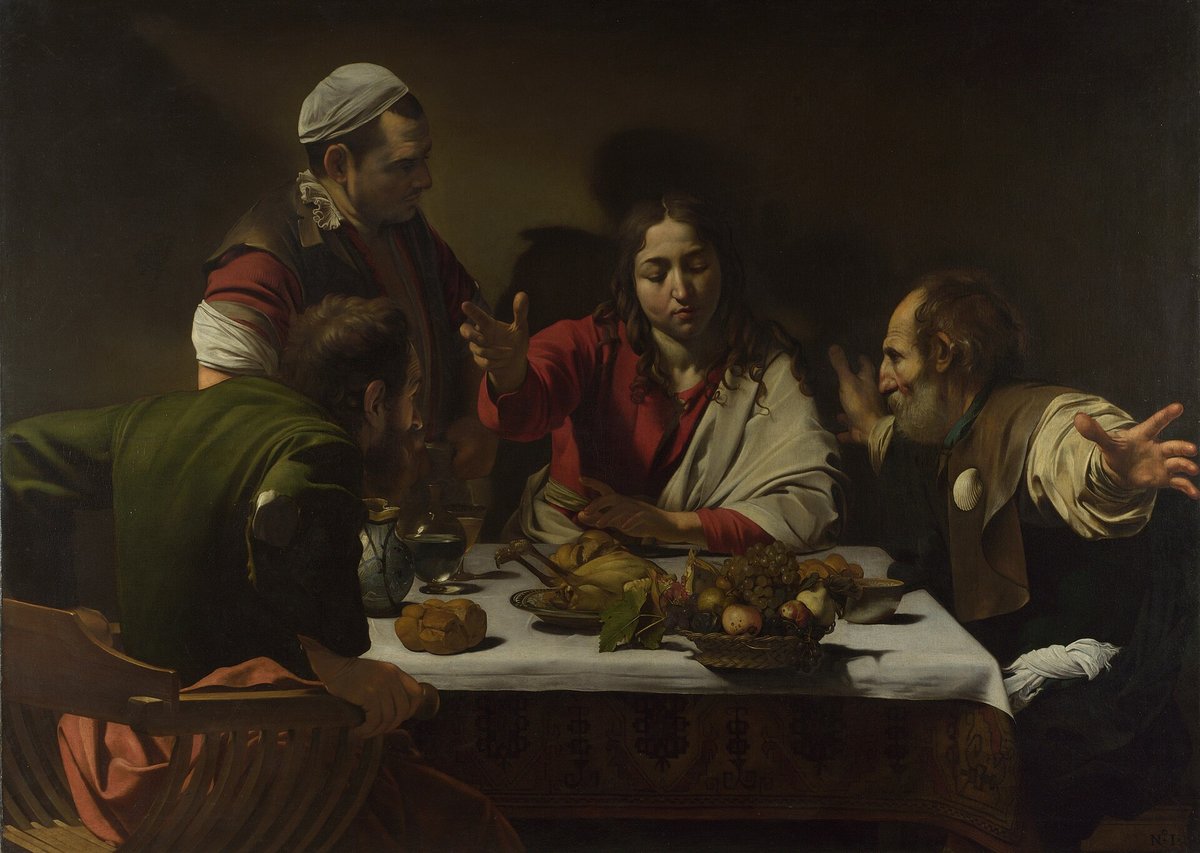
In The Supper at Emmaus, at London's National Gallery, the disciples react as they recognize Christ. One figure's arms extend across the scene; another seems ready to rise from his chair. The basket of fruit projects toward our space. The event takes place around an ordinary table, but the light and gestures make the moment unmistakably dramatic.
Caravaggio did not invent light or shadow. He used them with a force that makes the viewer aware of the space around a figure and the darkness beyond it. His people often look like people who might have been found in the streets and rooms of his own time.
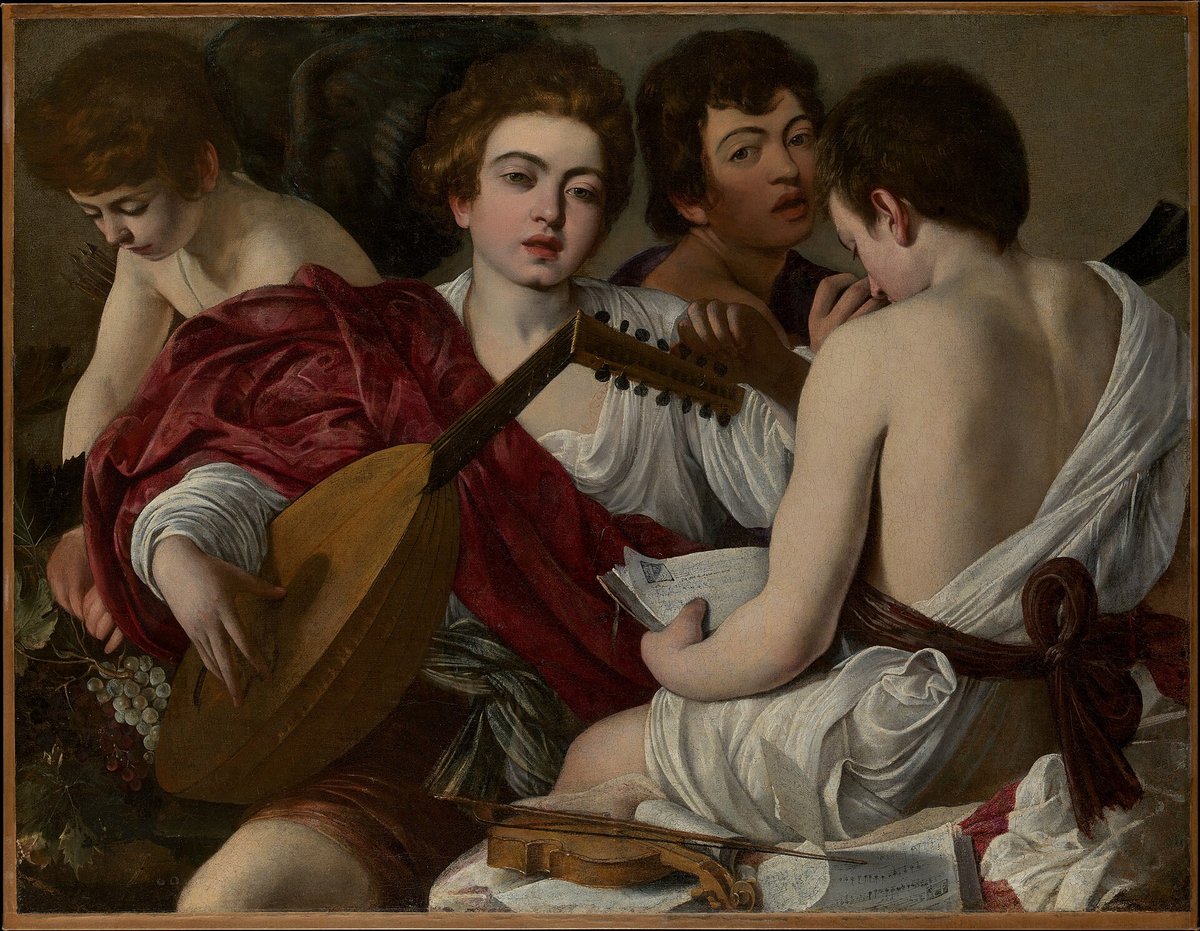
At the Metropolitan Museum of Art in New York, The Musicians offers another subject: young performers preparing to play. The museum describes the composition as carefully constructed from individual models. What appears to be a single observed instant was also a painter's arrangement.
The difference matters. Naturalism is not necessarily a photograph made with a brush. The artist still chooses who stands where, what the viewer sees and what remains in shadow.
What happened to the Madrid Ecce Homo?
A painting of Ecce Homo was withdrawn from an auction at Ansorena in Madrid in April 2021 after specialists raised the possibility that it was by Caravaggio, and it was presented at the Prado in 2024 as his work. The episode turned an overlooked picture into an international story about attribution and provenance.
The online catalog had attributed it to the circle of José de Ribera, with a guide price of €1,500. That was a starting figure in an auction catalog, not a completed sale. No one bought the painting for that amount at the stopped auction.
After the withdrawal, experts examined and restored the work. The Prado presented it in 2024, describing it as painted by Caravaggio around 1605–1609 and noting evidence that it had belonged to King Philip IV of Spain in the 17th century. By then its owners had sold it to an undisclosed buyer, who lent it to the museum; the price was not announced. Research and public presentation gave people an opportunity to see the painting and study the case for its attribution.
The story is appealing because the contrast between an inexpensive opening figure and a major attribution is so dramatic. But the useful work sits between those points: recognizing a possibility, stopping the sale, examining the object, comparing evidence and documenting its history.
There is another detail worth preserving. Attribution is a conclusion supported by evidence and the opinions of specialists. It is more informative to name the Prado and the researchers' position than to write that a painting “proved itself” overnight.
Did a Caravaggio painting sell for €30 million in 2026?
Yes: in March 2026 the Italian Ministry of Culture bought Caravaggio's Portrait of Maffeo Barberini for €30 million after more than a year of negotiations, The Art Newspaper reported. It was a private state acquisition, not an auction result.
The sitter later became Pope Urban VIII. The portrait was bought from its Florentine private owners. The art historian Roberto Longhi first attributed it to Caravaggio in 1963, and it went on view at Rome's Palazzo Barberini in November 2024, the first time it had been shown in public since 1963. The museum was to receive it for its permanent collection after the acquisition.
A state purchase can return a work from private ownership to a public institution. Its reported price is a meaningful market fact, but it should not be placed in a table of auction records as if a bidder raised a paddle at Sotheby's or Christie's.
Another much-discussed painting, Judith and Holofernes, was discovered in an attic near Toulouse and sold privately in 2019 before a planned auction. Its attribution to Caravaggio has been disputed. It had been estimated at €100–150 million; the price and the buyer of the private sale were kept confidential, so I will not invent a figure.
Two works, two transactions or proposed transactions, different levels of public information. Both show why a painting's documented route matters as much as the size of a headline.
What is Caravaggio's auction record?
Caravaggio has no reliable public auction record for an undisputed painting, because his major works almost never appear at public auction and auction databases mix works by him with works attributed to him, after him or in his circle.
The large figures in his market come from private transactions instead. That is not a contradiction: private negotiations and public auctions are different events.
The Madrid Ecce Homo did not sell for its opening figure in 2021; it was withdrawn. The Toulouse Judith was sold privately before the planned auction, with the sale price undisclosed. The 2026 Barberini portrait was purchased by the Italian state through negotiation.
I would rather leave the auction-record question open than convert an estimate, a private purchase or an uncertain attribution into a confident but wrong number. Each event is still worth reporting on its own terms.
What are five striking facts about Caravaggio?
Five details show the distance between a familiar name and the life of an individual object:
1. His name points to a place. Caravaggio was Michelangelo Merisi; the name by which he is known refers to the town associated with his family.
2. A dramatic supper reaches toward the viewer. In the National Gallery's Supper at Emmaus, gestures and objects make the space feel close to us.
3. He fled Rome after a killing. The National Gallery records that in 1606 he stabbed a rival in a swordfight, the man died, and Caravaggio left Rome rather than face justice.
4. A Madrid auction was stopped. The 2021 Ecce Homo listing was withdrawn before a sale after specialists raised a possible attribution.
5. A portrait returned to public view before a state purchase. The Barberini portrait was shown in Rome in 2024 and acquired by Italy in 2026.
The fourth fact is particularly relevant to anyone interested in the art market. A catalog entry is a statement made at a particular moment. New evidence can change how a work is understood.
Where can you see Caravaggio's work?
You can see major Caravaggio works in Rome at the Galleria Borghese and Palazzo Barberini, in London at the National Gallery, in New York at the Metropolitan Museum of Art and in Madrid at the Prado. Check each institution's current display or loan information before traveling.
The National Gallery, London holds works including The Supper at Emmaus.
The Metropolitan Museum of Art, New York holds The Musicians.
Gallerie Nazionali di Arte Antica, Rome includes Palazzo Barberini, where the Barberini portrait was exhibited.
Museo Nacional del Prado, Madrid showed the Ecce Homo from May to October 2024; check its current status.
Galleria Borghese, Rome holds important Caravaggio paintings.
Caravaggio also made works for churches and specific settings. Seeing a painting in relation to the architecture around it can be different from encountering a reproduction on a screen.
Why does a painting's history matter?
A painting's history matters because attribution, ownership, restoration and exhibition records help us understand what the object is and how it reached the present. The Madrid and Toulouse stories show why a public claim, a stopped auction and a completed sale should be kept distinct.
At CoArt Market, we want objects that have spent years in private hands to become visible again. Every object carries a cryptographic certificate of authenticity that records its path from owner to owner, and we are building a market for fractional ownership of Blue Chip art and collectibles, a core part of the system we are working on now.
Caravaggio could make a scene from a distant story feel as if it had just happened at the next table. Which painting of his would you most like to see in person?
Sources
- National Gallery, Michelangelo Merisi da Caravaggio: www.nationalgallery.org.uk/artists/michelangelo-merisi-da-caravaggio
- National Gallery, The Supper at Emmaus: www.nationalgallery.org.uk/paintings/michelangelo-merisi-da-caravaggio-the-supper-at-emmaus
- The Metropolitan Museum of Art, The Musicians: www.metmuseum.org/art/collection/search/435844
- The Art Newspaper, new Caravaggio once estimated at auction for €1,500 to go on show at the Prado (6 May 2024): www.theartnewspaper.com/2024/05/06/new-caravaggio-workonce-estimated-at-auction-for-1500to-go-on-show-at-the-prado
- The Art Newspaper, James Imam, “Caravaggio portrait of influential patron, and future Pope Urban VIII, purchased by Italy for €30m” (11 March 2026): www.theartnewspaper.com/2026/03/11/caravaggio-portrait-influential-patronand-future-pope-urban-viii-purchased-by-italy
- The Art Newspaper, the Toulouse Judith sold privately before its auction (25 June 2019): www.theartnewspaper.com/2019/06/25/ignored-by-the-louvre-lost-caravaggio-bought-in-private-sale-is-destined-for-important-museum