

David Hockney: a swimming pool, two figures and $90.3 million
A swimming pool, two figures and a painting that sold for $90.3 million: Hockney's California, seen up close
The thirty-third article of our series “Great artists” follows David Hockney from Bradford to California and back to the landscapes of Yorkshire. Along the way, a swimming pool became the setting for what was, on the night of its sale, the most expensive work ever sold at auction by a living artist.
Who was David Hockney?
David Hockney was a British painter and printmaker whose work moved between portraits, swimming pools, landscapes, photography and digital drawing. He was born in Bradford, Yorkshire, on July 9, 1937, and studied at Bradford School of Art before entering the Royal College of Art in London in 1959.
Hockney's early career unfolded as British artists were reconsidering what subjects and styles painting could include. He is often associated with Pop Art, although he resisted being confined to a single label. Fair enough. It is hard to fit an artist into one box when he keeps changing the shape of the box.
In the 1960s he found a new set of subjects in California. Bright light, modern houses and swimming pools offered a visual contrast with the northern England of his childhood. Later he returned repeatedly to Yorkshire, looking at roads, fields and trees with the same curiosity he had brought to Los Angeles.
Hockney died at home in London on June 11, 2026, aged 88. He worked across more than six decades and kept exploring new tools into old age. His paintings of California made him famous, but they tell only part of the story.
Why did David Hockney paint swimming pools?
Hockney painted swimming pools because California's light, architecture and water gave him a new way to examine how the world looks. A pool could be a place, a surface and a problem for a painter all at once.
Water moves, reflects and distorts. A tiled bottom looks different depending on the angle of light; a splash exists for an instant. A photograph can stop that moment. A painter has to decide how to construct it.
A Bigger Splash (1967), now in Tate's collection, shows a pool and a burst of water against a sunlit building. The person responsible for the splash is absent. We see the result and imagine the action. Hockney gives us a scene that feels immediate, although the painting took time and care to make.
His pools are often described as images of leisure, and they are. They also reward close attention to the space around them: the edge of the water, the architecture and the relationship between the surface and what lies beneath. The sunshine is easy to notice. The construction is where the artist keeps you looking.
There is a second human story in these paintings. Hockney's work includes openly queer subjects and relationships at a time when British and American attitudes and laws were changing. His portraits of friends and lovers belong to the history of his art, not merely to the footnotes of his private life.
What is David Hockney's most expensive painting?
Hockney's most expensive painting is Portrait of an Artist (Pool with Two Figures) (1972), which sold at Christie's New York on November 15, 2018, for $90,312,500 including buyer's premium. It shows a clothed man looking down toward a swimmer beneath the water. The standing figure is Hockney's former partner Peter Schlesinger, and the painting brings together a landscape, a pool and a relationship that had changed.
The image looks calm. It is also carefully composed: one figure is upright and still, the other moves horizontally below the surface. The distance between them is as important as the water itself. We can interpret that distance in more than one way, and the painting does not need us to agree on a single story.
Hockney worked from photographs and observation in developing the image. Photography was not a substitute for painting here. It was one of the tools he used to ask how separate moments and viewpoints could become a picture.
On the night of the sale it set the auction record for a work by a living artist, a title it held until Jeff Koons's Rabbit sold at Christie's New York in May 2019. It is still Hockney's own auction record.
One swimmer, one observer, and a price that made headlines around the world. But the painting was already interesting before the auctioneer raised a hand. The sale added a chapter to its story; it did not paint the figures.
How did Hockney use photography and the iPad?
Hockney used photographic collage and later digital drawing to explore how people see across time and from more than one position. In the early 1980s he assembled multiple photographs into larger compositions, sometimes called “joiners.” A single camera frame gives one view at one instant; a collage can bring several views together.
The result can look fragmented, but the idea is familiar. When we look at a room or a person, our eyes do not remain perfectly fixed. We move, notice one detail and then another, and build an understanding of the whole. Hockney's photographic work made that process visible.
His later use of the iPad surprised people who thought a painter of his generation should be content with brushes. He used a screen to draw flowers, trees and seasonal changes, including landscapes made in Normandy. A new device did not change the basic question: what happens when an artist looks carefully and tries to show someone else what he sees?
He also proposed controversial ideas about the use of optical devices by earlier painters in his book Secret Knowledge. Some specialists challenged the strength of his claims. The disagreement is worth mentioning because a question can be stimulating without becoming settled fact simply because a famous artist asked it.
What did David Hockney's paintings sell for recently?
The most recent major Hockney sale was David, Celia, Stephen and Ian, London 1982, which sold at Phillips New York on November 17, 2026, for $10 million at the hammer and $12.2 million with fees, within its $10 million to $15 million estimate. Phillips called it “the highest price for the artist across the industry this year.” The work is made of eight canvas panels and brings together the artist and people close to him.
An earlier double portrait, Christopher Isherwood and Don Bachardy (1968), sold at Christie's New York on November 17, 2025, for $44,335,000 including fees. The painting portrays the writer and his partner in a shared domestic space. As with Pool with Two Figures, the people in the picture are not interchangeable subjects: knowing who they are changes the conversation around it.
These are completed public sales. The auction record belongs to Portrait of an Artist (Pool with Two Figures); the 2026 result belongs to the eight-panel group portrait. Neither figure tells us what another work will sell for.
What are five facts to remember about David Hockney?
Five details I find worth remembering:
1. Hockney was born in Bradford and returned to Yorkshire landscapes throughout his career.
2. California gave him pools, bright light and a different kind of architecture to observe.
3. His portraits include friends and partners, not just commissioned sitters.
4. He used photographic collages and digital screens as well as conventional painting materials.
5. He died in June 2026; the November sale at Phillips took place after his death.
Where can you see David Hockney's work?
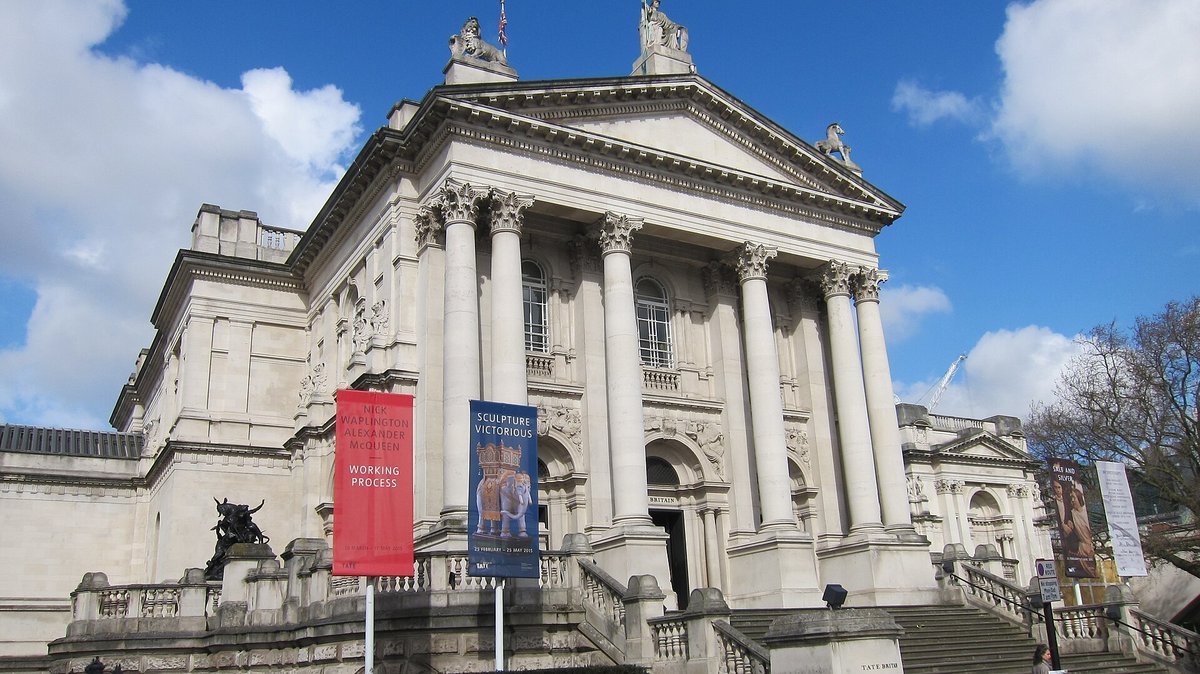
You can see Hockney's work at Tate in Britain, which holds A Bigger Splash, and at the National Gallery of Australia, which describes a major collection of his work. The David Hockney Foundation provides a chronology of his career. Check an institution's current displays before visiting; collection ownership does not guarantee that a particular painting is on view.
At CoArt Market, every object carries a cryptographic certificate of authenticity, and we are building a market for fractional ownership of Blue Chip art and collectibles, a core part of the system we are working on now.
A painter from Yorkshire spent his life asking how to show what he saw. Sometimes the answer involved a blue pool; sometimes a country road or a screen. When you look at Hockney, where do you want to stand first: beside the pool, or on a road through the trees?
Sources
- Christie's, Hockney's first double portrait, with the 2025 result and his record of 2018: www.christies.com/en/stories/david-hockney-first-last-double-portrait-c23c5d87360e4f0386d060a8b5d625e1
- Phillips, New York evening sale results, 17 November 2026: www.phillips.com/press/release/phillips-new-york-evening-sale-soars-55-yearonyear-
- Phillips, David Hockney, David, Celia, Stephen and Ian, London 1982, lot 12: www.phillips.com/detail/david-hockney/241817
- The Art Newspaper, Sarah Cascone, Modigliani heads Phillips's New York evening sale (18 November 2026): www.theartnewspaper.com/2026/11/18/modigliani-heads-phillipss-new-york-evening-sale-at-446m
- Phillips, Remembering David Hockney: www.phillips.com/article/169289568/in-remembrance-david-hockney
- David Hockney Foundation, chronology: www.thedavidhockneyfoundation.org/chronology
- National Gallery of Australia, David Hockney: nga.gov.au/stories-ideas/david-hockney/
- Fondation Louis Vuitton, artist biography: www.fondationlouisvuitton.fr/en/collection/artists/david-hockney
- Associated Press, obituary: apnews.com/article/79ddb3813406f21a8859d3b22e653852