

Edgar Degas: a young dancer, a wax original and a $41.6 million bronze
A young dancer modelled in wax, the bronzes cast after Degas's death and a $41.6 million result
The twenty-first article of our series “Great artists” begins with a fourteen-year-old ballet student shown in wax at an exhibition in 1881. More than a century later, a bronze cast sold at Christie's New York for $41.61 million. The original and the cast are not the same object.
Who was Edgar Degas?
Edgar Degas was a French artist born in Paris in 1834, known for paintings, pastels, drawings, prints and sculpture depicting modern life. He died in Paris in 1917.
His name is often followed immediately by the word “ballerinas.” They are an important part of his work, but his subjects also included horse races, performers, women in everyday settings and portraits. His practice ranged across several media, and he frequently returned to a pose or figure in more than one work.
Degas exhibited with the Impressionists, although his interest in controlled drawing and work in the studio complicates any simple picture of an artist standing outdoors in the sun. The group was not a uniform factory, and its members did not all work in the same way.
He watched performers rehearse, adjust clothing, wait and rest. A stage performance offers the audience a carefully arranged moment. Degas also paid attention to the labor and less polished moments around it.
That is one reason the dancers remain interesting. They are not only there to be admired from the front row. They are people practicing a demanding profession.
Why is Degas famous for dancers?
Degas is famous for dancers because he repeatedly depicted ballet students and performers in rehearsal, backstage and on stage, using them to explore movement, posture and composition. His pictures often show preparation rather than the final bow.
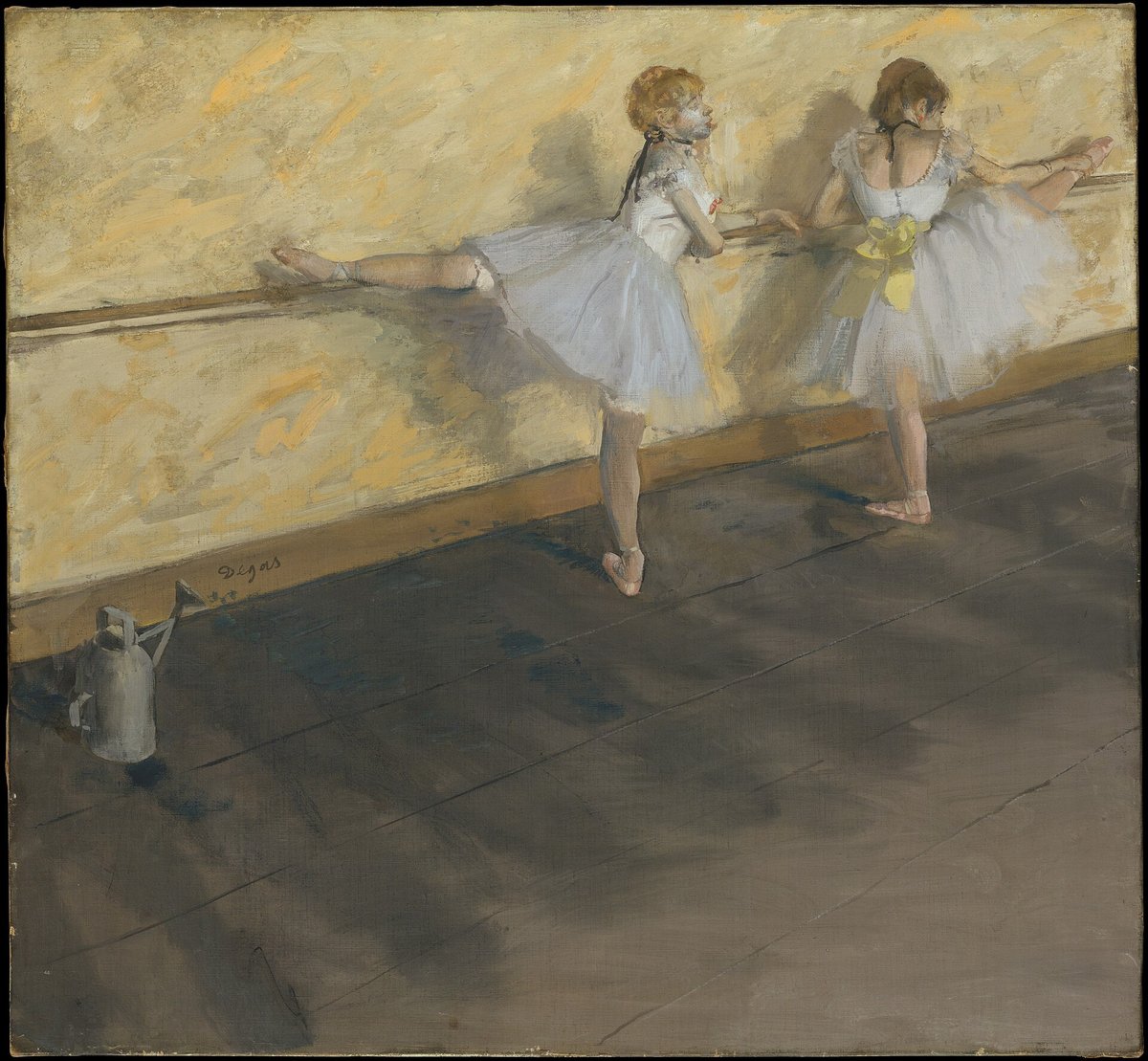
At the Metropolitan Museum of Art, Dancers Practicing at the Barre includes a watering can. The Met explains that water was sprinkled on the rehearsal-room floor to keep dust from rising. It also notes that the shape of the can echoes the pose of a dancer nearby.
That is a detail I like. An ordinary object belongs to the practical life of the room, and it also becomes part of the visual arrangement. A painting can be carefully composed without pretending the working equipment has disappeared.
The Met records another unusual chapter: Degas gave the painting to collector Henri Rouart as a replacement for an earlier work that he had altered and accidentally destroyed. Sometimes an artist can be his own most effective editor. In this case, perhaps a little too effective.
Many young dancers came from modest backgrounds and worked in a world with difficult conditions and unequal power. The beautiful costumes do not explain the whole institution. Looking at the work behind the performance gives the image another dimension.
Who was the Little Dancer?
Little Dancer Aged Fourteen is a sculpture for which Degas used a young Paris Opera ballet student as his model; he exhibited the wax original in 1881. The National Gallery of Art describes it as the only sculpture he publicly exhibited during his lifetime.
The original figure combines pigmented wax with materials including real hair and fabric. She stands with her arms behind her, chin raised and feet positioned as a dancer's might be. The combination of modeled body, clothing and hair made her unusually lifelike for contemporary viewers.
The National Gallery notes that many critics responded harshly when the sculpture first appeared. The dancer did not resemble an idealized classical figure placed safely on a pedestal. She seemed connected to a real working world that some members of the audience preferred not to see.
Her pose is not a grand leap across the stage. It is a young person holding a position. There is pride in the way she stands, but also the possibility of fatigue and effort. A viewer can read the figure differently without needing to invent a conversation with her.
The original's materials matter. Wax, fabric and hair are not the same as bronze, even when the figures share a pose. That brings us to the auction record.
What is the difference between the wax Little Dancer and the bronze casts?
The wax Little Dancer shown in 1881 was made during Degas's lifetime, while the bronze casts were produced after his death. The National Gallery of Art identifies its wax version as the original formed by the artist's hands.
Bronze casts allow the sculpture's form to exist in more than one place. Individual casts have their own dates, foundry information, ownership histories and condition. Some are dressed with fabric skirts and ribbons, so their appearance combines cast material with elements that can vary or require care.
This is not a reason to dismiss a bronze. It is a reason to describe it accurately. “Degas's Little Dancer” may refer to the wax original or to a particular bronze cast. A museum visitor or collector deserves to know which one is being discussed.
The cast sold at Christie's in 2022 is dated 1927. It is a bronze with a muslin skirt and satin hair ribbon. Those details belong beside the auction price, because they identify the object offered in the room.
A sculpture can have a complex life after the artist's death. Casting, collecting, exhibition and conservation each add information. The title stays familiar while the individual objects follow different paths.
What is Edgar Degas's auction record?
Degas's auction record is $41,610,000 including fees for a 1927 bronze cast of Petite danseuse de quatorze ans, sold at Christie's New York on 12 May 2022 to a telephone bidder for $36 million at the hammer, against an estimate of $20 million to $30 million. It came from the collection of Anne H. Bass.
The artist also achieved notable public results in other media. Sotheby's own list of his top results includes Dans les coulisses at Christie's London on 27 February 2018 for $12.5 million, Danseuse at Sotheby's New York on 12 May 2021 for $11.8 million, and Danseuses (Les coulisses de l'Opéra) at Christie's Paris on 31 March 2022 for about $6.8 million.
Those results should be compared with their medium, date and individual provenance in view. A bronze cast, a pastel and a painting are different objects. A work's title may tell us that dancers are present, but it will not tell us everything about the object or its history.
There is also an older market story at the Met. Its Dancers Practicing at the Barre was purchased by Louisine Havemeyer at Rouart's estate sale in 1912 for $95,700, which the museum describes as a record for a work by a living artist at the time.
The 1912 and 2022 figures are nominal prices more than a century apart. They show different moments in the reception of Degas's work; they are not a promise about what any other work will sell for.
What are five surprising facts about Degas?
Five details take us beyond the familiar image of a dancer in a tutu:
1. He exhibited only one sculpture during his lifetime. It was the wax Little Dancer Aged Fourteen at the 1881 Impressionist exhibition.
2. The original used real materials. Wax, hair and fabric contributed to the figure's lifelike appearance.
3. The famous bronzes were cast later. Their production followed Degas's death, and each cast has an individual history.
4. A watering can belongs in the rehearsal room. The Met explains its practical use and its visual relationship to a dancer's pose.
5. One Met painting replaced another. Degas accidentally destroyed an earlier work while altering it and gave Rouart Dancers Practicing at the Barre instead.
The last fact is a useful reminder that conservation, revision and the artist's own decisions can be as eventful as an auction. A work's history begins long before its first sale catalogue.
Where can you see Degas's work?
You can see major Degas works in Paris, New York, Washington and Chicago. Individual works, especially drawings and pastels, may not always be on display, so check the museum before traveling.
Musée d'Orsay, Paris holds paintings and sculptures by Degas.
The Metropolitan Museum of Art, New York holds Dancers Practicing at the Barre.
National Gallery of Art, Washington holds the wax Little Dancer Aged Fourteen.
The Museum of Modern Art, New York holds works by Degas in several media.
The Art Institute of Chicago holds paintings and works on paper by the artist.
If you encounter a bronze dancer after seeing the wax original, look at the materials as well as the pose. The differences are part of the story.
Why does an object's history matter?
An object's history matters because medium, casting date, ownership and exhibition records identify the particular work we are looking at. The wax dancer and the later bronze casts share an image but have different material histories.
At CoArt Market, I want objects that have spent years in private hands to become visible again. Each object receives a cryptographic certificate of authenticity that records its path from owner to owner on the platform, and we are building a market for fractional ownership of Blue Chip art and collectibles, a core part of the system we are working on now.
Degas watched dancers rehearse, wait and work as well as perform. Which moment would you choose to paint?
Sources
- National Gallery of Art, Little Dancer Aged Fourteen (wax original): www.nga.gov/artworks/110292-little-dancer-aged-fourteen
- National Gallery of Art, Degas's Little Dancer exhibition: www.nga.gov/exhibitions/exhibition-degass-little-dancer
- Christie's, May 2022 marquee week results: www.christies.com/en/stories/20-21-may-2022-marquee-week-sale-results-892c301bd67746f4b8a88a05d30404ad
- The Art Newspaper, Christie's evening sales, 13 May 2022: www.theartnewspaper.com/2022/05/13/christies-evening-sales-831m-ernie-barnes
- Sotheby's, Edgar Degas, top auction results 2018–2023: www.sothebys.com/en/articles/29-edgar-degas
- The Metropolitan Museum of Art, Dancers Practicing at the Barre: www.metmuseum.org/art/collection/search/436139