

Edvard Munch: four screams, two thefts and a $119.9 million sale
Four versions, two museum thefts and a $119.9 million auction: the story of the most familiar face in modern art
The fifteenth article of our series “Great artists” follows one of the most familiar faces in modern art across four versions, museum thefts and a record auction. First, a correction to the picture many of us carry in our heads: there is more than one Scream.
Who was Edvard Munch?
Edvard Munch was a Norwegian painter and printmaker whose images of love, anxiety, illness and death made him a major figure in the development of Expressionism. He was born in 1863 and died in 1944.
Munch grew up with illness and loss in his family. His mother died when he was a child, and his sister Sophie died while still young. These experiences became part of the emotional world he returned to in his work, but his paintings were more than a diary written in color.
He worked in Norway and elsewhere in Europe, exhibiting in cities including Berlin and Paris. Some exhibitions attracted intense criticism. The images could be uncomfortable: faces are distorted, figures seem isolated even when they are close together, and a familiar room can hold a great deal of tension.
Munch painted, drew and made prints. He also returned to subjects repeatedly. If one image could be painted, drawn and printed in different ways, he had several opportunities to change its color, surface and emotional force.
That habit matters when we get to The Scream. A famous title is not the same thing as a unique object.
Why is Munch famous for The Scream?
Munch is famous for The Scream, an image of a figure on a bridge beneath a turbulent sky that has become widely associated with anxiety. Its fame has spread through museums, books, films, advertising and a considerable number of digital conversations.
The figure holds its hands against its head. Behind it are two smaller figures; beyond them the landscape bends under a sky of intense color. It is immediately recognizable, even if the version on a phone screen is very different from standing in front of an original.
Sotheby's catalogue relates the image to Munch's Frieze of Life, a group of works concerned with themes including love, anxiety and death. The bridge scene is not a conventional portrait of a named sitter. It turns an experience into a visual event.
People sometimes say the figure is screaming. The title makes that a reasonable assumption. Munch's own account describes a scream passing through nature, a distinction that can change how we look at the figure: is it producing the sound, hearing it, or both? The painting leaves room for a viewer to feel the question.
I find the background as important as the face. The sky and landscape do not calmly observe the figure's distress. They seem to participate in it.
How many versions of The Scream did Munch make?
Munch made four principal versions of The Scream in painting and pastel, and he also produced a lithograph that allowed the image to circulate in print. They share the basic composition but differ in medium, color and individual history.
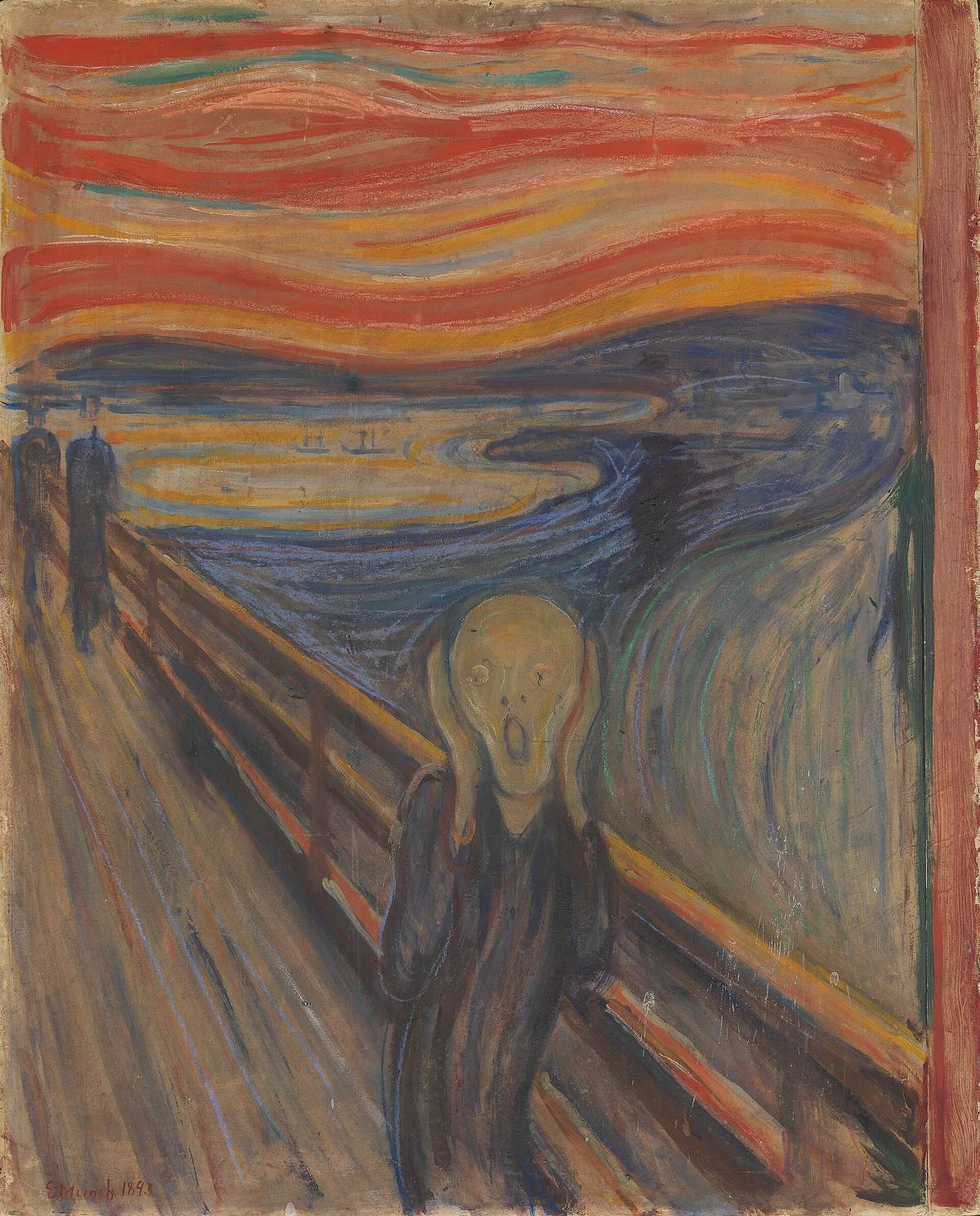
The 1895 work sold at Sotheby's in 2012 is pastel on board, signed and dated by Munch. Sotheby's describes it as one of four versions and records its original frame. The other three principal versions were in Norwegian museum collections when the 2012 catalogue was published.
That distinction makes a difference. A museum may own one version while another appears at auction. A print can carry the same image without being the pastel. A later reproduction is another object again.
The 1895 pastel's provenance includes the collector Arthur von Franquet, the collector Hugo Simon and the Norwegian collector Thomas Olsen, followed by descent in the Olsen family. Its exhibition history includes appearances in European cities and a loan to the National Gallery of Art in Washington.
When a headline says “The Scream sold,” I want to know which one. It is a small question that prevents a surprisingly large misunderstanding.
Was The Scream stolen?
Two different versions of The Scream were stolen from Norwegian museums in 1994 and 2004, and both were later recovered. These thefts involved museum works, not the 1895 pastel sold at Sotheby's in 2012.
The 1893 painting was taken from Oslo's National Gallery in 1994 and recovered later that year. In 2004, a different version was stolen from the Munch Museum along with Munch's Madonna; both works were recovered in 2006.
It is easy to combine these events into a single dramatic story about one painting being stolen twice and then appearing at auction. The actual story involves different objects. The distinction is less convenient for a headline and much more useful to anyone who wants to understand what happened.
A theft can also leave a history after an object returns: condition, examination, conservation and security all become part of the work's record. The public sees the image again, while the people responsible for it have a great deal of quieter work to do.
Munch's subject was already famous before either theft. The thefts added another chapter to the image's public life, not to the artist's original intention.
What did The Scream sell for at auction?
The 1895 pastel version of The Scream sold at Sotheby's New York on 2 May 2012 for $107 million at the hammer and $119,922,500 including fees, setting Munch's auction record. At the time, the total was also a record for a work sold at auction.
The work had belonged to the Norwegian Olsen family before the sale. Sotheby's published an extensive ownership and exhibition history, including its earlier relationship with Hugo Simon. The pastel had traveled and been shown publicly; it did not suddenly appear without a past.
The bidding lasted about twelve minutes. The final amount with fees is the number most often repeated, while the hammer price tells us the winning bid before the buyer's premium. Both are useful, provided we say which is which.
For comparison, another Munch, Dance on the Beach, sold at Sotheby's London on 1 March 2023 for £14.5 million at the hammer, about £16.9 million with fees. It was sold under an agreement between the Olsen family and the heirs of its earlier owner, the Berlin collector Curt Glaser. Different image, different medium and a different ownership history.
A record is not a price label for every Munch. A painting, a pastel, a print and a reproduction can share a famous subject while remaining very different objects. Date, medium, condition, edition where applicable and documented ownership all matter.
What are five surprising facts about Munch?
Five details help separate the artist's long career from the single image most people know:
1. There is more than one Scream. Munch made four principal versions in paint and pastel, as well as a lithograph.
2. The record work is a pastel. The version sold in 2012 is pastel on board, not the same object as either of the stolen museum versions.
3. Two separate thefts involved different versions. The 1994 and 2004 museum thefts are distinct events; both works were recovered.
4. The original frame was part of the 2012 sale. Sotheby's described the 1895 pastel as being in its original frame, which carries Munch's own text about the scream in nature.
5. He returned to major themes. Love, anxiety and death recur across works associated with his Frieze of Life.
That last point matters to me. Munch did not use one image to explain everything and then move on. He returned to difficult subjects and found different ways to make them visible.
Where can you see Munch's work?
You can see major Munch works in Oslo, at MUNCH and the National Museum, and in collections elsewhere, although individual works may be on loan or temporarily unavailable. Check the museum's current display before traveling.
MUNCH, Oslo holds a substantial collection of the artist's paintings, drawings and prints.
The National Museum, Oslo holds the 1893 painted version of The Scream.
The Museum of Modern Art, New York holds paintings and prints by Munch.
The National Gallery of Art, Washington holds a lithograph of The Scream.
If a particular version is the reason for your journey, check the medium and the museum record. The same title may lead you to a painting, pastel or print.
Why does an object's history matter?
An object's history matters because its medium, owners, exhibitions, condition and documented movements help identify the specific work being discussed. The Scream shows why the famous image and the individual objects that carry it need to be distinguished.
At CoArt Market, I want objects that have spent years in private hands to become visible again. Each object receives a cryptographic certificate of authenticity that records its path from owner to owner on the platform, and we are building a market for fractional ownership of Blue Chip art and collectibles, a core part of the system we are working on now.
Munch made a face that seems to react to the whole landscape around it. When you look at The Scream, do you notice the figure first, or the sky?
Sources
- Sotheby's, The Scream (1895), catalogue, provenance and exhibition history: www.sothebys.com/en/auctions/ecatalogue/2012/impressionist-modern-art-evening-sale-n08850/lot.20.html
- Sotheby's, top lot of every year since 2000: www.sothebys.com/en/articles/can-you-guess-sothebys-top-lot-of-every-year-since-2000
- Artnet News, Sotheby's Impressionist and Modern sale, May 2012: www.artnet.com/magazineus/news/artmarketwatch/sothebys-imp-and-mod-5-3-12.asp
- MUNCH, 5 things you should know about The Scream: www.munchmuseet.no/en/the-collection/5-things-you-should-know-about-the-scream/
- National Museum, Oslo, The Scream (1893): www.nasjonalmuseet.no/en/collection/object/NG.M.00939
- Sotheby's, press release on Dance on the Beach: www.sothebys.com/en/press/a-seminal-four-metre-long-painting-by-edvard-munch-exploring-love-life-death-on-the-oslo-fjord
- The Art Newspaper, Sotheby's London evening sale, 2 March 2023: www.theartnewspaper.com/2023/03/02/kandinksy-makes-37m-auction-record-at-a-procedural-but-solid-sothebys-london-evening-sale
- National Gallery of Art, The Scream (lithograph): www.nga.gov/artworks/11546-geschrei-scream