

Egon Schiele: the restless line, the lost collections and a record cityscape
A restless line, collections lost and returned, and a cityscape that set Schiele's record in London
The eighteenth article of our series “Great artists” begins with a young artist in Vienna and follows his work through collectors' homes, Nazi persecution, restitution and the auction room. Schiele died at 28. His works have continued to lead complicated lives.
Who was Egon Schiele?
Egon Schiele was an Austrian painter and draftsman, born in Tulln in 1890, whose portraits, nudes and cityscapes became central to Viennese Expressionism. He died in Vienna in 1918, aged 28.
Schiele studied at Vienna's Academy of Fine Arts and encountered Gustav Klimt, an older artist whose work and support were important to the young painter. Schiele soon developed a visual language of his own: sharp contours, unusual poses, exposed hands and feet, and faces that do not always make the viewer comfortable.
He made a remarkable number of drawings as well as paintings. Some works are intimate and unsettling; others look over streets and rooftops from above. The artist most often introduced through an angular self-portrait also saw towns as arrangements of houses, color and restless lines.
His career ended during the influenza pandemic of 1918. His wife Edith, who was pregnant, died of influenza shortly before him. There is no need to turn that loss into an explanation for every line he drew. It is part of a life that ended while he was still working.
Why is Egon Schiele famous?
Schiele is famous for expressive portraits and drawings in which angular bodies, intense faces and exposed gestures make psychological tension visible. He did not usually flatter a sitter by smoothing away every awkward detail.
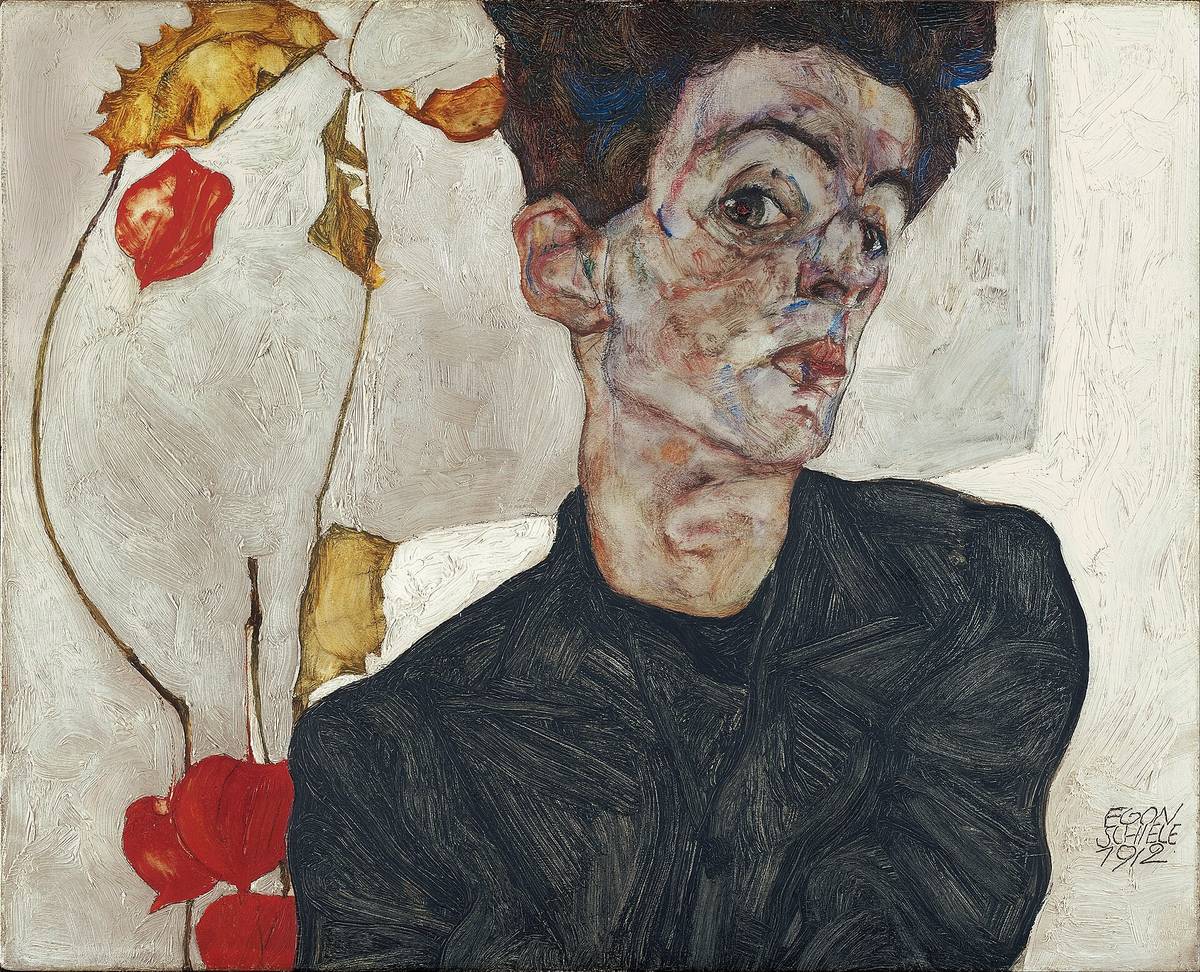
Hands are particularly difficult to ignore. Fingers bend and spread; wrists twist; an arm can seem almost too thin for the gesture it is making. In self-portraits, Schiele turns the same scrutiny toward himself. He does not stand at a comfortable distance from the subject just because the subject is the artist.
The explicit treatment of the body made his work controversial in his lifetime and remains a subject of discussion. A serious account needs to distinguish the evidence about particular events, models and works from a general reputation for scandal. A provocative image is not an excuse to stop asking precise questions.
Schiele's landscapes offer another route into his art. Roofs, walls and gardens are arranged in compressed spaces. The effect can feel as intense as a portrait, even when no face is present. A city becomes a subject with its own expression.
Why did Schiele paint Krumau?
Schiele painted Krumau, now Český Krumlov in the Czech Republic, repeatedly because the town was connected to his family and offered a setting for his distinctive views of houses and streets. It was the birthplace of his mother.
He lived and worked there for a period with Wally Neuzil, who also appeared in his work. Their life in the town attracted local disapproval, and they eventually left. The place remained in his pictures.
In works associated with the town, buildings press together, windows look out toward us and streets may seem narrow or oddly angled. These are not necessarily the views a real-estate agent would choose for a cheerful brochure. They are much more memorable.
Schiele's Häuser mit bunter Wäsche (Vorstadt II), usually translated as Houses with Colorful Laundry (Suburb II), shows the artist's interest in houses and their surfaces. The subject is a useful counterweight to the idea that his career can be summed up entirely through nudes.
A town has inhabitants even when the picture does not place them in the foreground. Laundry, walls and windows can suggest the lives behind them without giving us a conventional group portrait.
What is Egon Schiele's most expensive painting?
Schiele's most expensive painting, and his auction record, is £24,681,250 including fees for Häuser mit bunter Wäsche (Vorstadt II), sold at Sotheby's London in 2011. Sotheby's reports the result as approximately $40.1 million at the time.
Another Krumau subject, Dämmernde Stadt (Die kleine Stadt II), sold at Sotheby's New York on 12 November 2018 for approximately $24.6 million including fees. Sotheby's presented it as a restitution: a sale agreed between its owners and the heirs of Elsa Koditschek, a Viennese widow who had bought it in 1928. The two cityscapes are different works, and the lower dollar result did not replace the 2011 record.
Works on paper have their own market histories. In November 2025, Schiele's 1917 Crouching Nude, Back View sold at Dorotheum in Vienna for €3.23 million. Dorotheum says the work had been restituted and had belonged to the collection of August and Serena Lederer.
A painting, a drawing and a print are not interchangeable comparisons. Nor can we infer the history of one Schiele from another. Each result belongs to a specific work, medium, sale and documented chain of ownership.
The record cityscape also complicates an easy assumption: the work most widely associated with an artist's public image is not necessarily the work that holds the highest auction result.
Why are some Schiele works connected to restitution?
Some Schiele works have restitution histories because Jewish collectors and families were persecuted and dispossessed during the Nazi era, and heirs later sought the return of works taken from them. The facts differ from object to object.
One collector was the Viennese cabaret performer Fritz Grünbaum. Christie's provenance for a Schiele drawing sold after restitution records Grünbaum's ownership, its spoliation after March 1938, later movements through dealers and collectors, and its return to his heirs in 2024.
That sequence is not merely a list of names to make a catalogue look impressive. It raises questions about what happened when the work left its original owner, how it traveled and what evidence later allowed the claim to be resolved.
The drawing's story is not automatically the story of every work by Schiele. A different painting or drawing may have a different history and a different set of surviving records. The individual documents matter.
The same care applies to the Lederer collection and the work sold at Dorotheum. We should identify the particular owner and work rather than treating every restitution case as one general event. Behind each catalogue entry are people whose lives and collections were disrupted.
What are five surprising facts about Schiele?
Five details expand the story beyond the most familiar portraits:
1. His mother came from Krumau. The town became a recurring subject in his cityscapes.
2. His auction record is a cityscape. Houses with Colorful Laundry holds the artist's record in Sotheby's account.
3. He was a prolific draftsman. Works on paper are essential to understanding how he used line and gesture.
4. His collectors included a cabaret performer. Fritz Grünbaum's collection later became the subject of restitution research and claims.
5. A 2025 Vienna sale had a Lederer connection. Dorotheum identified Crouching Nude, Back View as a restituted work from the Lederer collection.
The fifth detail is an example of why I read provenance. A work on paper can be physically small and still carry a very large history.
Where can you see Schiele's work?
You can see significant Schiele collections in Vienna and works elsewhere in Europe and the United States. Drawings are often displayed for limited periods, so check the museum's current program before traveling.
Leopold Museum, Vienna holds a major collection of Schiele paintings and works on paper.
Belvedere, Vienna includes Schiele among the artists of Viennese Modernism.
Albertina, Vienna holds works on paper by the artist.
National Gallery of Art, Washington holds a 1912 self-portrait.
The Museum of Modern Art, New York holds works by Schiele and his contemporaries.
A drawing and a painting can show different decisions by the same artist. I would look for both rather than relying on the reproduction most often shared online.
Why does a work's history matter?
A work's history matters because ownership, exhibition records and evidence about past transfers help us understand the object before us. Schiele's restitution cases show why an apparently simple catalogue line can carry a family's history.
At CoArt Market, I want objects that have spent years in private hands to become visible again. Each object receives a cryptographic certificate of authenticity that records its path from owner to owner on the platform, and we are building a market for fractional ownership of Blue Chip art and collectibles, a core part of the system we are working on now.
Schiele could give a face or a row of houses the same restless energy. Which would you choose to look at first?
Sources
- Sotheby's, 21 facts about Egon Schiele (record and life): www.sothebys.com/en/articles/21-facts-about-egon-schiele
- Sotheby's, Dämmernde Stadt, a restituted masterpiece by Egon Schiele: www.sothebys.com/en/articles/a-restituted-masterpiece-by-egon-schiele
- Sotheby's, 100 years after the First World War, auction records fall: www.sothebys.com/en/articles/100-years-after-the-first-world-war-auction-records-fall-for-the-artists-who-changed-history
- Leopold Museum, Changing Times: Egon Schiele's Last Years: www.leopoldmuseum.org/en/press/news/1403/Changing-Times-Egon-Schieles-Last-Years
- Dorotheum, million-euro price for Schiele (November 2025): www.dorotheum.com/en/p/million-euro-price-for-schiele/
- Christie's, Schiele, Sitzender weiblicher Akt von vorn, Grünbaum provenance and 2024 restitution: www.christies.com/en/lot/lot-6508693
- National Gallery of Art, Egon Schiele, Self-Portrait, 1912: www.nga.gov/artworks/82933-self-portrait