

Gustav Klimt: the portrait that survived, and the woman behind it
A portrait that survived, the woman who sat for it and a $236.4 million sale in New York
The sixth article of our series “Great artists” follows a Klimt portrait from a Viennese family's home through Nazi confiscation and restitution to a New York auction. The price made headlines. The story of the woman in the painting deserves at least as much attention.
Who was Gustav Klimt?
Gustav Klimt was an Austrian painter and a founder of the Vienna Secession, known for portraits, landscapes and the gold of The Kiss. Born in 1862, he trained in Vienna, began with decorative commissions and became one of the city's most recognizable modern artists.
His father was a gold engraver. Klimt studied at the School of Arts and Crafts, where he learned the disciplined techniques that supported his later experiments. With his brother Ernst and their colleague Franz Matsch, he worked on major decorative projects, including paintings for Vienna's Burgtheater.
It is tempting to tell the story as if the young artist immediately shocked everyone and the established world refused to let him through the door. The truth is more interesting. He first learned to work within that world, received important commissions, and then began to test its boundaries.
The Vienna Secession, founded in 1897, sought a different kind of artistic life and a wider exchange with contemporary art beyond Austria. Klimt was its first president. His work became more decorative, more direct in its treatment of the body and less interested in behaving according to someone else's rules.
Official recognition and public controversy are not mutually exclusive. Klimt had both.
Why is Gustav Klimt famous?
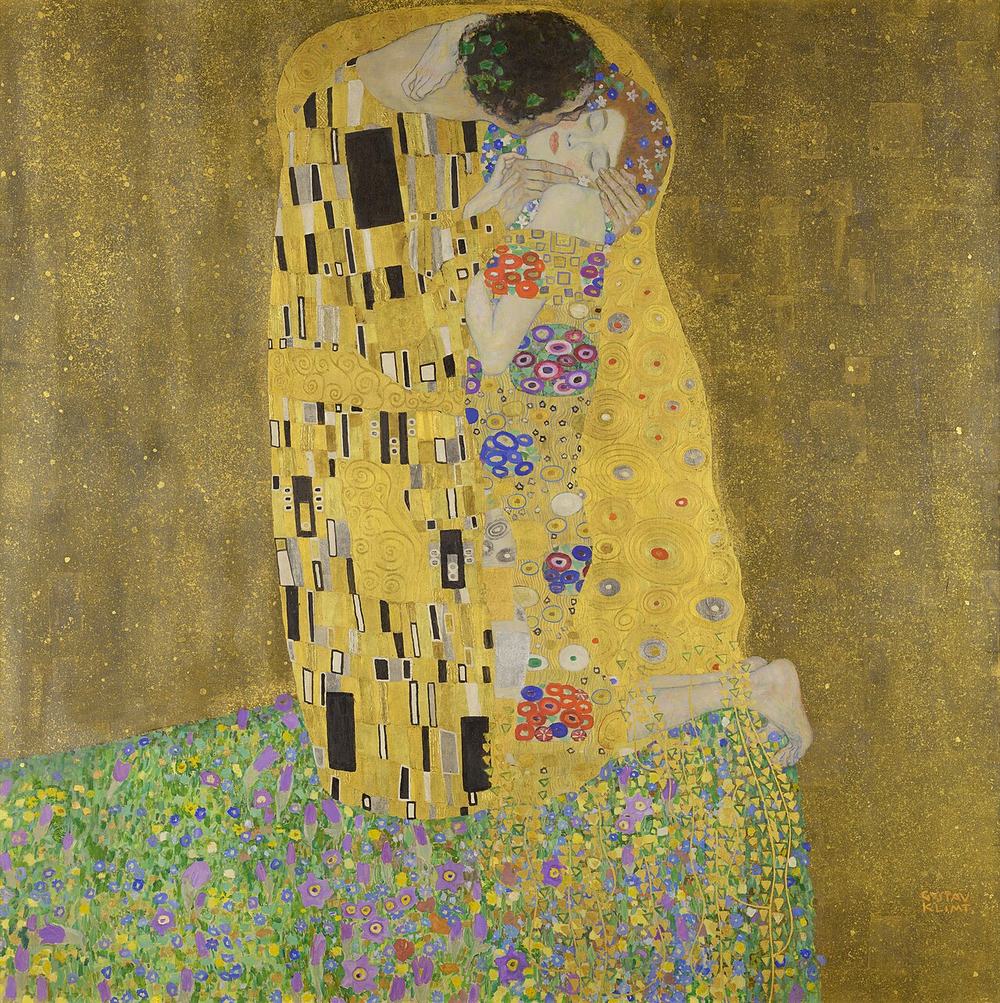
Klimt is famous for combining portraiture and the human figure with vivid patterns, ornamental surfaces and, in his Golden Period, gold leaf. His most familiar painting, The Kiss, brings a couple together in an embrace surrounded by gold and patterned fabric.
The figures stand out, but so do the details around them: rectangles, circles, flowers, a small patch of ground. Clothing and background almost become a world of their own. It is a painting about two people that also rewards looking closely at everything that is not a face.
At Vienna's Belvedere you can see The Kiss in person. Reproductions have carried it onto postcards, bags and an impressive number of household objects. The original is still worth meeting without a shopping bag between you and the surface.
Klimt also painted landscapes, often with a square format and densely worked color. A birch forest or a field of flowers could occupy the whole canvas. If your idea of Klimt consists entirely of gold and glamorous portraits, his trees may change the conversation.
Who was Elisabeth Lederer?
Elisabeth Lederer was the daughter of Serena and August Lederer, major Viennese collectors and patrons of Klimt, who commissioned her portrait in 1914. Klimt worked on it until 1916. He painted her standing full length, surrounded by an elaborate robe and richly colored decoration.
The Lederers' home brought together art, wealth and the social life of Vienna. Their collection included numerous works by Klimt. Serena was not merely someone passing through the background of his career: the family supported the artist and lived with his work.
Look at the portrait without knowing what happened later and you see a young woman presented with considerable care and authority. The costume is striking. So is her expression. She is not part of the scenery in a room full of pattern.
The next chapter is much darker. After Nazi Germany annexed Austria in 1938, the Jewish Lederer family faced persecution and their collection was seized. Elisabeth's survival depended on more than the painting, but the artist's connection to the family became part of an extraordinary attempt to protect her.
How did the portrait survive the war?
The Nazis confiscated Portrait of Elisabeth Lederer, and it survived the war before being returned in 1948 to Elisabeth's brother Erich Lederer. Other works from the family's collection did not survive; Sotheby's records that several were destroyed in a fire near the end of the war.
Elisabeth herself sought recognition by the Nazi authorities as Klimt's daughter. Sotheby's catalogue describes that claim as a life-saving fiction, supported by her mother. The authorities accepted the claim. She died in Vienna in 1944.
I do not want to turn that into an entertaining anecdote about an artist's private life. It was a strategy used by a woman living under a regime that threatened her because of her family's Jewish identity. The portrait is connected to that history, whether it hangs in a private apartment or appears under auction lights.
The painting later entered the collection of Leonard A. Lauder. Its passage through the Lederer family, seizure, restitution and subsequent ownership is documented in the Sotheby's catalogue. That paper trail matters. A work's history is not simply a list of distinguished names: sometimes it records what those people lost and what it took to recover it.
What did Klimt's portrait of Elisabeth Lederer sell for?
On 18 November 2025, Portrait of Elisabeth Lederer sold at Sotheby's New York for $205 million at the hammer and $236.4 million including fees, setting Klimt's auction record. Sotheby's says six collectors competed over approximately twenty minutes.
It was the portrait's first appearance at auction and came from the Leonard A. Lauder collection.
A previous Klimt record was set on 27 June 2023, when Dame mit Fächer (Lady with a Fan) sold at Sotheby's London for £85,305,800 including fees. Sotheby's also records its earlier sale at Sotheby's New York in 1994 for $11,662,500.
Klimt's landscapes have produced striking results too. On 9 November 2022, Birch Forest, from the Paul G. Allen collection, sold at Christie's New York for $104,585,000 including fees.
The latest came in November 2026. On 17 November 2026, at Christie's 20th Century Evening Sale in New York, a Klimt landscape hammered at $71 million, $82.3 million with fees, the Observer reported. Two specialists bid against each other for just under five minutes. The same canvas had sold at Sotheby's New York in 1997 for $14.7 million, then a record for the artist.
Four different works, four public sales, two auction houses. A portrait, another portrait and two landscapes. The prices tell us what happened in those rooms on those dates. They do not tell us the value of every work bearing Klimt's name.
What are five surprising facts about Klimt?
Five details help explain the distance between the decorative painter beginning his career and the artist we know today:
1. Gold was part of his family background. His father worked as a gold engraver. Klimt's own use of gold leaf became one of the features most closely associated with his art.
2. He began with large official commissions. Before becoming a leading figure in the Secession, he helped decorate important public buildings, including the Burgtheater in Vienna.
3. A university commission caused a scandal. His paintings for the University of Vienna provoked severe criticism. Klimt ultimately withdrew them and moved away from government commissions.
4. The famous gold is only part of the story. Landscapes such as Birch Forest show his interest in dense color and natural patterns without depending on the familiar gold backgrounds.
5. A portrait can carry two histories at once. Elisabeth Lederer is both a work from Klimt's late career and a document connected to a family's experience of Nazi persecution and restitution.
The last point is why I find a simple ranking of the most expensive Klimts unsatisfying. It places the numbers in order. It does not tell us what the paintings have lived through.
Where can you see Klimt's paintings?
You can see important Klimt works in Vienna and New York, particularly at the Belvedere, Leopold Museum and Neue Galerie. Check each museum's current display before planning a visit; works may travel or be temporarily unavailable.
Belvedere, Vienna holds The Kiss and a substantial collection of Klimt's paintings.
Leopold Museum, Vienna presents art of Viennese Modernism, including works by Klimt.
The Secession, Vienna displays the Beethoven Frieze, a monumental decorative work by the artist.
Neue Galerie New York is home to Klimt's Portrait of Adele Bloch-Bauer I, another painting whose ownership history deserves close attention.
Vienna is a particularly good place to connect the works with the buildings, institutions and cultural debates around them. Klimt did not paint in an empty white room detached from his city.
Why does a painting's history matter?
A painting's documented history matters because it connects the object in front of us to the people, places and events it has passed through. In Elisabeth Lederer's portrait, the story includes a commission, a family collection, persecution, confiscation, restitution and later ownership.
A high price may bring a painting to the attention of millions of people for a day. Provenance can give them a reason to remember it for longer. It can also help collectors ask better questions about objects that have never appeared in a headline.
At CoArt Market, we want objects that have remained in private collections to become visible again. Each object receives a cryptographic certificate of authenticity that records its path from owner to owner on the platform. We are building a market that people starting a collection, experienced professionals and established collectors can all take part in.
Klimt gave Elisabeth Lederer a portrait that would outlive both of them. Looking at it today, do you notice the gold and pattern first, or the person standing among them?
Sources
- Belvedere, Who Was Gustav Klimt?: www.belvedere.at/en/stories/who-was-gustav-klimt
- Klimt Foundation, Klimt Database, The Klimt Family (father a gold engraver): klimt-database.com/en/network-vienna-1900/family-and-environment/the-klimt-family
- Sotheby's, Portrait of Elisabeth Lederer, catalogue and provenance: www.sothebys.com/en/buy/auction/2025/leonard-a-lauder-collector-evening-auction/bildnis-elisabeth-lederer-portrait-of-elisabeth
- Sotheby's, 2025 Lauder collection results: www.sothebys.com/en/articles/historic-night-at-sothebys-continues-as-white-glove-leonard-a-lauder-collection-totals-527-5m
- The Art Newspaper, 2025 hammer price: www.theartnewspaper.com/2025/11/18/klimt-record-sothebys-new-york-lauder-collection
- Sotheby's, 1994 and 2023 results for Lady with a Fan: www.sothebys.com/en/slideshows/highlights-on-view-in-new-york
- Christie's, 2022 Paul Allen collection results: press.christies.com/visionary-the-paul-g-allen-collection-part-i-totals-15-billion-in-a-single-night/
- Observer, Elisa Carollo, A Record Kandinsky, a Klimt Landscape and a Modigliani Head Led New York's Second Night of Marquee Sales (18 November 2026): observer.com/2026/11/auction-news-christies-phillips-new-york-auction-week-kandinsky/