

Toulouse-Lautrec and the face somebody cut away
A singer cut out of a Moulin Rouge painting, a dancer seated in the audience and a $22.4 million laundress: Toulouse-Lautrec's Paris
The eighty-eighth article of our series “Great artists” begins with a woman who almost missed her appointment with us by a century. Open the Art Institute of Chicago's image of At the Moulin Rouge. An English performer named May Milton has come up very close to the right edge. The light across her face is green. Somebody once cut away the part of the canvas that included her. It had been reattached by 1914. Before you read another word, cover her with your hand. Do the people at that table seem to be having the same evening?
Who is watching whom at the Moulin Rouge?
The people at the table have one another to look at. May Milton has us. I keep trying to settle down among the people chatting in the middle of the picture, and the face at the edge keeps interrupting. It is about the size a stranger's face might suddenly appear if she passed your table in a crowded room. You barely have time to register her expression before she is gone. Here, of course, she can take as long going past as we care to give her.
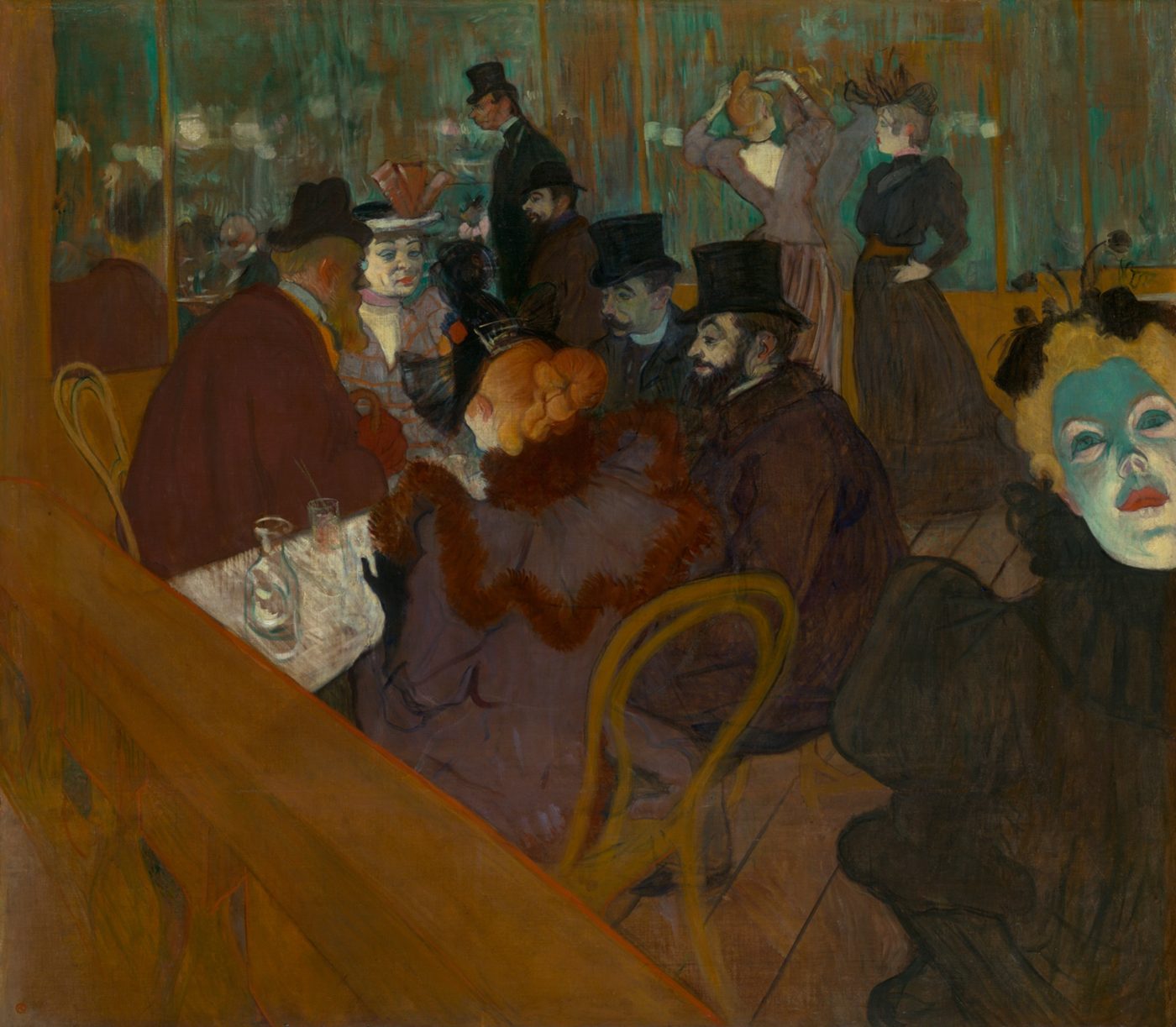
Farther back, Toulouse-Lautrec painted himself crossing the room alongside his much taller cousin, the physician Gabriel Tapié de Céleyran. Think about the odd privilege that gives the painter. He can remember the room from the place where he stood and then put himself where somebody else would have seen him. A photographer arriving with a camera would have had to make arrangements to appear in the same shot. The painter simply walks in twice. Which position feels closer to his own opinion of the evening, the little figure in the distance or the person whose eyes have brought us up against May?
The museum dates the painting to 1892–95. A date spanning several years seems quite appropriate for an image often encountered as a snapshot of Paris at night. The apparently casual glance was something the artist had time to reconsider. A painting can keep the peculiar slant of a table caught at the instant you turn your head, even after the painter has gone home, slept, and come back for another evening.
How did a painter of horses get into the nightclub?
A horse helped him through the front door. Joseph Oller bought Toulouse-Lautrec's Equestrienne (At the Cirque Fernando) in 1888 for his new café-concert, the Moulin Rouge, which opened in 1889, and the painting hung in its lobby. I like that detail because the word nightclub summons dancers, lamps and paying guests so quickly that there seems hardly any room for a horse. A mounted performer makes the connection perfectly plain. Someone in a ring and someone on a stage both have to make an extraordinarily difficult movement look as if it happened of its own accord.
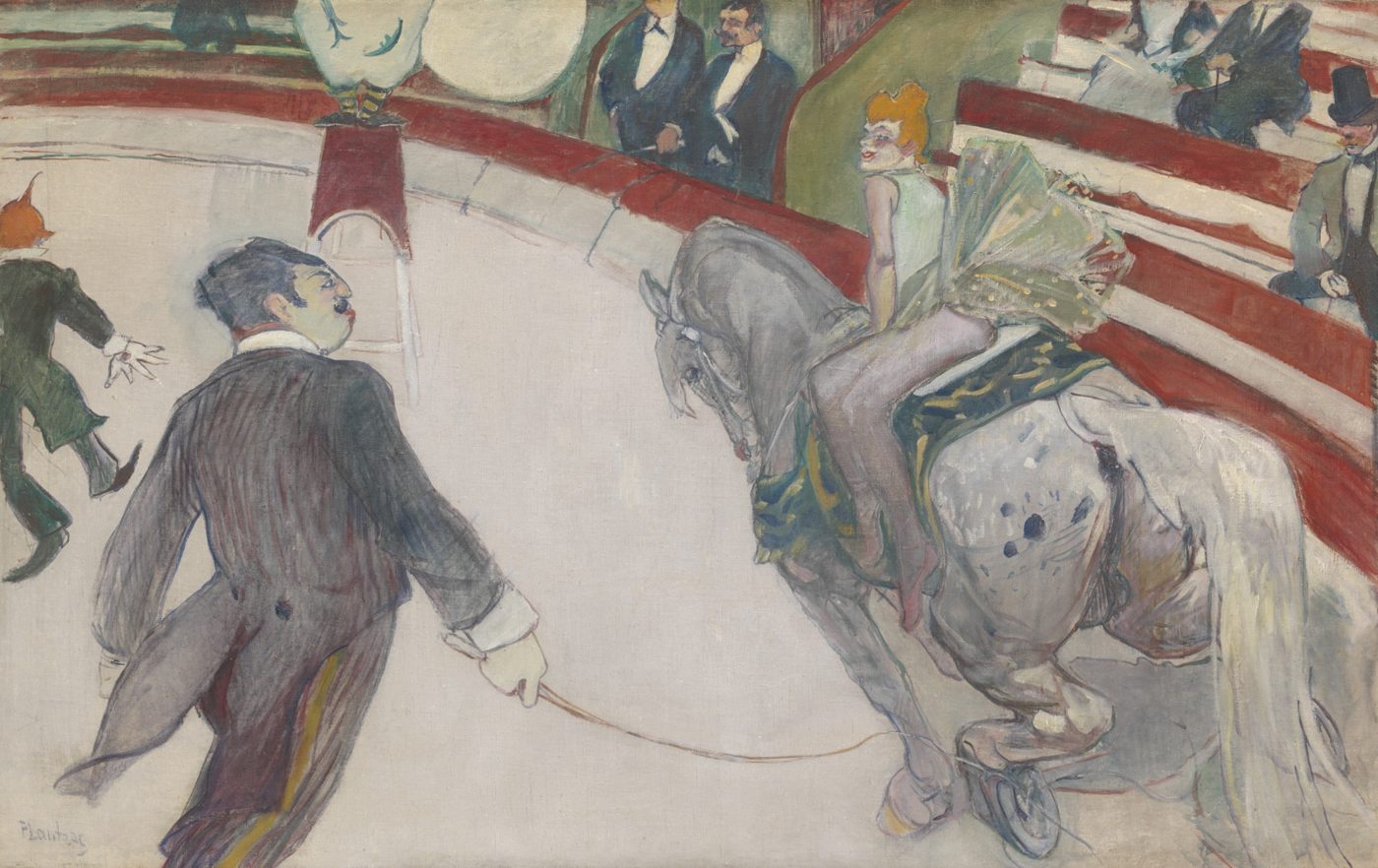
Born on November 24, 1864, in Albi, Toulouse-Lautrec grew up far from the Paris streets on which his name would eventually be printed in large letters. Horses belonged to the world he knew before Montmartre. Their interest for a draftsman is easy to test. Try remembering exactly where the four legs of a trotting animal were the last time one passed you. Now try the same exercise with a dancer's elbows. Memory tends to keep the gesture that made the person recognizable and quietly discard much of the anatomy. A good poster designer can put that habit to work.
In 1891 he designed Moulin Rouge: La Goulue. Here was a different invitation to the establishment. A painting in the lobby addresses somebody who has already decided to enter. A poster in the street must persuade a person with somewhere else to go. What would you keep from a whole evening of music and dancing if your prospective audience had only the time it takes to walk past a wall?
How do you draw a famous singer without showing her face?
Give her the gloves everybody knows. In the poster for the Divan Japonais, the top edge cuts off Yvette Guilbert's head. Her long black gloves remain visible onstage. Down among the audience the dancer Jane Avril occupies a much more conspicuous position. Imagine commissioning publicity for a performance and discovering that the artist has given a customer a better place in the picture than the performer. Would you send it back for alterations?
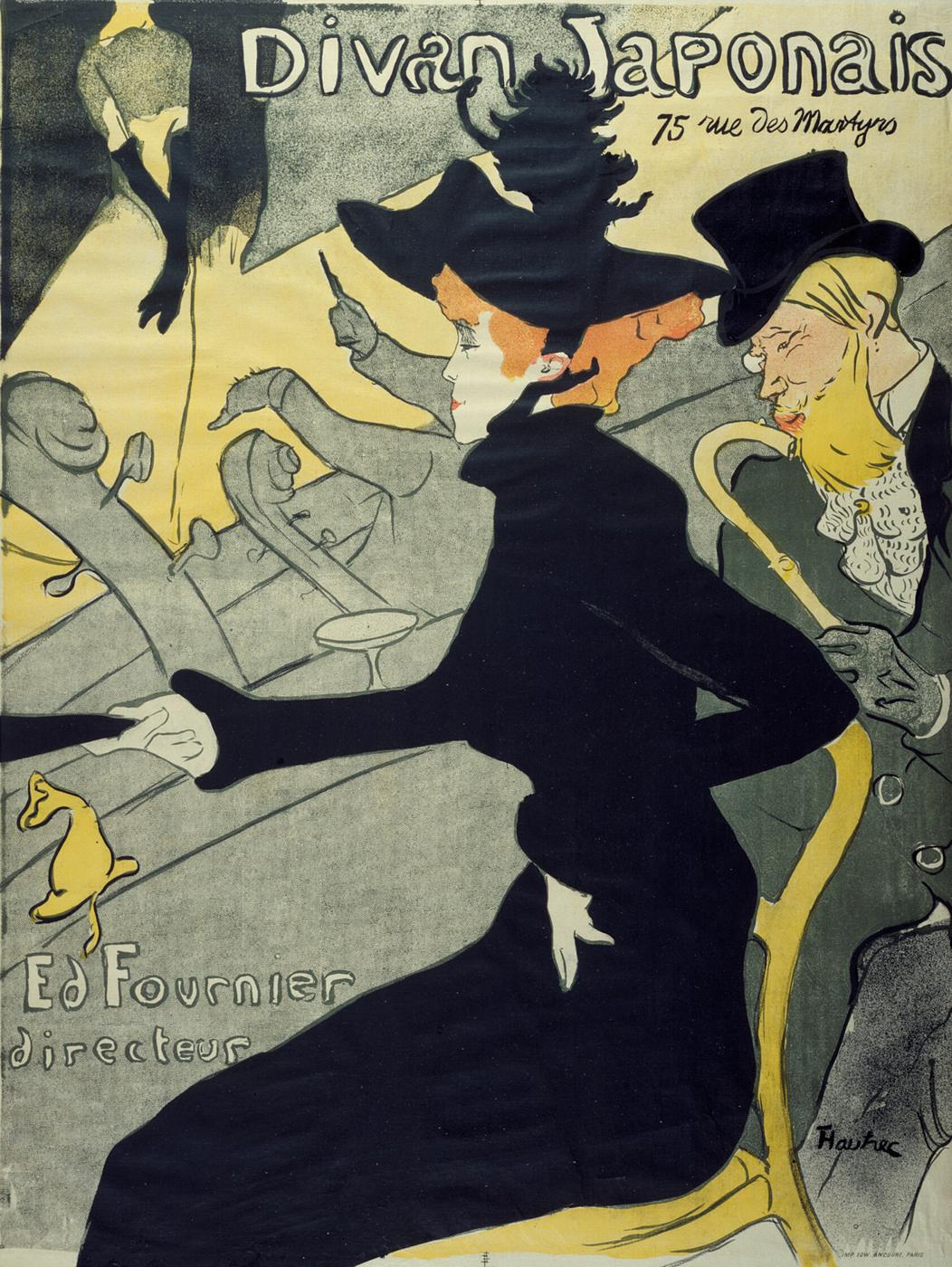
It works because the customer is Jane Avril. Anybody who recognized her might reasonably want to know where she spent an evening off. Anybody who recognized Guilbert from a pair of gloves had the additional satisfaction of being in on the joke. A century later, a museum caption can supply the missing names. What it cannot quite restore is the tiny public triumph of recognizing those gloves before the friend walking beside you did.
Try a version of this with somebody you know. Describe the friend who always gets to the restaurant first, using only what you could see across a crowded room. You may discover that the tilt of a hat or the way a person holds a menu does more work than the color of their eyes. Lautrec gave his printer wonderfully little to put on paper and his audience quite a lot to contribute.
What are five details that change a second look at Toulouse-Lautrec?
1. There are two different Moulin Rouge encounters. Equestrienne hung in the lobby; the 1891 poster addressed potential customers out in the street.
2. Lautrec included his own figure in At the Moulin Rouge, in the center background, beside his cousin. Knowing which figure to look for makes the background suddenly feel inhabited.
3. May Milton's presence on the right has a material history. The canvas was cut and reunited. The reason for the cut is less certain than the fact that it happened.
4. Jane Avril appears as a member of the audience in Divan Japonais. A dancer's evening can include sitting still and watching somebody else work.
5. Two black gloves identify the woman singing onstage. A visitor who has never heard Yvette Guilbert's voice can still learn something about what an audience remembered when she left the room.
What is Toulouse-Lautrec's most expensive painting?
Toulouse-Lautrec's most expensive painting at auction is La blanchisseuse (The Laundress), which sold at Christie's New York on November 1, 2005, for $22,416,000 against a pre-sale estimate of $20–25 million. The house announced it as "a new world auction record for the artist."
I find the subject as interesting as the number. If you knew Toulouse-Lautrec chiefly from the posters and somebody asked you to guess the subject of his record painting, how many guesses would you need before you arrived at a woman who washed clothes?
The people who made the evening glitter needed clean linen. One person's leisure depended on somebody else's day at work. A collector able to compare the laundress with the women at the nightclub can put those hours back together. The woman has an existence before the auctioneer announces a price, just as Jane Avril has a life on both sides of the footlights.
Where can you see Toulouse-Lautrec's work?
Art Institute of Chicago holds At the Moulin Rouge and Equestrienne (At the Cirque Fernando).
The Metropolitan Museum of Art, New York holds the Divan Japonais poster.
Musée Toulouse-Lautrec, Albi holds the largest public collection of his work, in the town where he was born.
Musée d'Orsay, Paris holds his paintings of Montmartre.
Why does an old photograph matter?
In a case like the Chicago canvas, imagine the value of a photograph taken while May was missing. A future owner might learn more from one old view of the family room than from a dozen perfectly lit pictures taken after the repair.
At CoArt Market, every object carries a cryptographic certificate of authenticity, and we are building a market for fractional ownership of Blue Chip art and collectibles, a core part of the system we are working on now.
Go back to the right edge now. Imagine that the cut section had survived on its own and that all you had ever seen of this painting was the woman passing close by. If somebody then showed you the rest of the canvas, would you feel you had finally found her story, or that all those people had just walked into hers?
Sources
- Art Institute of Chicago, At the Moulin Rouge: www.artic.edu/artworks/61128/at-the-moulin-rouge
- Art Institute of Chicago, At the Moulin Rouge, on Google Arts & Culture: artsandculture.google.com/asset/at-the-moulin-rouge-henri-de-toulouse-lautrec-french-1864-1901/pAGg8GwiHleSkA
- The Metropolitan Museum of Art, Divan Japonais: www.metmuseum.org/art/collection/search/334197
- Christie's, press release, November 1, 2005: www.christies.com/presscenter/pdf/11022005/11022005d.pdf