

Henri Matisse: from a law office to painting with scissors
From a law office to painting with scissors: how Matisse kept beginning again, and an odalisque from the Rockefeller collection
The sixteenth article of our series “Great artists” begins with a young law clerk recovering from an operation and ends with a painting from the Rockefeller collection at Christie's. Between those two rooms are wild colors, dancers and a pair of scissors.
Who was Henri Matisse?
Henri Matisse was a French painter, sculptor, draftsman and printmaker, born in 1869, whose experiments with color and form helped shape modern art. He died in Nice in 1954.
He did not begin in an artist's studio. Matisse studied law and worked as a clerk before taking up painting while recovering from appendicitis. He later moved to Paris, studied with Gustave Moreau and worked through a difficult early period in which recognition did not necessarily pay the bills.
His art changed repeatedly. There were the bold colors of Fauvism, the monumental figures and interiors, paintings made in Nice, sculptures, drawings and late works made from cut paper. A visitor who knows only one period can find a very different Matisse in the next gallery.
His interest in color remained. So did his attention to the relationship between a figure and the room around it. A patterned cloth, a chair or a window could become as important to the composition as the person sitting beside them.
I like the story of the law clerk because it reminds us that a career can change direction. It is not an argument against law offices. It is an argument for paying attention when something else begins to matter more.
Why is Henri Matisse famous?
Matisse is famous for using vivid color, simplified forms and expressive line in paintings, sculptures and paper cut-outs. He was a leading figure in Fauvism, the early twentieth-century movement associated with painters whose colors shocked some contemporary critics.
The term fauves means “wild beasts.” It was applied to painters whose pictures seemed to abandon the polite color expected by parts of the art world. As a name for a group of artists, it has survived rather well. Most criticism would be fortunate to leave such a legacy.
Matisse spent time in southern France with artists including André Derain. The colors in their work became stronger and less dependent on making a scene look exactly as it did in nature. A face could contain unexpected greens and blues. A landscape could be built from areas of color rather than carefully described leaf by leaf.
This did not mean Matisse had stopped paying attention. It meant he was deciding what kind of attention the painting required. The result can look direct, even effortless. The decisions behind it were rarely so simple.
At MoMA in New York, Dance (I) offers a very different subject from the intimate interiors of his Nice years. Figures move together across large areas of color. Later, Matisse would find another way to make figures move across a surface, using paper and scissors.
What are Matisse's cut-outs?
Matisse's cut-outs are compositions made from paper painted in color, cut into shapes and arranged to create works ranging from small designs to large wall-sized images. They became central to his late career.
He had used cut paper for practical design purposes earlier, including theater projects. MoMA traces its use to a ballet design in 1919 and to planning a mural in the early 1930s. In later years, the method became a medium in its own right.
Assistants painted sheets of paper, and Matisse cut and arranged forms that could be pinned, moved and reconsidered. The method let him work with color and line at the same time: the edge of the cut defined a shape while the paper supplied its color.
His health became more fragile, and the technique helped him continue working on an ambitious scale. It would be a mistake to describe the cut-outs merely as a substitute for painting. They were a way to make images that could not be achieved in quite the same way with a brush.
The studio walls could become a changing composition. A leaf, a dancer or a patch of blue might be moved, replaced or pinned again. It sounds playful. It was also a serious way of thinking through a work.
What is Odalisque couchée aux magnolias?
Odalisque couchée aux magnolias is a 1923 Matisse painting made in Nice, showing a reclining model in an interior filled with color, pattern and flowers. It later belonged to the collection of Peggy and David Rockefeller.
Christie's identifies the model as Henriette Darricarrère, a dancer who posed for Matisse. The painting includes a chaise longue, textiles and magnolias. The figure is important, but the surrounding objects also participate in the composition: stripes, leaves, flowers and furniture create a setting that rewards attention beyond the center.
The word “odalisque” carries a history of European artists imagining and depicting women in settings associated with the East. These pictures can be admired for their color and composition while also being discussed in the context of the traditions and fantasies from which the genre emerged. A good painting can support more than one conversation.
David Rockefeller acquired the work in 1958 from the Chicago collector Leigh Block. Christie's account places it within a collection shaped in part through Rockefeller's relationship with Alfred Barr, the founding director of MoMA. A painting's route from one collector to another can tell us something about the people who helped define an artist's public reputation.
The work remained part of the Rockefeller collection until the 2018 sale. Then the private history became an auction headline.
What is Henri Matisse's most expensive painting?
Matisse's most expensive painting at auction is Odalisque couchée aux magnolias, sold at Christie's New York on 8 May 2018 for $80,750,000 including fees. It came from the collection of Peggy and David Rockefeller.
Before that sale, the Matisse auction record was held by a bronze: Nu de dos, 4 état (Back IV), sold at Christie's New York in 2010 for $48,802,500 including fees. The sculpture was conceived around 1930 and the cast sold in 2010 was made in 1978.
The date of a cast is not the same as the date of the original conception. Both belong in the description. A bronze and an oil painting are also different objects, even when the same artist's name appears beside them.
The most recent major results came this year. On 19 May 2026, at Sotheby's New York, La Chaise lorraine (1919) sold for $41.5 million at the hammer, $48.4 million with fees, after four bidders competed for ten minutes; The Art Newspaper reported it as the second most valuable Matisse painting sold at auction. In the same sale La Séance du matin sold for $17.5 million at the hammer, $20 million with fees. Neither replaces the 2018 record.
These prices describe individual past sales. They do not establish a standard price for every Matisse painting, drawing or edition. A buyer needs to look at the specific work, its medium, condition, ownership history and place in the artist's development.
What are five surprising facts about Matisse?
Five details show the range of a career often reduced to a few bright colors:
1. He first worked in law. Painting entered his life while he was recovering from appendicitis.
2. The wild beasts got their name from criticism. The label fauves became attached to the painters' bold use of color.
3. Textiles mattered. Matisse grew up in a region with a textile industry and collected fabrics whose patterns entered his visual world.
4. He used cut paper long before the late cut-outs. MoMA documents its use in theater and mural planning decades earlier.
5. His auction record is an interior from Nice. The 1923 Rockefeller painting sold in New York in 2018 for $80.75 million including fees.
A fabric, a dancer, a painted wall and a piece of cut paper may seem like unrelated subjects. In Matisse's hands, each could become a way to test what color and line can do together.
Where can you see Matisse's work?
You can see important Matisse paintings, sculptures and cut-outs at MoMA and the Met in New York, the Musée Matisse in Nice, the Musée Matisse in his birthplace Le Cateau-Cambrésis, the National Gallery of Art in Washington and the Art Institute of Chicago. Museums change displays, so check the official page before traveling for a particular work.
The Museum of Modern Art, New York holds paintings, sculptures and cut-outs, including Dance (I).
The Metropolitan Museum of Art, New York holds works from different stages of his career.
Musée Matisse, Nice presents a collection connected with the city where he lived and worked.
Musée Matisse, Le Cateau-Cambrésis is in the town where he was born.
National Gallery of Art, Washington holds paintings and other works.
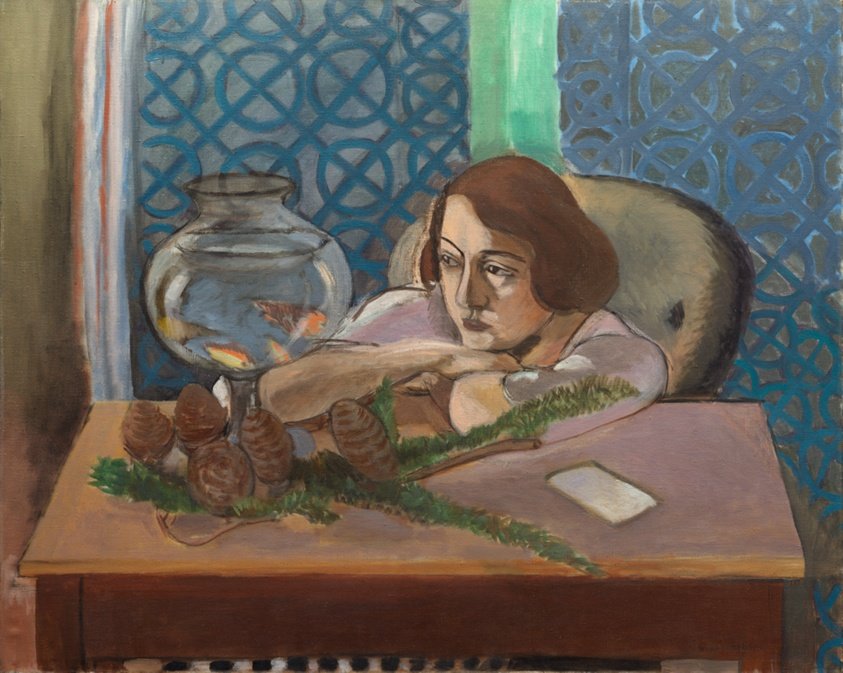
Art Institute of Chicago holds Bathers by a River and the Nice-period Woman before an Aquarium.
Look at an early painting and a late cut-out in succession if you have the chance. The materials change. The interest in color, shape and the space between them remains.
Why does a work's history matter?
A work's history matters because its materials, owners, exhibitions and documented transfers help us understand the particular object in front of us. The Rockefeller ownership of Odalisque couchée aux magnolias is one chapter in the painting's story, followed by its 2018 auction.
At CoArt Market, I want objects that have spent years in private hands to become visible again. Each object receives a cryptographic certificate of authenticity that records its path from owner to owner on the platform. We want beginners, professionals and established collectors to be able to participate in the market.
Matisse began with a brush and later found new possibilities in painted paper and scissors. If you could spend an hour with one period of his work, would you choose the Fauve paintings, the Nice interiors or the late cut-outs?
Sources
- MoMA, artist biography: www.moma.org/interactives/exhibitions/2014/matisse/about-matisse.html
- MoMA, history of the cut-outs: www.moma.org/interactives/exhibitions/2014/matisse/the-cut-outs.html
- MoMA, artist and collection: www.moma.org/collection/artists/3832
- Christie's, 2018 Rockefeller sale and previous record: press.christies.com/wp-content/uploads/2023/09/bd320d53d71b28a696cd72a9a789c475.pdf
- Christie's, Matisse collecting guide (record painting and model): www.christies.com/en/stories/henri-matisse-collecting-guide-309b92f2c3c142bd975979a573aefb7b
- Christie's, “Live like a Rockefeller”: the painting's history, Leigh Block and Alfred Barr: www.christies.com/en/stories/live-like-a-rockefeller-matisse-odalisque-couchee-aux-magnolias-bccf2efa290d45e7a57e4da6d8b5661a
- The Art Newspaper, Carlie Porterfield, “Bidding battle for Matisse leads Sotheby's $303.3m Modern art evening sale in New York” (20 May 2026): www.theartnewspaper.com/2026/05/20/bidding-battle-for-matisse-leads-sothebys-3033m-modern-art-evening-sale-in-new-york
- National Gallery of Art, biography: www.nga.gov/artists/1706-henri-matisse