

Ivan Aivazovsky: the man who could paint the sea from memory
The man who painted the sea from memory, The Ninth Wave and the shipwreck survivors that set his record in London
The twenty-sixth article of our series “Great artists” goes to sea with Ivan Aivazovsky. The sea in his paintings can be calm enough to invite you closer. A moment later, it can swallow a ship.
Who was Ivan Aivazovsky?
Ivan Aivazovsky was a marine painter born in 1817 in Feodosia, a port on the Crimean coast of the Black Sea, into an Armenian family; he is also known by the Armenian name Hovhannes Aivazian. He grew up where ships, changing weather and the horizon were part of everyday life.
His talent brought him to the Imperial Academy of Arts in St. Petersburg. There he trained as a painter and gained opportunities to travel, study European art and observe the sea in different places. His career later brought him recognition across Europe and beyond.
Descriptions of Aivazovsky sometimes try to fit him neatly into one national story. His life is more interesting than that. He was an artist of Armenian heritage, born in Crimea, trained in the Russian Empire, and connected through travel and patronage to a much wider world. Those facts belong together.
His relationship with Feodosia remained important. He established an art gallery there in 1880 and supported cultural life in his home city. The National Gallery of Armenia in Yerevan also holds works by the artist. His story connects the places where he lived and worked to audiences far beyond them.
Aivazovsky died in 1900. The Guggenheim's educational material records that he left an unfinished painting begun on the day of his death. It is a memorable image of an artist who worked to the end.
Why is The Ninth Wave so famous?
The Ninth Wave, painted in 1850, is famous because it captures the moment between disaster and possible survival: a handful of shipwrecked people clinging to a mast in a vast, luminous sea at dawn.
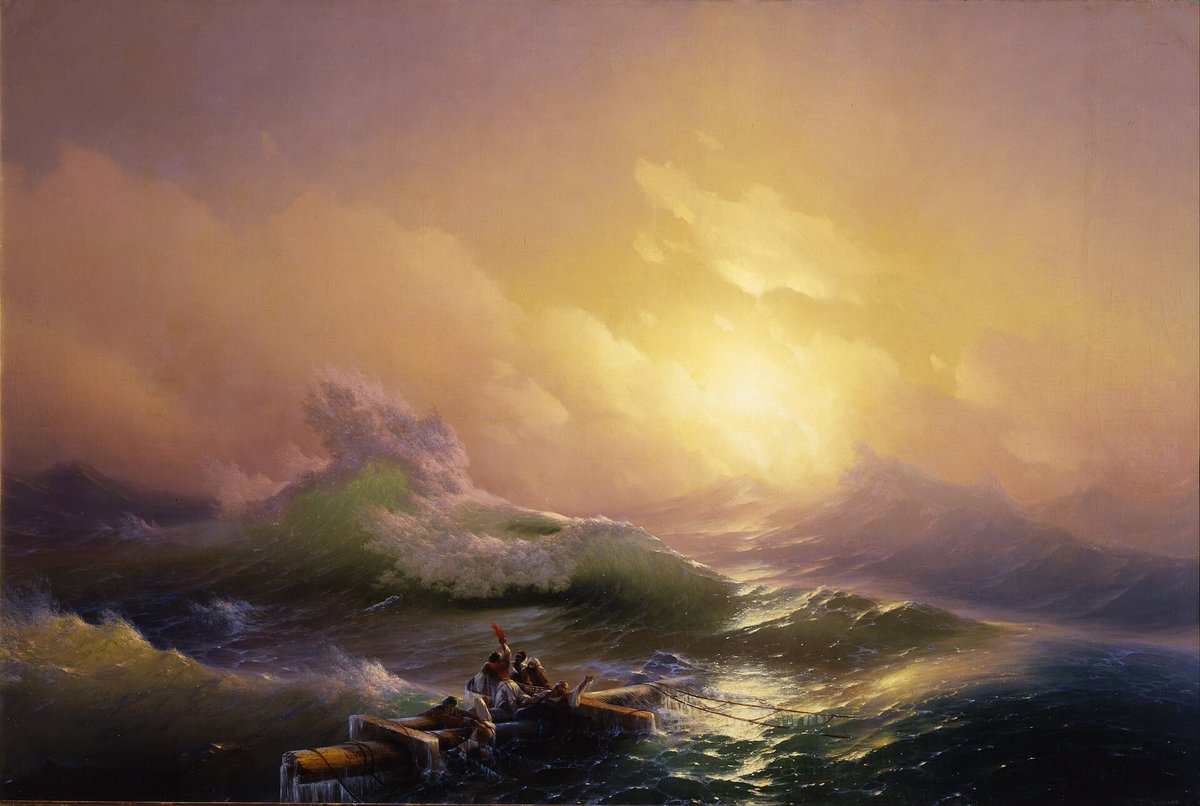
Around them, the sea rises and falls in immense translucent masses. Behind them, the sky opens into warm morning light. We do not know their fate. Aivazovsky gives us enough hope to keep looking, and enough danger to understand what that hope is up against.
The title refers to a longstanding sailors' belief that waves arrive in groups and that one can be especially powerful. The painting's dramatic arrangement belongs to Romanticism, a movement interested in the force of nature and the limits of human control.
Look closely at the water. Aivazovsky does not treat a wave as a flat blue surface. It is transparent in places, dense in others, lit from behind and continually changing shape. That ability to make painted water appear to move is central to his reputation.
The Ninth Wave belongs to the State Russian Museum in St. Petersburg, which received it in 1897 from the Imperial Hermitage. It is a museum work, not the painting sold at the recent record auction. Confusing a famous museum painting with a similarly dramatic work offered for sale would tell readers the wrong story.
Did Aivazovsky really paint the sea from memory?
Yes: Aivazovsky observed the sea closely, but he composed his paintings in the studio from memory and imagination rather than in front of the waves. A storm changes too quickly for a painter to record every wave as if it were a still life. Memory allowed him to bring separate observations together into a composition that expressed the larger experience of weather, light and movement.
This helps explain why his pictures can feel both convincing and theatrical. He was not merely copying a view. He was deciding where the light would fall, how the waves would guide our eyes and how small a ship or a person should appear against the water.
His range went beyond shipwrecks. He painted views of Constantinople and the Bosphorus, Venice, moonlit harbors and inland scenes. The calm pictures deserve attention too. In them, water reflects architecture and sky; the drama is quieter, but the control of light is just as important.
His prolific output is often put at around 6,000 works. Such a figure is an estimate rather than an inventory we can independently check here. What matters when looking at any particular painting is its individual history: the object, the attribution, the documentation and the evidence connecting it to the artist.
What connects Aivazovsky's art to the wider world?
Aivazovsky's art is tied to the wider world through its subjects: ships, ports and sea routes such as the Bosphorus and Venice, places where people, goods, languages and political powers met.
The Bosphorus, for example, brings together water, architecture and the traffic between different shores. Venice offers another kind of encounter between a city and the sea. These subjects remind us that the artist was not limited to a single coast or a single way of imagining maritime life.
His paintings also raise a question about the relationship between observation and storytelling. A ship can be painted accurately and still carry an emotional meaning: isolation, travel, danger or the possibility of reaching home. Aivazovsky understood that a viewer does not need to know the name of every vessel to feel the tension in a scene.
His history is also inseparable from the complicated history of Crimea. Feodosia is in Crimea, internationally recognized as part of Ukraine and occupied by Russia since 2014. When writing about where works are held or displayed, accurate location and institutional information matter, and exhibition arrangements should be checked before a visit.
What is Aivazovsky's most expensive painting?
Aivazovsky's most expensive painting at auction is The Survivors (1878), sold at Sotheby's London in November 2025 for £4,188,000 including fees, a new auction record for the artist. Sotheby's catalogs it as an oil on canvas measuring 195 by 266 centimeters, against an estimate of £2–4 million. It depicts people in a small boat on a turbulent sea – a subject that brings us back to the human scale of his art.
The painting's title and subject should not be confused with The Ninth Wave. They are separate works with separate histories. Sotheby's catalog dates The Survivors to 1878; some secondary coverage gives a different year, so the auction house's signed-and-dated catalog entry is the stronger source.
The previous record was View of Constantinople and the Bosphorus (1856), sold at Sotheby's London on 24 April 2012 for £3,233,250, far above its estimate of £1.2–1.8 million.
These are completed sales, not starting prices or estimates. They also concern different paintings. Size, subject, condition, attribution and provenance all help explain why an auction result belongs to the particular object sold.
What are five facts to remember about Aivazovsky?
Five details bring the artist into focus:
Born in Feodosia in 1817, he came from an Armenian family.
He trained at the Imperial Academy of Arts in St. Petersburg.
His subjects ranged from violent storms to moonlit coastal cities and inland landscapes.
The Ninth Wave is a museum painting; The Survivors is a different work with its own auction history.
He founded an art gallery in his home city in 1880.
Where can you see Aivazovsky's paintings?
You can see Aivazovsky's paintings at the National Gallery of Armenia in Yerevan, at the State Russian Museum in St. Petersburg, which holds The Ninth Wave, and in the gallery he founded in Feodosia, in occupied Crimea. Museums and exhibitions can change what they have on view, so check with the institution before traveling.
National Gallery of Armenia, Yerevan holds a large group of his works.
The State Russian Museum, St. Petersburg, holds The Ninth Wave.
The Aivazovsky National Art Gallery in Feodosia, the gallery he founded in 1880, is in Crimea, occupied by Russia since 2014.
For me, the power of Aivazovsky's work comes down to something simple. He paints an immense sea, then gives us a small reason to look for the people inside it.
At CoArt Market, every object carries a cryptographic certificate of authenticity, and we are building a market for fractional ownership of Blue Chip art and collectibles, a core part of the system we are working on now.
When you stand before one of those paintings, what do you see first – the storm, or the hope beyond it?
Sources
- Guggenheim teaching materials, Aivazovsky's life and work: www.guggenheim.org/wp-content/uploads/2019/12/guggenheim-teaching-materials-russia.pdf
- Encyclopedia of Ukraine, Aivazovsky: www.encyclopediaofukraine.com/display.asp?linkpath=pages%5CA%5CI%5CAivazovskyIvan.htm
- Sotheby's, The Survivors, lot 21, Fabergé, Imperial & Revolutionary Art, London, 13–25 November 2025: www.sothebys.com/en/buy/auction/2025/faberge-imperial-revolutionary-art-l25113/the-survivors
- Kursiv, “Sotheby's sells Aivazovsky's work for record-high price” (2 December 2025), £4,188,000: kz.kursiv.media/en/2025-12-02/enkg-tank-sothebys-sells-aivazovskys-work-for-record-high-price/
- Sotheby's, View of Constantinople and the Bosphorus, The Orientalist Sale, London, 24 April 2012, lot 6: www.sothebys.com/en/auctions/ecatalogue/2012/the-orientalist-sale/lot.6.html
- Antiques and Art Ireland, 2012 sale, £3,233,250: antiquesandartireland.com/2012/04/auction-record-russian/