

Johannes Vermeer: a missing painter, a disputed girl, and a $30 million sale
A painter who left few works, a disputed girl with a flute, and a £16.2 million sale in London
The eleventh article of our series “Great artists” follows an artist who left remarkably few paintings, a girl whose attribution changed, and two works sold in London. Vermeer's pictures often appear quiet. Their histories are not always so calm.
Who was Johannes Vermeer?
Johannes Vermeer was a Dutch painter from Delft, born in 1632, known for carefully constructed interiors and figures illuminated by light. He died in Delft in 1675, leaving a small body of work and a number of questions that scholars continue to investigate.
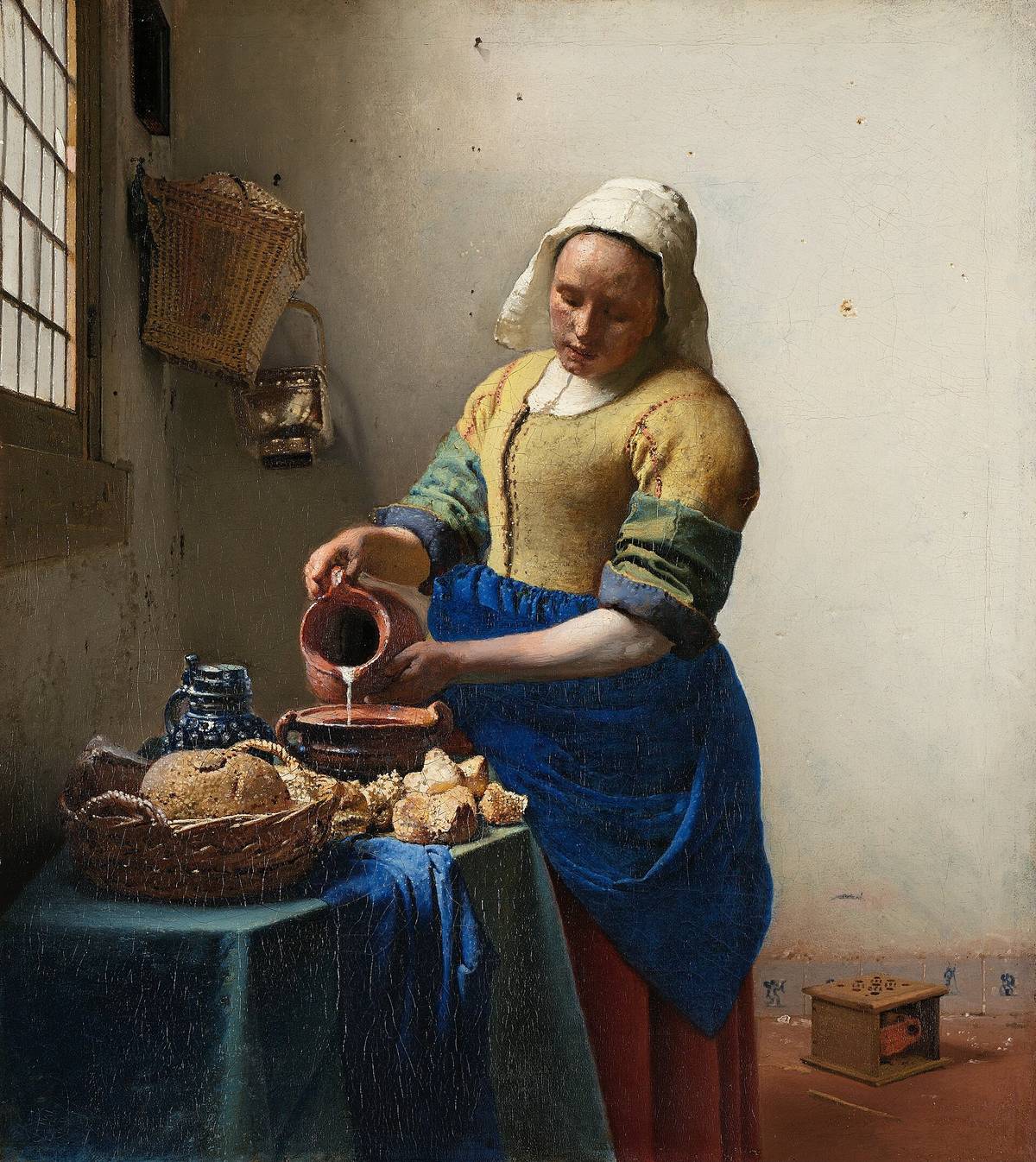
His best-known pictures include Girl with a Pearl Earring and The Milkmaid. They are intimate paintings: a woman turns her head, another pours milk, light enters a room. These descriptions sound simple until you stand in front of the originals and see how much attention has gone into each surface.
Vermeer also worked as an art dealer and was involved in the painters' guild in Delft. He had a family and financial obligations, and his death left debts. The familiar image of an artist alone in a beautiful silent room is therefore incomplete. There was a household outside the frame and a working life beyond the easel.
Exactly how many paintings belong to him depends partly on attribution. The Rijksmuseum's major 2023 exhibition referred to an oeuvre of 37 works. Other institutions use different totals, especially when disputed works are counted. With a number this small, one painting can make a noticeable difference.
Why is Vermeer famous?
Vermeer is famous for paintings in which ordinary activities, subtle light and carefully arranged interiors become subjects of extraordinary concentration. His figures read letters, make music, pour milk or pause in a room that seems both familiar and slightly mysterious.
At the Rijksmuseum in Amsterdam, The Milkmaid shows a woman pouring milk from a jug. Look closely at the light on the wall, the bread on the table and the weight of the jug. The action takes perhaps a few seconds. Vermeer gives us reasons to look much longer.
At the Mauritshuis in The Hague, Girl with a Pearl Earring turns toward the viewer against a dark background. The painting is often called a portrait, but it is also understood as a tronie: a study of a character or head rather than necessarily a commissioned likeness of an identified individual.
What is she thinking? We do not know. I am suspicious of anyone who can answer that with complete confidence. Vermeer left us a face, a turn of the head and a remarkable drop of light. The rest of the conversation happens between the painting and the viewer.
How many Vermeer paintings can you see together?
In 2023 you could see 28 Vermeer paintings together, at the Rijksmuseum in Amsterdam from 10 February to 4 June 2023, an exhibition that drew 650,000 visitors from 113 countries and became the most successful in the museum's history.
Think about the logistics. These paintings normally belong to different institutions and private collections. Each has its own history, condition and travel arrangements. Bringing so many into one building required years of cooperation as well as an extraordinary appetite from visitors.
The exhibition's total also needs a little care. The museum described 28 of 37 works by the artist, while specialists do not agree about every attribution. A number in an exhibition announcement can be accurate for that museum's selection without ending the scholarly discussion.
I like the fact that the paintings came from different homes and then returned to them. For a few months it was possible to follow Vermeer's choices from room to room: light on a face, a musical instrument, a map, another window. Then the conversation scattered across the world again.
Is Girl with a Flute a Vermeer?
No: the National Gallery of Art in Washington concluded in 2022 that Girl with a Flute was made by an associate of Vermeer rather than by Vermeer himself. The identity of that artist and the exact circumstances of the work's creation remain unknown.
The museum's researchers compared the painting with Girl with the Red Hat, examining the surface, paint layers and materials. They found similarities in pigments and working methods, but also differences in execution and the way the paint was prepared and applied.
The conclusion is not that the picture is a modern fake. The museum identifies it as a seventeenth-century work made by someone close enough to Vermeer's methods to understand them. Who that person was is another question. A pupil, assistant, family member or another associate are possibilities, not established identities.
The result also challenges the idea that Vermeer necessarily worked alone. But there is no surviving document that simply introduces us to a named Vermeer assistant. The technical evidence supports a new line of investigation; it does not fill every gap in the archive.
This is why I find attribution debates more interesting than the word “fake” suggests. A painting may be old, skillful and historically important while the name on its label changes. The surface has not disappeared. Our understanding of who made it has changed.
What is the most expensive Vermeer ever sold at auction?
The most expensive Vermeer sold at auction is A Young Woman Seated at the Virginals, which sold at Sotheby's London on 7 July 2004 for £16.2 million (about $30 million) including fees. The hammer fell at £14.5 million, The Art Newspaper reported, and the winning bid came by telephone for an anonymous client.
Sotheby's catalogue called it the last original composition by Vermeer left in private hands and the first offered at auction since 1921. Today it belongs to The Leiden Collection in New York, which lent it to the Rijksmuseum's 2023 exhibition.
On 8 July 2014, Saint Praxedis sold at Christie's London for £6,242,500, or $10,687,160 at the conversion published with the sale, including the buyer's premium. Christie's presented it as a Vermeer. Its attribution has been debated, and that debate belongs beside the price.
Saint Praxedis is an early religious subject and, as Christie's notes, copies a composition by the Florentine painter Felice Ficherelli. It looks very different from the quiet Delft interiors that many visitors expect when they hear Vermeer's name. Different is not automatically wrong; it is a reason to ask more questions.
Both sales are public results, not a price guide for every work associated with Vermeer. The number of accepted works is small, very few appear on the market, and the attribution of an individual painting can have a major effect on how it is presented and received.
The market can tell us what a buyer paid in a particular room on a particular day. It cannot, by itself, decide which hand held the brush three and a half centuries earlier.
What are five surprising facts about Vermeer?
Five details show how much remains to be explored behind the quiet interiors:
1. His body of work is unusually small. The Rijksmuseum counts 37 paintings, while individual attributions remain contested.
2. A girl changed authorship. The National Gallery of Art now attributes Girl with a Flute to an associate of Vermeer, based on technical and stylistic examination.
3. The pearl is not an identification document. Girl with a Pearl Earring is generally understood as a character study rather than a securely identified sitter's formal portrait.
4. No Vermeer came to auction for 83 years. Between 1921 and the Sotheby's sale of 2004, none was offered at auction.
5. A religious painting entered the auction story. Saint Praxedis, sold as a Vermeer by Christie's in 2014, is an early work with a debated attribution and a subject far removed from his best-known interiors.
For an artist associated with silence, Vermeer has generated a surprisingly lively discussion. I think the paintings can survive it.
Where can you see Vermeer's paintings?
You can see major paintings by Vermeer in Amsterdam, The Hague, New York, Washington and London. Displays and loans change, so check the official museum page before traveling.
Rijksmuseum, Amsterdam holds The Milkmaid and other Vermeer paintings.
Mauritshuis, The Hague holds Girl with a Pearl Earring and View of Delft.
The Metropolitan Museum of Art, New York holds Young Woman with a Water Pitcher and other works.
The National Gallery of Art, Washington holds A Lady Writing and Girl with the Red Hat, as well as the reattributed Girl with a Flute.
The National Gallery, London holds A Young Woman standing at a Virginal and A Young Woman seated at a Virginal.
The last two London titles sound much alike. So does the title of the painting sold at Sotheby's in 2004, which is a different picture. Check the full title and the institution before assuming they are the same painting.
Why does attribution matter to the market?
Attribution matters because it identifies whose work a collector, museum or visitor is being offered, and it can change as new evidence is studied. A reliable history includes both what is known and the points on which specialists disagree.
At CoArt Market, I want objects that have spent years in private hands to become visible again. Every object carries a cryptographic certificate of authenticity that records its path from owner to owner, and we are building a market for fractional ownership of Blue Chip art and collectibles, a core part of the system we are working on now.
A woman pours milk; another turns toward us; a third holds a flute while researchers reconsider her creator. Which of these pictures would you choose to sit with for an hour?
Sources
- Rijksmuseum, "Rijksmuseum's Vermeer exhibition most successful in its history": www.rijksmuseum.nl/en/press/rijksmuseum-s-vermeer-exhibition-most-successful-in-its-history
- National Gallery of Art, 2022 research into Girl with a Flute: www.nga.gov/press/new-findings-national-gallery-art-suggest-existence-studio-vermeer
- National Gallery of Art, Girl with a Flute, attribution history: www.nga.gov/research/publications/online-editions/dutch-paintings-seventeenth-century-girl-flute-c-16691675
- Sotheby's, Old Master Paintings, London, 7 July 2004, lot 8: A Young Woman Seated at the Virginals: www.sothebys.com/en/auctions/ecatalogue/2004/old-master-paintings-part-1-l04031/lot.8.html
- The Art Newspaper, "From the archive: £16.2 million Vermeer led patchy sales" (1 September 2004): www.theartnewspaper.com/2004/09/01/from-the-archive-|-£162-million-vermeer-led-patchy-sales
- Christie's, Old Master and British Paintings Evening Sale results, 8 July 2014: press.christies.com/results-old-master-british-paintings-evening-sale-1/
- Christie's, Saint Praxedis by Johannes Vermeer: press.christies.com/release-saint-praxedis-by-johannes-vermeer-in-old-master-british-paintings-evening-sale-london-8-july-1/
- The Metropolitan Museum of Art, Young Woman with a Water Pitcher: www.metmuseum.org/art/collection/search/437881