

Katsushika Hokusai: a great wave, a woman in snow and a record in Tokyo
A great wave, a woman in snow and a painting that set Hokusai's record in Tokyo
The twenty-fourth article of our series “Great artists” begins beneath a wave that has traveled around the world in thousands of reproductions. It continues with a painting of a woman in snow, sold in Tokyo in 2025 for a record reported price.
Who was Katsushika Hokusai?
Katsushika Hokusai was a Japanese artist born in Edo, present-day Tokyo, in 1760, known for paintings, drawings, illustrated books and woodblock-print designs. He died in 1849 after a long career in which he worked under several names.
The image most people recognize is Under the Wave off Kanagawa, commonly called The Great Wave. It belongs to a series of views of Mount Fuji, although a first-time viewer might spend a while looking for the mountain behind the enormous wave.
Hokusai's career was much larger than that single image. He designed landscapes and figures, produced drawings for books and made paintings. His work reached Japanese audiences through publishing and, later, artists and collectors far beyond Japan.
He made the Fuji series late in life, in his seventies. That is one of my favorite details in the story. An artist can spend decades working, change names more than once and still find a new subject that travels further than almost anything he has made before.
A long career also means we should be careful with dates, signatures and labels. Hokusai did not produce every work in the same medium or under the same name. A painting and a print may both be his work, but they have different histories.
Why is Hokusai famous for The Great Wave?
Hokusai is famous for The Great Wave, a woodblock-print design of the early 1830s showing three boats beneath a towering wave with Mount Fuji in the distance, from his series Thirty-six Views of Mount Fuji.
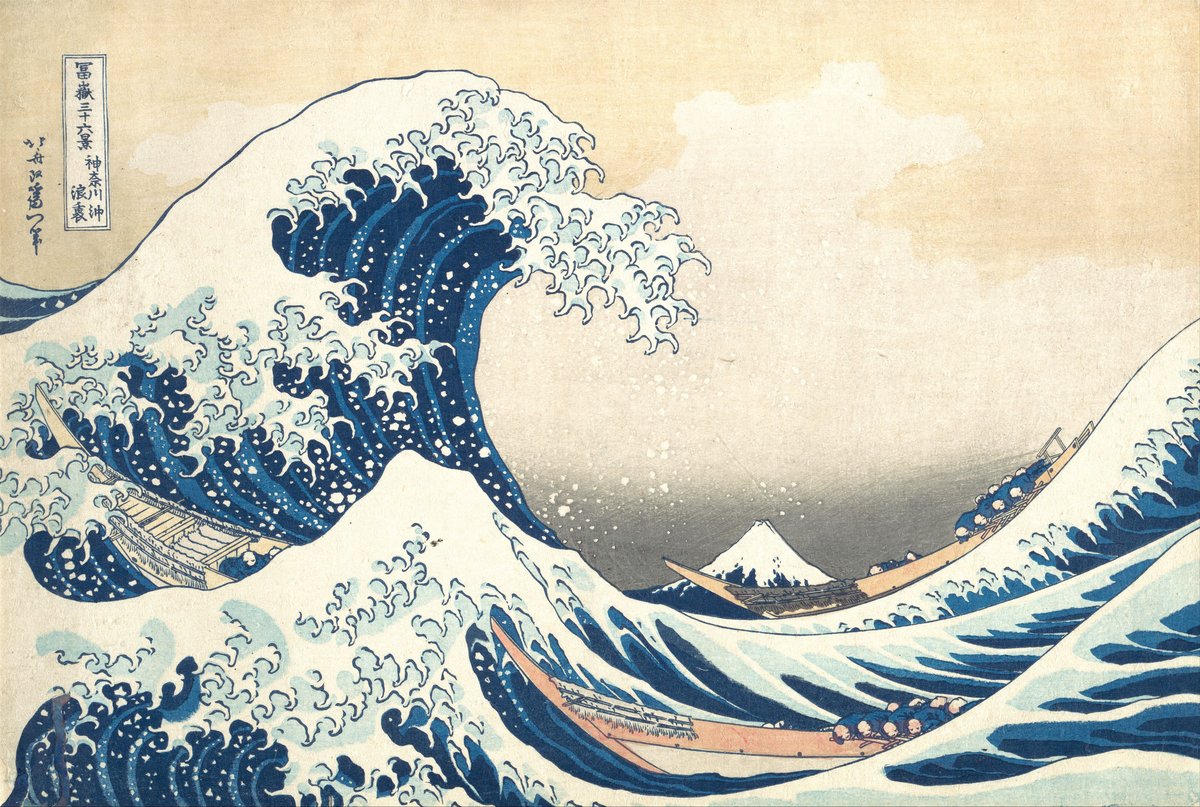
The wave fills much of the image. Its crest breaks into forms that seem almost like claws; three boats and their occupants are caught beneath it. Far away, the small shape of Fuji can be mistaken for another wave. The British Museum's research points out that the mountain is the main subject of the print even though it can easily be mistaken for another crest.
The composition is carefully balanced. The enormous curve of water takes our attention, then the eye moves toward the boats and the mountain. It is a dramatic image of people working in a landscape, not only an attractive blue design for a wall.
The series title says thirty-six views. The final series contained forty-six designs after Hokusai added ten more. Titles can survive a change of plan, particularly when the audience is interested enough to welcome more.
I like the way Hokusai lets the most famous mountain in Japan become a small shape behind the action. An important subject does not always have to occupy the largest part of the picture.
How was The Great Wave made?
The Great Wave is a woodblock print made through a collaborative publishing process in which a design was cut into blocks and printed in color on paper. Hokusai provided the design; specialist carvers, printers and the publisher were also part of the process.
A print design can produce multiple impressions. These are individual objects made from the blocks, not later photographs of a single painted canvas. Their colors, paper, condition and details can differ, and the blocks themselves changed through use.
That is why a museum's Great Wave and an impression sold at auction can show the same image without being the same object. Each has its own physical condition and history. A collector or researcher may ask when it was printed, how clearly the blocks printed and what happened to the paper afterward.
The British Museum has studied the making and evolution of the print. That work takes us behind the familiar image to materials and processes. A wave that seems to move in a fraction of a second required the coordinated labor of several people.
The image's fame makes it easy to forget the people in the boats. It also makes it easy to forget the people who cut and printed the blocks. Both groups deserve a place in the story.
What is Hokusai's auction record?
Hokusai's reported auction record for a single work is ¥621 million, about $4 million, paid for his hand-painted Beauty in Snow, with an inscription by Shokusanjin (1813–19), at a Tozai New Art auction in Tokyo on 8 November 2025. The buyer was the home-furnishings company Nitori, which said it would show the painting at its museum in Otaru, Hokkaido.
This was a hand-painted work, not an impression of The Great Wave. It shows a courtesan standing in falling snow beneath an umbrella. The reports give the price but do not say whether it includes the buyer's premium.
A complete set of the 46 prints in Thirty-six Views of Mount Fuji sold for $3,559,000 at Christie's New York on 19 March 2024. A set of prints and one painting are different kinds of lot, even when both are associated with Hokusai.
An impression of The Great Wave from the Okada Museum of Art sold at Sotheby's Hong Kong in November 2025 for HK$21.72 million (US$2.79 million) after more than 20 bids, surpassing the previous auction record for the print, Sotheby's reports. That previous record was set at Christie's New York on 21 March 2023, at $2,760,000.
Those distinctions matter: a painting, a complete set and an individual impression are not the same category. Nor can a price for one impression automatically be assigned to every example of the same design. Condition, printing, provenance and the particular sheet all matter.
What did a Great Wave sell for in 2026?
An impression of The Great Wave sold at Christie's Paris on 10 June 2026, in the Art d'Asie sale, for €1,646,000. At the same sale, Storm below the Summit, known as Black Fuji, sold for €304,800.
A strong result, but not a new record: the Hong Kong impression of 2025 still holds the record for the print, the New York result the one for the full set, and the Tokyo painting the reported record for any Hokusai.
An auction result is a completed transaction. A starting price or estimate is not a sale price, and a withdrawn lot has no sale price at that auction. Here, Christie's reports an actual result, date and location.
The Paris impression also reminds us that the same design can travel through different collections and appear in different markets. Each sheet needs its own description. A photograph of the image may look familiar; the physical object and its history still need to be checked.
What are five surprising facts about Hokusai?
Five details make the familiar wave part of a larger career:
1. The mountain is easy to miss. Mount Fuji appears in the distance beneath the wave's curve.
2. The series grew beyond its title. Thirty-six Views of Mount Fuji ultimately included 46 designs.
3. The image was made through collaboration. Hokusai's design was brought to paper through the work of carvers, printers and a publisher.
4. He used at least 30 names. Christie's counts at least thirty during his lifetime, so signatures and dates need to be read in the context of his long career.
5. His reported auction record is not a wave print. The 2025 Tokyo result was for the hand-painted Beauty in Snow.
The last point is useful when a famous image becomes almost synonymous with its maker. Hokusai's work included more than the picture that appears most often on postcards.
Where can you see Hokusai's work?
You can see Hokusai prints and paintings at the Metropolitan Museum of Art in New York, the British Museum in London, the Museum of Fine Arts in Boston and the Sumida Hokusai Museum in Tokyo, among others. Works on paper are shown for limited periods to protect them from light, so check the current display before traveling.
The Metropolitan Museum of Art, New York holds an impression of The Great Wave.
The British Museum, London holds Hokusai works and research on the print.
The Sumida Hokusai Museum, Tokyo presents material relating to his life and work.
Museum of Fine Arts, Boston holds an extensive Japanese art collection including Hokusai works.
The Hammer Museum, Los Angeles holds another impression of Under the Wave off Kanagawa.
If you see impressions in different museums, look at the colors and details as well as the composition. The design is shared; the sheets have lived separate lives.
Why does an individual print's history matter?
An individual print's history matters because its printing, condition, ownership and exhibition records identify the particular sheet being discussed. Hokusai's wave shows why a famous image and an individual impression should not be treated as the same thing.
At CoArt Market, I want objects that have spent years in private hands to become visible again. Every object carries a cryptographic certificate of authenticity that records its path from owner to owner, and we are building a market for fractional ownership of Blue Chip art and collectibles, a core part of the system we are working on now.
Hokusai placed Mount Fuji behind a wave so large that it can take a moment to find the mountain. When you look at the print, what do you see first: the wave, the boats or Fuji?
Sources
- British Museum, Capucine Korenberg, "The making and evolution of Hokusai's Great Wave": www.britishmuseum.org/sites/default/files/2022-03/korenberg_article-for_hokusai%20_edited_volume_final-2020_accessible.pdf
- The Mainichi (Kyodo), Hokusai painting sells for record 621 million yen (12 November 2025): mainichi.jp/english/articles/20251112/p2g/00m/0et/013000c
- Tokyo Weekender, on the Hong Kong Great Wave and the Tokyo painting sale: www.tokyoweekender.com/?p=279228
- Sotheby's, "Inside a Stellar Year for Asian Art at Sotheby's: 2025 in Review": www.sothebys.com/en/articles/inside-a-stellar-year-for-asian-art-at-sothebys-2025-in-review
- Christie's, "10 things to know about Hokusai": 2023 impression, 2024 complete set, his names: www.christies.com/en/stories/newimport/evergreen-content/features-by-artist/10-things-to-know-about-hokusai-9742
- Christie's, "How Hokusai's iconic work The Great Wave swept across the world": Paris results, 10 June 2026: www.christies.com/en/stories/hokusai-36-views-mount-fuji-ukiyo-e-prints-c3312f8242094e498801b27571f7edb6
- The Metropolitan Museum of Art, The Great Wave: www.metmuseum.org/art/collection/search/45434