

Kazimir Malevich: a black square, a Berlin journey and an $85.8 million record
A black square, a journey to Berlin and the highest price ever paid for a Russian painting at auction
The thirteenth article of our series “Great artists” begins with a black square on a white ground and follows another painting from Malevich's studio to Berlin, Amsterdam and two New York auctions. It is a journey about art, ownership and a family trying to recover a history.
Who was Kazimir Malevich?
Kazimir Malevich was an artist born in Kyiv in 1879, then part of the Russian Empire, who founded Suprematism and became a central figure of the early twentieth-century avant-garde. He died in Leningrad in 1935.
His family was of Polish origin. His life and work crossed places and cultures that are now described using different national histories. I prefer to begin with where he was born, where he worked and what he made. Those facts tell us more than trying to fit the whole man into a single convenient label.
Malevich experimented with several styles before developing the geometric language for which he is best known. He painted figures and landscapes as well as abstract compositions. He taught, wrote and argued about art. In Vitebsk, his ideas also entered the lively artistic world associated with Marc Chagall and El Lissitzky.
When someone says Malevich, many people immediately say “black square.” Fair enough. But that square has a history, and it is a good deal more complicated than the time it takes to draw four sides.
Why is Malevich famous for Black Square?
Malevich is famous for Black Square, shown in Petrograd in 1915, because it became a defining image of his attempt to make painting independent of recognizable objects. A dark, roughly square form sits against a light ground. There is no sitter to identify, no landscape to locate and no dramatic event to narrate.
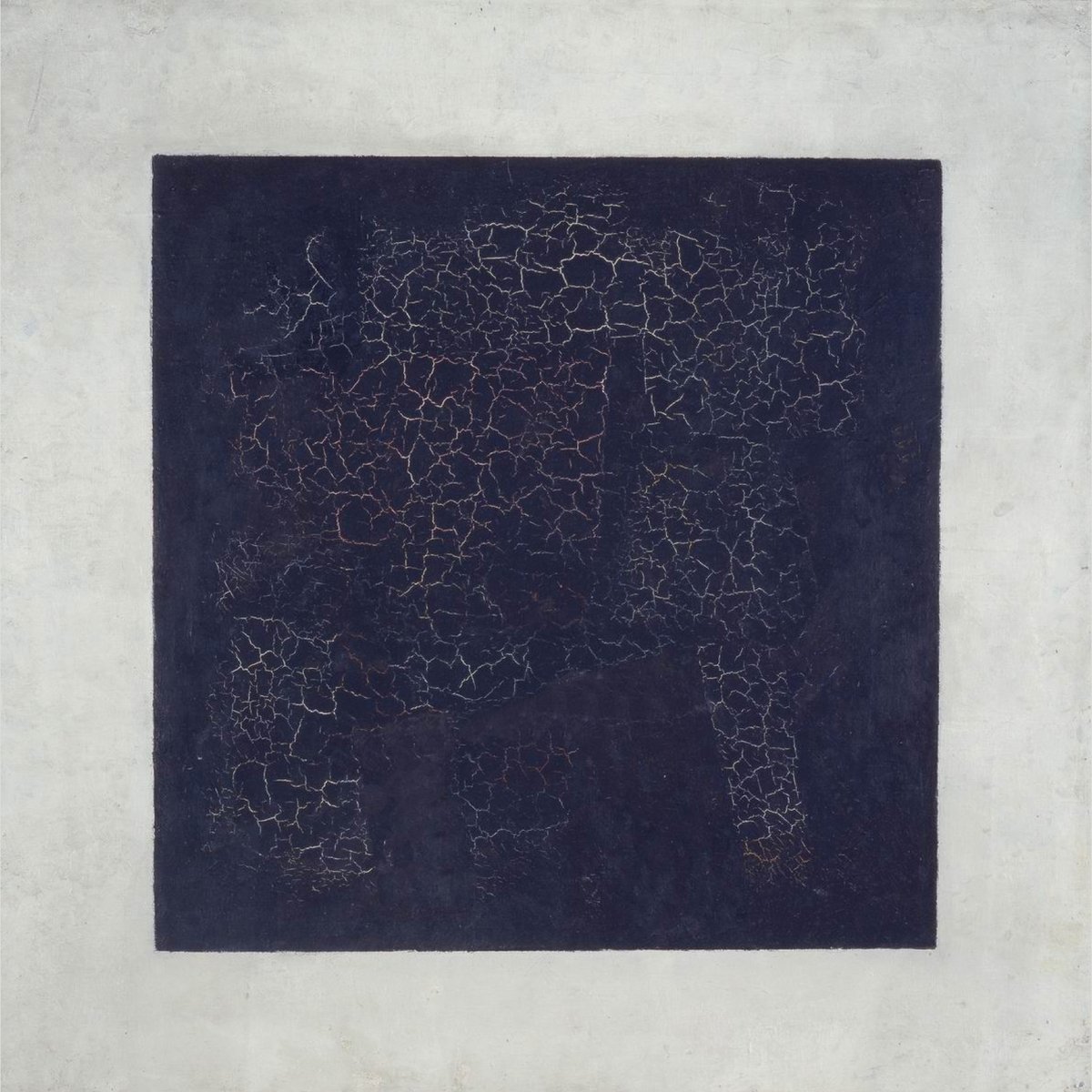
At the 1915 exhibition in Petrograd, the painting was hung high in a corner, a position associated in traditional homes with religious icons. Its placement made the presentation part of the argument. This was not simply a small picture that happened to be difficult to understand from across the room.
There are several versions of Black Square, so a date, collection and specific work matter. A reproduction labeled “Malevich's Black Square” can make different paintings look like one object. A museum catalogue can help us keep them apart.
I have heard the familiar objection: anyone could paint a black square. Perhaps. But Malevich made this one, showed it in a particular place at a particular moment, and asked what painting could become when it stopped representing the visible world. The conversation has continued for more than a century. That is an impressive amount of work for four sides.
What is Suprematism?
Suprematism was Malevich's artistic movement built on geometric forms, color and the experience of painting without depicting familiar objects. Squares, rectangles and other shapes could be arranged against a light field without becoming a landscape or a portrait in disguise.
This does not mean the paintings are merely diagrams. Shapes appear to move, overlap or float; their proportions and colors change the rhythm of the surface. The white surrounding them is not simply an empty margin waiting to be filled. It is part of the composition.
In Suprematist Composition of 1916, colored forms meet and cross over a light background. There is a prominent blue rectangle, along with smaller shapes. Someone could describe the objects in a few seconds. Understanding why the artist placed them where he did can take much longer.
Malevich's ideas developed during a period of artistic and political upheaval. The forms look simple, but the ambitions behind them were not modest. He was trying to change the basis on which a painting could be made and understood.
How did Suprematist Composition reach Amsterdam?
Malevich's Suprematist Composition reached Amsterdam because he brought it to Berlin for his exhibition of 1927, left it behind in Germany when he returned to the Soviet Union, and it later entered the collection of the Stedelijk Museum. The works he left were in the care of the architect Hugo Häring.
That separation lasted much longer than anyone planning an exhibition might reasonably expect. After Malevich's death, the paintings remained outside the country where much of his family lived. The Stedelijk acquired works from the material associated with Häring, and they became part of its important Malevich collection.
The artist's heirs later sought their return. In 2008 an agreement involving the Stedelijk and the family led to the restitution of five paintings, including Suprematist Composition. The history had involved competing claims and negotiations; the agreement resolved that group of claims. It should not be reduced to a story in which a painting simply wandered from one wall to another.
The work's journey passed through an artist's exhibition, a custodian, a museum, a family and then the auction market. Each step is relevant. Knowing the sale price without knowing how the painting reached the seller would leave out the most interesting part.
What is Malevich's auction record?
Malevich's auction record is $85,812,500 including fees for Suprematist Composition (1916), sold at Christie's New York on 15 May 2018. Christie's identified the result as a world auction record for the artist and the highest price ever paid for a Russian painting at public auction.
The same painting had sold at Sotheby's New York on 3 November 2008 for just over $60 million, the Associated Press reported, after its restitution to the artist's heirs. That price was then the record for the artist. Two major auction houses, one painting and a decade between the public sales.
Later in 2018, Christie's London sold Malevich's Landscape (1911) for £7,883,750, which Christie's describes as a world auction record for a Russian work on paper. It is not another version of Suprematist Composition. Medium, date and subject are essential when comparing results.
The prices are past transactions. They do not mean that a later geometric painting, a print or an unattributed drawing has the same market history. In this case, the 1916 date, the place of the work in Malevich's early Suprematist period, its exhibition history and the restitution agreement all belong in the account.
There is a certain irony in watching an argument for freedom from recognizable objects become the subject of such precise arithmetic. But the arithmetic is real, and so is the history that came before it.
What are five surprising facts about Malevich?
Five details help place the square in the artist's larger life:
1. He was not always painting squares. Malevich experimented with figurative subjects and other modern styles before and after his early Suprematist works.
2. The square was displayed like an icon. At the 1915 exhibition it occupied a high corner position with a familiar cultural meaning for viewers of the time.
3. He worked across art and theater. His stage designs connected his experiments in form with performance and the avant-garde's wider ambitions.
4. He taught in Vitebsk. His work there intersected with an artistic school associated with Chagall and El Lissitzky, and their ideas about the direction of art could differ sharply.
5. His record painting returned to his heirs. Suprematist Composition was among works restituted in 2008 after an agreement involving the Stedelijk Museum and the family.
The Vitebsk connection is especially interesting to me. Two artists can work in the same city, disagree about the future of art and both leave works that people still travel to see.
Where can you see Malevich's work?
You can see important Malevich works at the Stedelijk Museum in Amsterdam, the Museum of Modern Art in New York and the Centre Pompidou in Paris, among other collections. Individual works may be on loan or temporarily unavailable, so check the museum's current display before traveling.
Stedelijk Museum, Amsterdam holds a major collection of Malevich and related avant-garde works.
The Museum of Modern Art, New York holds works including Suprematist Composition: White on White.
Centre Pompidou, Paris holds works by Malevich within its collection of the European avant-garde; check its current venues and display information.
Tate, London provides information about Malevich and works connected with his career.
A painting's presence in a museum collection and its presence on a gallery wall are not always the same. A quick check can save a long trip made for a particular square.
Why does a painting's ownership history matter?
A painting's ownership history matters because it connects the object to the people and institutions responsible for it, including moments when ownership or custody is disputed. Suprematist Composition shows how exhibition records, correspondence and an agreement with heirs can become central to a painting's later life.
At CoArt Market, I want objects that have spent years in private hands to become visible again. Every object carries a cryptographic certificate of authenticity that records its path from owner to owner, and we are building a market for fractional ownership of Blue Chip art and collectibles, a core part of the system we are working on now.
Malevich placed a black square where an audience might have expected a picture of something else. More than a century later, does it look empty to you, or full of possibilities?
Sources
- Christie's, May 2018 Impressionist and Modern Evening Sale report: www.christies.com/en/stories/may-2018-impressionist-and-modern-evening-sale-report-58a217b5ec63408d92603c83dd6b5b53
- Christie's press release, Suprematist Composition: Berlin 1927, the Stedelijk and the 2008 restitution: press.christies.com/releasenbspkazimir-malevichs-revolutionary-suprematist-composition-1916-to-lead-christies-evening-sale-of-impressionist-and-modern-art?lang=eng
- Christie's, "50 years of Russian art at Christie's": the Russian painting record and Landscape (1911): www.christies.com/en/stories/50-years-of-russian-art-at-christies-e208c6bb5b7f48d4a7967c7aa246f207
- Associated Press, Ula Ilnytzky, "Despite gloom, modern art booms", in the Taipei Times (5 November 2008): www.taipeitimes.com/News/feat/archives/2008/11/05/2003427811
- Sotheby's, Impressionist & Modern Art Evening Sale, New York, 3 November 2008, lot 6: www.sothebys.com/en/auctions/ecatalogue/2008/impressionist-modern-art-evening-sale-n08485/lot.6.html
- MoMA, Kazimir Malevich: www.moma.org/artists/3710
- Tate, Kazimir Malevich: www.tate.org.uk/art/artists/kazimir-malevich-1561