

Keith Haring: from a subway wall to a $6.5 million auction record
From chalk drawings on subway walls to a $6.5 million record: Keith Haring's language for everyone
The thirty-first article of our series “Great artists” begins with a black advertising panel in the New York subway and a young man with a piece of white chalk. A few years later, his art would be in museums, on T-shirts and at the center of arguments about who art is really for.
Who was Keith Haring?
Keith Haring was an American artist whose lively figures and bold lines carried messages about life, politics and the AIDS crisis. He was born on May 4, 1958, in Reading, Pennsylvania, and grew up in nearby Kutztown. His father drew cartoons, and Keith drew from an early age.
In 1978 he moved to New York and studied at the School of Visual Arts. The city offered an education of another kind: its clubs, streets, subway stations and downtown artists gave him a public and a community. He met artists including Jean-Michel Basquiat and became part of a scene in which music, performance, fashion and visual art crossed paths.
Haring worked quickly, and he had reason to. He died of AIDS-related complications on February 16, 1990, at just 31. In little more than a decade, he had made drawings, paintings, prints, murals and objects that would travel far beyond the city where his career began.
It is easy to describe that career as a journey from underground to establishment. It happened, but that is only half the story. Even after galleries began exhibiting his work, Haring kept asking how to put images in front of people who might never walk into one.
Why did Keith Haring draw in the New York subway?
Haring drew in subway stations because unused advertising panels gave him a highly visible surface and an audience already passing by. Around 1980 he noticed that empty ad spaces were covered with matte black paper. White chalk showed up beautifully against it.
The arrangement was practical. He could work quickly, and the drawings were visible to commuters without admission tickets, opening hours or an invitation from a curator. A train arrived, a crowd moved on, and someone else came along. The drawings were temporary: the next advertisement could cover them.
Haring's figures are recognizable at a glance – crawling babies, barking dogs, dancing bodies and radiating lines. Recognizable does not mean simple in meaning. Those same outlines can suggest joy, danger, desire, fear or solidarity depending on how the figures are arranged.
He was also drawing in public without permission. That made the subway a risky studio as well as an open one. He was arrested more than once. An artist making a drawing while waiting for a train is not the sort of scene most people expect to end at a police station. In New York in the early 1980s, it sometimes did.
The subway images helped him reach collectors and galleries, but the public encounter came first. People saw the drawings in the middle of an ordinary day, not necessarily because they had set out to look at art. I like that detail. It changes the question from “How do we bring people to the art?” to “Why not bring the art to the people?”
What happened to the first Crack is Wack mural?
The first Crack is Wack mural, painted by Haring in 1986 on a handball court wall in Harlem as a warning about the crack epidemic, was painted without the city's permission and had to be covered; the mural seen at the site today is the new version he made afterward.
The story did not stop with the first coat of paint. The Keith Haring Foundation records that the city ordered Haring to cover the unauthorized mural; the New York City Parks Department then asked him to create a new mural on the same theme. The distinction matters: the work visible at the site is not simply the untouched first version.
The mural shows one side of Haring's social engagement. He also made images addressing apartheid, nuclear weapons, gay visibility, safer sex and AIDS. His visual language could be playful, but he did not reserve it for easy subjects.
Haring was diagnosed with AIDS in 1988. In 1989 he established the Keith Haring Foundation, which supports children's programs and organizations concerned with HIV and AIDS. The foundation remains part of his legacy alongside the works in museums and collections.
These images came from a particular moment, when stigma made an already devastating epidemic even harder to confront. Haring used a language many people could immediately recognize to make issues harder to ignore.
Why did Keith Haring open the Pop Shop?
Haring opened the Pop Shop in Manhattan in 1986 to make products bearing his designs available to a wider audience. Visitors could buy T-shirts, posters and other objects with images related to his work.
Not everyone in the art world approved. A shop selling merchandise could look suspiciously commercial to people accustomed to treating the gallery as the proper setting for serious art. Haring saw another side: a person who could not buy a painting could still take an image home.
The tension did not disappear because he wanted access. His gallery works were also bought and sold as valuable individual objects. The shop and the gallery existed at the same time, and the distance between their prices was real.
I do not think we need to resolve that tension with a slogan. A museum painting, an authorized print and a T-shirt are different things. What is interesting is that Haring wanted the same visual language to cross those boundaries. He was willing to let a child recognize a dancing figure before ever learning what a curator called it.
His figures have since appeared so widely that it can be easy to overlook the artist's own choices. He did not merely become a brand after the fact. He actively explored how his images could circulate, and he used that visibility for causes that mattered to him.
What is Keith Haring's most expensive painting?
Keith Haring's most expensive painting at auction is Untitled (1982), which sold at Sotheby's New York on May 18, 2017, for $6,537,500 including buyer's premium, a hammer price of $5.6 million, and set his auction record. That is the artist's record for a public auction, not the price of every work with a dancing figure on it.
One of the more personal recent sales involved a gift. Haring's Self-Portrait (1985), dated February 4, 1985, is dedicated on the canvas “HAPPY BIRTHDAY – FOR KERMIT”, to his childhood friend Kermit Oswald. It was offered at Sotheby's New York on May 14, 2026, with works from Oswald's collection, and Sotheby's reported that every Haring from that collection sold, for $5.6 million altogether. Forty-one years passed between the birthday and that public sale.
On November 17, 2026, another painting, Untitled (1988), sold at Phillips New York for $1,161,000 including buyer's premium, within its estimate of $900,000 to $1.2 million.
Three paintings, three histories. And the distinction between a hammer price and a price including fees is not an accounting detail to skip. A starting price or an estimate is not a sale price at all. If a lot is withdrawn, it has no sale price at that auction.
The story of the Self-Portrait also explains why provenance interests me. A birthday dedication, a friendship, the fact that a work passed from artist to friend: these details tell us more than a number on an auction screen. They tell us where the work has been and who lived with it.
That is part of what we are building at CoArt Market. Every object carries a cryptographic certificate of authenticity, and we are building a market for fractional ownership of Blue Chip art and collectibles, a core part of the system we are working on now.
Where can you see Keith Haring's work?
You can see Haring's work at the Whitney Museum of American Art and the Museum of Modern Art in New York, at the Nakamura Keith Haring Collection in Yamanashi, Japan, a museum devoted to him, and in public places such as the Crack is Wack mural in Harlem and Tuttomondo (1989), his mural on a church wall in Pisa. Check an institution's current display information before making a special trip: a work listed in a collection is not necessarily on the wall that day.
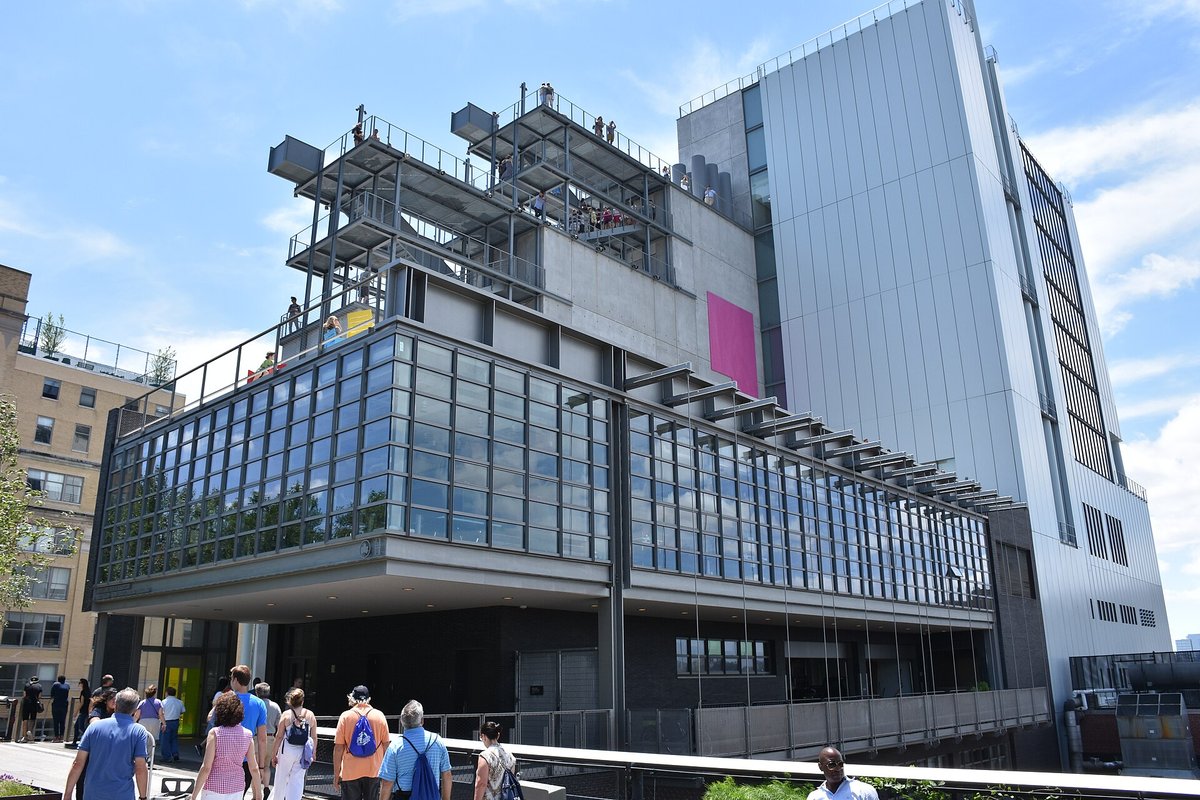
Whitney Museum of American Art, New York holds work by Haring.
The Museum of Modern Art, New York documents his work and exhibitions.
Nakamura Keith Haring Collection, Yamanashi exhibits the collection of its founder, Kazuo Nakamura.
The Keith Haring Foundation provides information about his projects, murals and continuing legacy.
What are five facts to remember about Keith Haring?
Five things I would keep in mind when looking at his art:
1. He used empty subway advertising panels as a temporary public drawing surface.
2. His well-known figures could address serious subjects as well as movement and joy.
3. The Crack is Wack mural at its Harlem location is the later version, made after the first unauthorized one was covered.
4. His Pop Shop brought his designs to people who could not buy a painting, while his gallery work continued to circulate separately.
5. The Self-Portrait sold in 2026 was dedicated to a childhood friend, giving its auction history a human starting point.
Haring once chose a subway platform as his place to meet the public. Today his work belongs to museums and private collections, and some paintings sell for millions. I wonder which encounter he would have enjoyed more: a crowded gallery, or a stranger stopping for a moment on the way to a train?
Sources
- Whitney Museum of American Art, Keith Haring: whitney.org/artists/2685
- PBS American Masters, Keith Haring biography and timeline: www.pbs.org/wnet/americanmasters/keith-haring-biography/16012/
- Keith Haring Foundation, Crack is Wack: www.haring.com/!/art-work/108-2
- Sotheby's, Contemporary Art Evening Auction, New York, 18 May 2017, lot 26: Untitled (1982): www.sothebys.com/en/auctions/ecatalogue/2017/contemporary-art-evening-auction-n09761/lot.26.html
- The Art Newspaper, "Basquiat skull painting sells for record $110.5m at Sotheby's" (18 May 2017): the Haring record and its hammer price: www.theartnewspaper.com/2017/05/18/basquiat-skull-painting-sells-for-record-dollar1105m-at-sothebys
- Sotheby's, Self-Portrait (1985), lot 113, The Now & Contemporary Evening Auction, 14 May 2026: www.sothebys.com/en/buy/auction/2026/the-now-contemporary-evening-auction/self-portrait-2
- Sotheby's, "New York's Spring Season Draws to a Close at $908.6 Million in Sales": www.sothebys.com/en/articles/editorial-new-york-2026-spring-season-wrap-up
- Phillips, Modern & Contemporary Art Evening Sale, New York, 17 November 2026: results: www.phillips.com/auctions/auction/NY010726
- Phillips, Keith Haring, Untitled (1988), lot 15: www.phillips.com/detail/keith-haring/NY010726/15