

Leonardo da Vinci: a lost painting, a recovered smile, and $450 million
A lost painting, a restored face and $450 million: the most expensive work ever sold at auction, and the doubts around it
The ninth article of our series “Great artists” follows a painting of Christ from obscurity to a $450 million auction. It also follows another Leonardo across a rather shorter distance: out of the Louvre in 1911 and back again two years later.
Who was Leonardo da Vinci?
Leonardo da Vinci was an Italian Renaissance painter, draftsman, engineer and investigator of the natural world, born near Vinci in 1452. He died in France in 1519 after working in Florence, Milan, Rome and at the French court.
His best-known paintings include the Mona Lisa and The Last Supper. His notebooks contain drawings and observations about the human body, movement, water and machines. The paintings and the notebooks belong to the same person, though museums have helpfully divided them between several countries.
Leonardo trained in the Florentine workshop of Andrea del Verrocchio. There he learned the practical business of making art in a workshop, a world where commissions, assistants and collaboration mattered. That background is useful to remember when we look at works whose authorship later became a question for specialists.
He painted slowly and left some projects unfinished. This did not prevent him from becoming one of the most famous painters in history. If anything, the small number of accepted paintings makes each one receive an amount of attention that its sitter might not have imagined.
What is Leonardo da Vinci famous for?
Leonardo is famous for paintings such as the Mona Lisa and The Last Supper, and for drawings and notebooks that reveal his studies of nature, anatomy and engineering. He looked at a face and wanted to know how it worked; he looked at water and wanted to know how it moved.
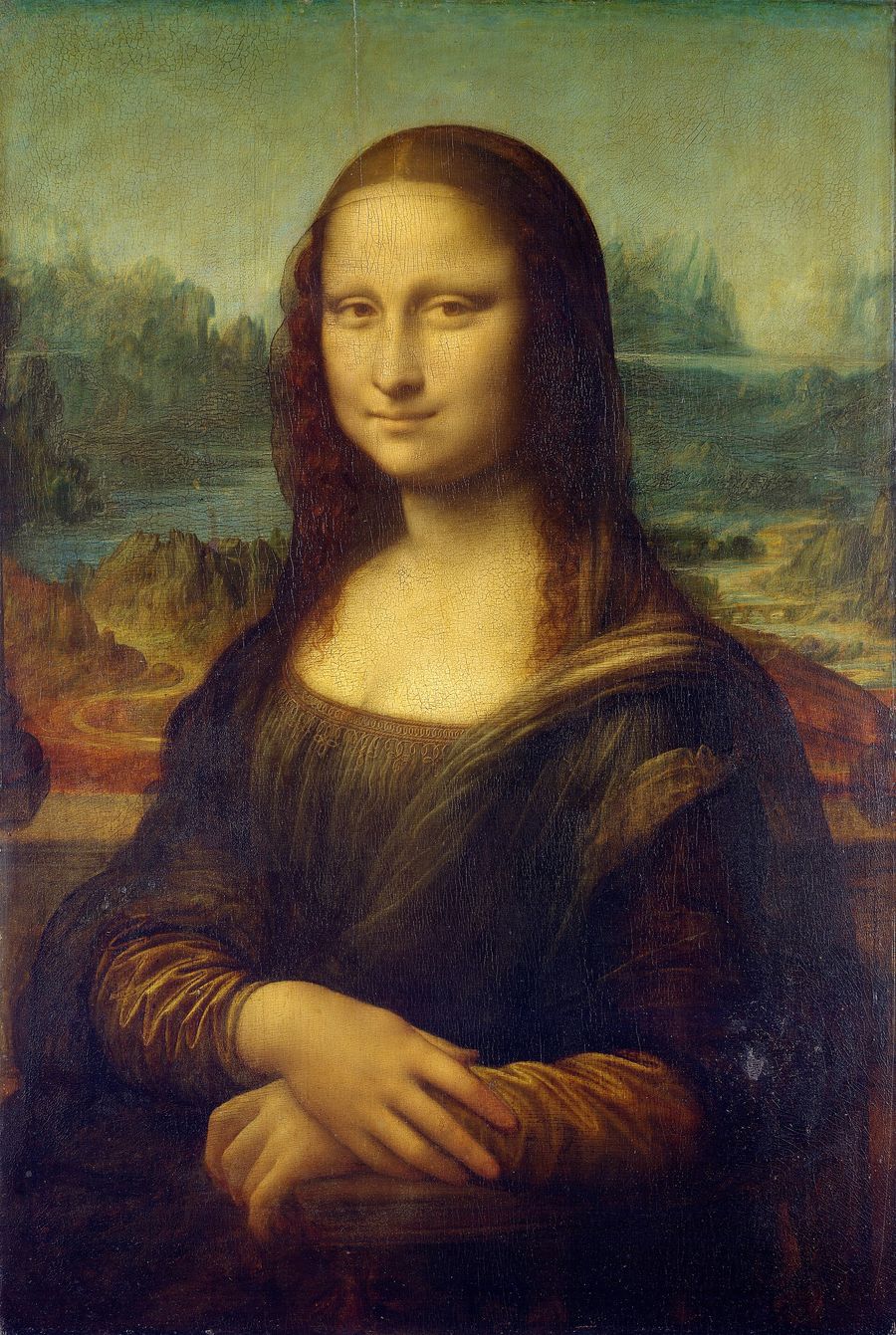
The Mona Lisa, in the Louvre, is a portrait of Lisa Gherardini. The sitter turns toward the viewer; the transitions of light and shadow across her face help give the impression that her expression is changing as we look. The longer you stand in front of her, the more determined the people behind you become to do the same.
The Last Supper occupies a wall of the former refectory of Santa Maria delle Grazie in Milan. Its subject was familiar to Leonardo's contemporaries, but the arrangement of the figures and their responses around the table gives each of them a role in the moment. It is a painting about a group in which almost every gesture asks to be read.
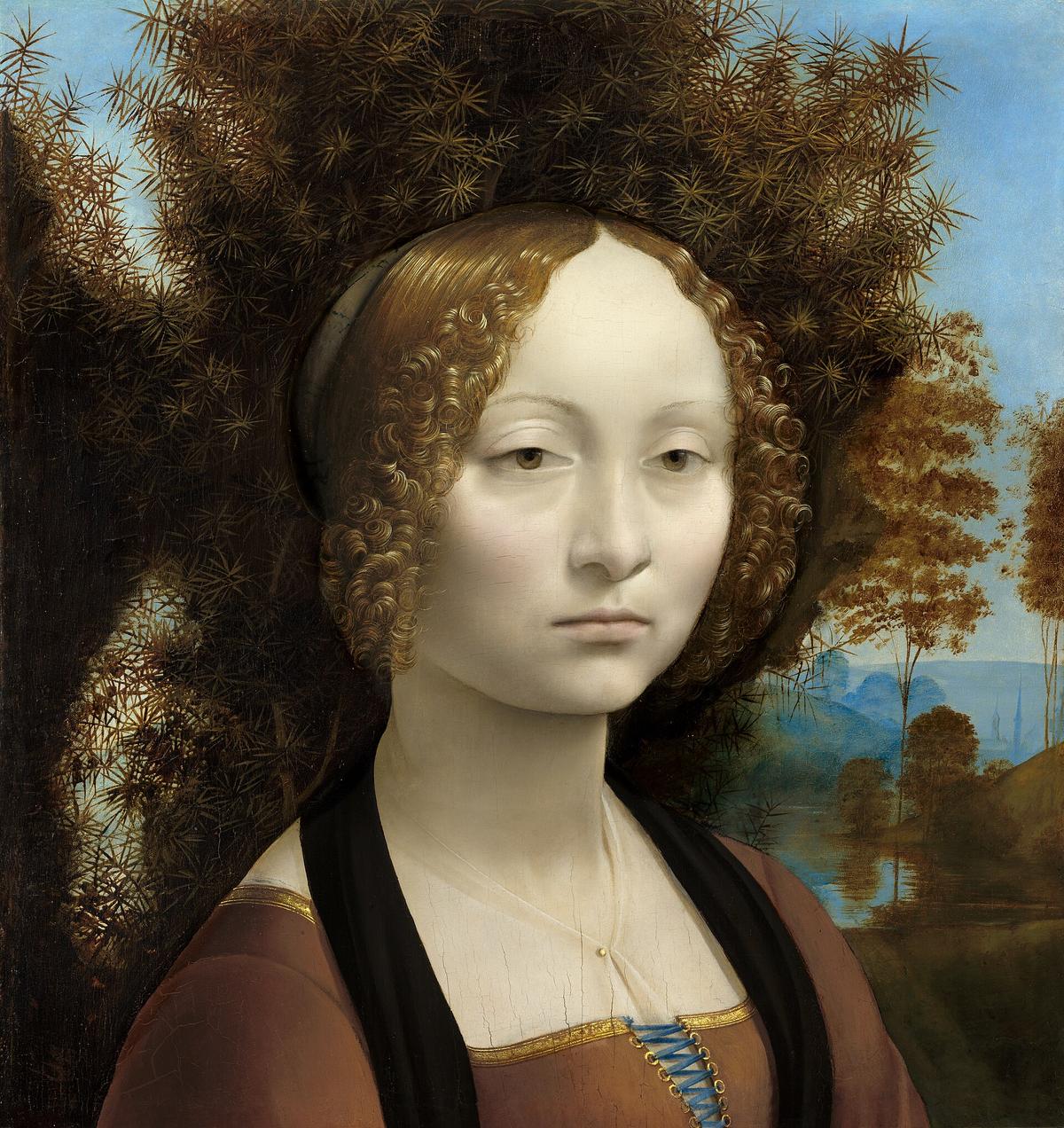
Then there are the drawings. At the National Gallery of Art in Washington, the portrait Ginevra de' Benci offers a different encounter with Leonardo's observation. The museum points to a fingerprint left in the paint. Five centuries later, the surface still holds evidence of a working hand.
How did the Mona Lisa leave the Louvre?
The Mona Lisa was stolen from the Louvre in August 1911 and recovered in Italy more than two years later. The theft turned an already admired painting into an international news story.
The man responsible, Vincenzo Peruggia, had worked at the museum. When he later approached an Italian art dealer to sell the portrait, the dealer alerted the authorities. The painting returned to France after being recovered.
It is difficult now to imagine the Louvre without queues to see her. Yet her fame has a history too: centuries of appreciation, reproduction, theft, reporting, return and the habits of millions of visitors. A painting can stay nearly the same while the world around it becomes a great deal noisier.
I find the dealer's role worth remembering. An object appeared for sale. Someone recognized its importance, understood that its history did not add up and contacted the authorities. Not every painting comes with the Mona Lisa's fame. The questions about where it came from still matter.
What is Salvator Mundi, and why is its attribution debated?
Salvator Mundi is a painting of Christ holding a transparent orb, presented as a work by Leonardo at the National Gallery in London in 2011 and sold as his work by Christie's in 2017. Specialists disagree about the extent of Leonardo's own hand and possible workshop participation.
The painting had been heavily overpainted and was rediscovered in the early twenty-first century. Research, conservation and comparison followed. The National Gallery included it in its 2011–2012 Leonardo exhibition under Leonardo's name. Christie's subsequently offered it as a painting by Leonardo.
Other scholars have questioned that attribution. The Art Newspaper records, for example, the art historian Carmen Bambach's view that the painting was substantially the work of Giovanni Antonio Boltraffio under Leonardo's close supervision. The same publication reported that a Louvre study reached a different conclusion and supported attribution to Leonardo.
Those are different expert positions, not different prices. The $450 million transaction happened. The debate concerns who painted how much of the picture. When a work is described as “the last Leonardo,” I want to know who is making the attribution and what evidence they considered.
There were many versions of this subject associated with Leonardo and his circle. A workshop was a place of real collaboration, not a modern photocopier. Drawings, patterns, pupils, revisions and materials all give researchers things to examine. They also make a simple answer harder to write in a headline.
The public story after the sale contains unanswered questions too. In December 2017 Louvre Abu Dhabi announced that it had acquired the painting; in September 2018 its planned unveiling there was called off. I would not send a reader to a museum on the strength of an old announcement.
What did Salvator Mundi sell for?
Salvator Mundi sold at Christie's New York on 15 November 2017 for $400 million at the hammer and $450,312,500 including fees, which Christie's announced as a new auction record for any work of art. The auctioneer, Jussi Pylkkänen, opened at $75 million; bidding lasted nineteen minutes.
Christie's placed the Renaissance painting in a post-war and contemporary evening sale. That choice gave a five-hundred-year-old religious image an audience more accustomed to an entirely different kind of sale. It also made the evening rather difficult to forget.
Nine years later, the result is still the highest public auction price for any painting. The arithmetic is clear: the hammer price was $400 million; the larger figure includes the buyer's premium. They are not two competing accounts of the same bid.
The painting had previously been sold at Sotheby's London in 1958 for £45, as a work by Leonardo's assistant Boltraffio, and its changing status later became part of its public story. But a market price cannot settle the questions debated by conservators and historians. It tells us what someone paid at a particular auction, for a particular painting, with the information and attribution presented at that time.
And it tells us something about scarcity. A painting accepted by major specialists as Leonardo, appearing on the public market, is an unusual event. The opportunity to see one may be available to almost anyone with a museum ticket. The opportunity to buy one is a different matter.
What are five surprising facts about Leonardo?
Five details make the familiar image of the Renaissance master a little more human:
1. He trained in a workshop. Verrocchio's Florentine studio taught practical skills in a collaborative environment, with several people contributing to commissions.
2. He studied water as closely as faces. His surviving drawings and notes record the movement of water as well as anatomy, machines and plants.
3. A fingerprint survives on a portrait. The National Gallery of Art identifies one on Ginevra de' Benci, where Leonardo used his fingers in working the paint.
4. The Mona Lisa was once missing. It took more than two years for the portrait stolen in 1911 to return to the Louvre.
5. A Renaissance painting led a contemporary sale. In 2017 Christie's offered Salvator Mundi during an evening auction of post-war and contemporary art.
The last fact may seem odd until you think about the room. Leonardo's influence did not stop at the end of the Renaissance. The people interested in an old painting do not have to leave their interest in new art at the door.
Where can you see Leonardo's works?
You can see important works by Leonardo in Paris, Milan, London and Washington, although museums change displays and some works require advance booking. Check the official site before traveling.
The Louvre, Paris holds the Mona Lisa and other paintings connected with Leonardo's career.
Santa Maria delle Grazie, Milan is home to The Last Supper.
The National Gallery, London holds paintings including The Virgin of the Rocks.
The National Gallery of Art, Washington holds Ginevra de' Benci.
The Royal Collection Trust cares for a major collection of Leonardo's drawings; availability varies with exhibitions.
One practical thought: a notebook drawing and a famous painting may tell us different things about the same artist. If you have the opportunity, look at both.
Why does a painting's history matter?
A painting's history matters because records of ownership, exhibition, restoration and attribution help us understand the object being presented to us. Salvator Mundi shows how much work can lie behind a single catalog line.
At CoArt Market, I want objects that have spent years in private hands to become visible again. Each object receives a cryptographic certificate of authenticity that records its path from owner to owner on the platform, and we are building a market for fractional ownership of Blue Chip art and collectibles, a core part of the system we are working on now.
Leonardo left us a smile that has been studied for centuries and a painting whose attribution is still debated. If you could spend an uninterrupted hour with one work, would you choose the familiar Mona Lisa or the disputed Salvator Mundi?
Sources
- Christie's, 2017 sale report (price, record, 19 minutes, auctioneer): press.christies.com/christies-sells-leonardo-da-vincis-500-year/
- Christie's, hammer price and sale: www.christies.com/en/stories/2017-highlight-leonardo-salvator-mundi-6f32f4dd4b274ec1b0d99037a7c6d97e
- The Art Newspaper, sale and hammer price: www.theartnewspaper.com/2017/11/15/leonardos-salvator-mundi-sells-for-dollar450m-at-christies-new-york
- The Art Newspaper, attribution, chronology, 1958 sale and Louvre Abu Dhabi: www.theartnewspaper.com/2022/11/18/a-timeline-of-the-450m-salvator-mundi-centuries-of-deals-disputes-and-drama
- The Art Newspaper, Louvre scientific examinations: www.theartnewspaper.com/2021/04/13/what-the-louvres-scientific-examinations-of-the-salvator-mundi-really-revealedaccording-to-the-museums-own-book
- The Louvre, Mona Lisa and the theft: www.louvre.fr/en/explore/the-palace/from-the-mona-lisa-to-the-wedding-feast-at-cana
- National Gallery of Art, Ginevra de' Benci: www.nga.gov/artworks/50724-ginevra-de-benci-obverse