

Michelangelo: a foot, a ceiling and a $27.2 million discovery
A foot, a ceiling and a red chalk study identified only recently that sold for $27.2 million
The twenty-third article of our series “Great artists” begins with a photograph sent for an auction estimate. It led to the identification of a drawing connected with the Sistine Chapel ceiling and, in 2026, a $27.2 million sale.
Who was Michelangelo?
Michelangelo Buonarroti was an Italian Renaissance sculptor, painter, architect and draftsman, born in 1475, whose works include David, the Vatican Pietà and the Sistine Chapel ceiling. He died in Rome in 1564.
His long life connected several major projects and patrons. He worked in Florence and Rome, carved marble, designed architecture and made drawings to prepare and explore his ideas. His public reputation grew during his lifetime, so he did not have to wait for later generations to discover that he was an important artist.
The familiar list of great works can become a little intimidating. David. The Pietà. The ceiling. The dome of St Peter's. It can sound like a list of monuments rather than the working life of a person who had to plan, negotiate, draw, cut stone and solve practical problems.
The drawing at the center of this story offers a different scale. It concerns a foot. Not the whole ceiling, not the entire building, just a detail studied on paper. That is a good place to begin looking at how a large work is made.
Why is Michelangelo famous?
Michelangelo is famous for sculpture, painting and architecture that brought exceptional attention to the human body, movement and monumental form. His works remain central to the collections and buildings for which many of them were made.
In Florence, David stands as a large marble figure whose concentrated expression and posture give a familiar biblical subject a particular moment of tension. At St Peter's Basilica, the Pietà brings the figures of Mary and Christ together in another kind of composition: still, carefully balanced and carved from stone.
On the Sistine Chapel ceiling, painted between 1508 and 1512, the figures occupy an elaborate arrangement of scenes, prophets, sibyls and painted architecture. The Vatican Museums explain that the original proposal was revised into a much broader program, with nine central scenes from Genesis.
Michelangelo also worked on architecture, including plans for St Peter's. It is easy to divide him into separate departments: sculptor on Monday, painter on Tuesday, architect on Wednesday. The drawings suggest a mind moving among related problems of form, structure and the human figure.
A monument can feel inevitable when we see it completed. The studies remind us that someone had to decide where a limb belonged before the world arrived to admire the whole figure.
What is the Libyan Sibyl drawing?
The record-setting drawing is a study for the foot of the Libyan Sibyl, one of the figures on Michelangelo's Sistine Chapel ceiling, with a study of a leg with the knee bent, in black chalk, on the reverse. Christie's identified it as a previously unknown study connected with the ceiling.
The owner sent a photograph through Christie's online "Request an Auction Estimate" service. A specialist recognized the possibility that the sheet was connected with Michelangelo, and further examination followed. In February 2026 the drawing appeared at auction in New York.
A photograph did not make the drawing a Michelangelo. It brought the object to the attention of someone who could ask the next question. Attribution requires comparison, expertise and examination of the work itself. The route from an online submission to an auction catalog is therefore interesting precisely because it involved more than a single glance.
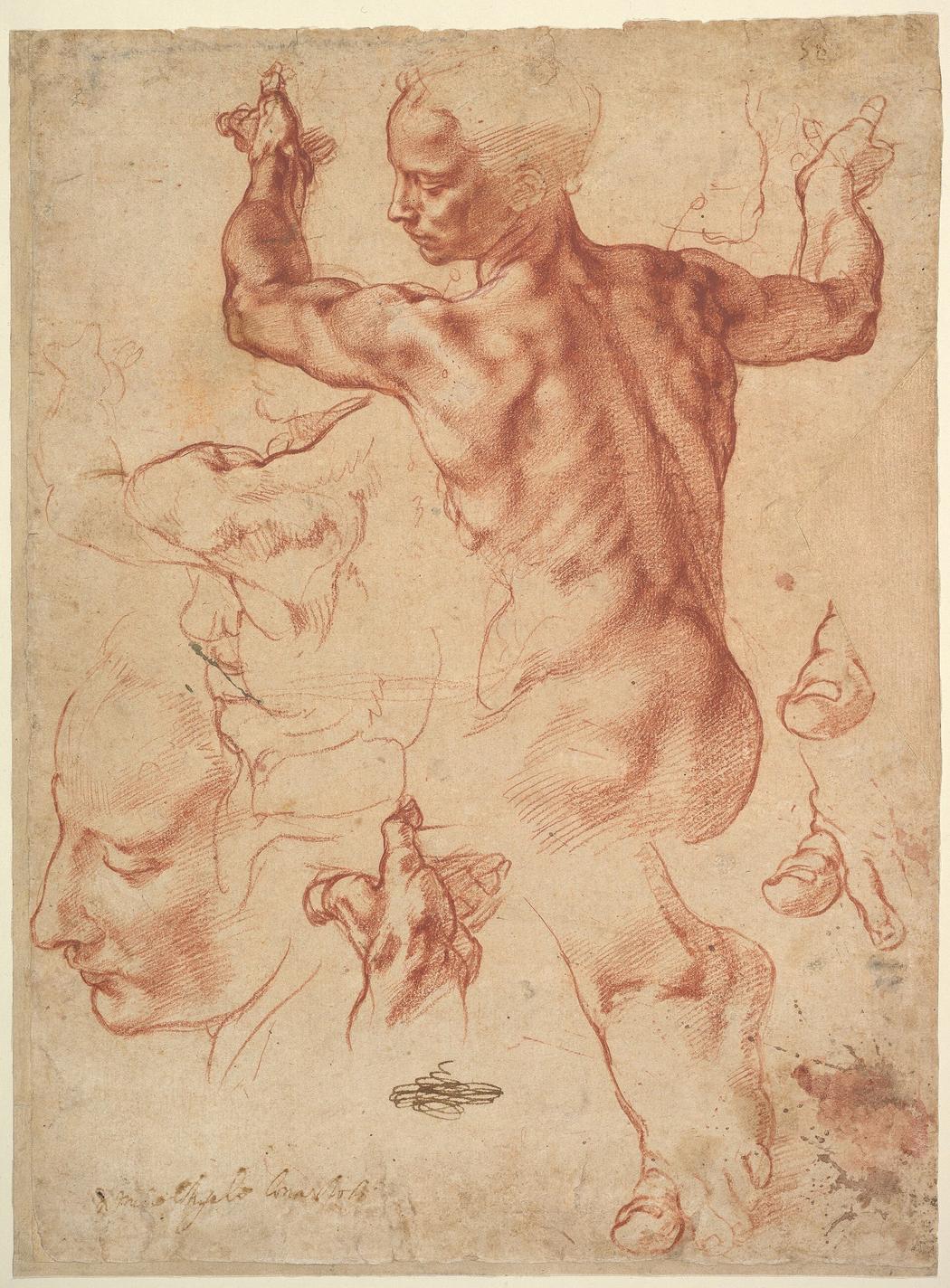
Christie's relates the study to the Libyan Sibyl on the ceiling. A visitor looking upward sees a vast painted program. On paper, a detail can be considered, corrected and studied separately. The small sheet offers a view into the work behind the monumental figure.
I enjoy the change in scale. Millions of people know the ceiling. Far fewer would immediately choose a foot as the detail that carries its story. Michelangelo apparently considered it worth studying.
How was the Sistine Chapel ceiling made?
Michelangelo painted the Sistine Chapel ceiling for Pope Julius II between 1508 and 1512, creating a program that includes scenes from Genesis, prophets and sibyls. The Vatican Museums record that the commission developed beyond an initial plan for a more limited decoration.
The ceiling had suffered structural problems, including a major crack, before the new decoration. The project required practical solutions as well as artistic ambition. It was made for a real building, under real conditions, for a patron with considerable expectations.
The first half was completed in 1510. The Vatican Museums say the work was finished by the end of October 1512, ahead of the pope's Mass in the chapel on 1 November. A later commission brought Michelangelo back to the chapel to paint The Last Judgment on the altar wall.
People often say he painted the whole ceiling lying on his back. The actual working arrangements are more complicated than that popular image. What is certain is that looking upward at a completed fresco is a much easier physical task than making one overhead for years.
The Libyan Sibyl drawing connects a sheet of paper to that immense setting. The ceiling has remained in place; the preparatory drawing could pass through private hands and, centuries later, enter an auction room.
What is Michelangelo's auction record?
Michelangelo's auction record is $27.2 million including fees for the Study for a Foot of the Libyan Sibyl, sold at Christie's New York on 5 February 2026. Artnet News reports a hammer price of $23.1 million. Christie's says the result is nearly 20 times the low estimate.
The previous artist record was set by A Nude Man (after Masaccio) and Two Figures Behind Him, sold at Christie's Paris on 18 May 2022 for €23,162,000 including fees. The drawing had been identified after an earlier valuation of a private collection.
Both results concern drawings. They should not be presented as auction prices for David or for the Sistine Chapel ceiling. Those works are part of public collections or historic buildings, not lots in these sales.
The 2026 drawing attracted approximately 45 minutes of bidding, according to Christie's. It is a long time for a small sheet of paper to command a room. Its connection with a famous project is part of the explanation, but the object also has its own medium, condition and history.
The two public results illustrate how a work can be reconsidered when specialists examine it closely. They do not mean that every old drawing of a foot or a figure is by Michelangelo. A name needs evidence attached to the specific sheet.
What are five surprising facts about Michelangelo?
Five details connect the monuments with the working artist:
1. The ceiling plan changed. The Vatican Museums describe an initial proposal followed by a much broader program.
2. A foot led to a record. The 2026 drawing concerns the Libyan Sibyl's foot, not a complete ceiling composition.
3. The drawing has another study on its reverse. A sheet of paper could carry work on both sides.
4. A photograph began the modern discovery. The owner sent an image to Christie's for an estimate, leading to specialist examination.
5. The previous record was also a drawing. The 2022 Paris sale concerned a study after Masaccio and two additional figures.
The third detail is a good reason to ask to see the back of a drawing. The front may be the image in the catalog. The reverse can be part of the object's history too.
Where can you see Michelangelo's work?
You can see major Michelangelo works in Florence, Rome, London and other cities. Drawings are sensitive to light and may not be on permanent display, so check the current program before traveling.
Galleria dell'Accademia, Florence houses David.
Vatican Museums include the Sistine Chapel.
St Peter's Basilica, Vatican City houses the Pietà.
The British Museum, London holds drawings by Michelangelo.
The Metropolitan Museum of Art, New York holds the Studies for the Libyan Sibyl, the sheet Christie's compares with the 2026 drawing.
A drawing may require a closer look than a marble figure or a chapel ceiling. That change in distance is useful: it allows us to move from the public monument back toward the artist's hand.
Why does a drawing's history matter?
A drawing's history matters because attribution, materials, ownership and its relationship to a larger project help identify the particular sheet being offered or studied. The Libyan Sibyl study shows how a small object can connect a private collection with a famous public monument.
At CoArt Market, I want objects that have spent years in private hands to become visible again. Each object receives a cryptographic certificate of authenticity that records its path from owner to owner on the platform, and we are building a market for fractional ownership of Blue Chip art and collectibles, a core part of the system we are working on now.
Michelangelo's ceiling asks us to look up. A small drawing asks us to come close. Which would you choose to study first?
Sources
- Christie's, discovery and 2026 sale: www.christies.com/en/stories/michelangelo-sistine-chapel-drawing-discovery-309182ff3ac24a498fe7ae60c2cb790d
- Artnet News, 2026 hammer and total: news.artnet.com/market/michelangelo-sistine-chapel-study-christies-2718805
- Christie's, 2022 drawing and result: www.christies.com/en/stories/michelangelos-first-known-study-of-a-nude-a6f83faf944c4a688a6d3b5cfbbb0d30
- Vatican Museums, ceiling: www.museivaticani.va/content/museivaticani/en/collezioni/musei/cappella-sistina/volta.html
- Vatican Museums, chapel history: www.museivaticani.va/content/museivaticani/en/collezioni/musei/cappella-sistina/storia-cappella-sistina.html
- Christie's, lot page (recto and verso, estimate): www.christies.com/en/lot/lot-6571681
- The Metropolitan Museum of Art, Studies for the Libyan Sibyl: www.metmuseum.org/art/collection/search/337497