

Oleg Tselkov: the boy before the mask
An early boy with balloons, years before the masks: where Tselkov's famous faces began
The seventy-eighth article of our series “Great artists” follows a boy with balloons through several collections and into a London auction – then asks why the painter spent most of his life returning to a very different face.
Who was Oleg Tselkov?
Oleg Tselkov was a Moscow-born painter who developed a distinctive language of mask-like figures within Soviet unofficial art and continued working in France after leaving the Soviet Union in 1977.
He was born in Moscow in 1934. His education did not proceed with the reassuring smoothness that an institution might prefer to print in an anniversary brochure. Expulsion from the Academy of Arts in Leningrad was followed by training in stage design at the Leningrad Theater Institute, under Nikolay Akimov.
That theatrical background is worth remembering. A figure in a Tselkov can seem to have entered a stage whose rules we do not know. The color supplies atmosphere; the body supplies a gesture. An ordinary explanation of what is happening may remain politely unavailable.
His career belongs to Soviet nonconformism, but the label is a beginning. These artists did not share one visual style. What connected them was, in part, the attempt to work beyond the demands of officially approved art.
A recurring face can be described as a mask. That still leaves the interesting question: is the mask concealing a person, revealing something collective, or taking the person's place? I would keep all three possibilities in the room.
What is the story of Boy with Balloons?
Boy with Balloons is a 1957 oil painting whose documented passage through international collections leads back to Tselkov's early career, before his mature mask became established.
The Sotheby's catalog begins its provenance with George Costakis, the collector closely associated with preserving the Russian avant-garde. It then names John Fast in Kingsville, Canada, followed by private collections in Canada and the United States.
The painting appeared at MacDougall's in London in November 2008, as lot 604, and sold there for £238,406. It returned to a London saleroom on December 1, 2021, this time at Sotheby's, where it realized £571,600. A canvas made by a young artist in the Soviet Union had acquired a life across countries and collecting environments.
For me, the important detail is the date on the painting: 1957. Auction headlines can make an artist's most familiar image seem like the obvious destination for the highest result. Here the record belongs to a painting made before the mature pictorial language that dominates introductions to him.
Would you recognize it as a Tselkov without the name? And if you did not, would that weaken your interest or give you a reason to discover the artist before he became instantly recognizable?
Why did Tselkov paint the same kind of face?
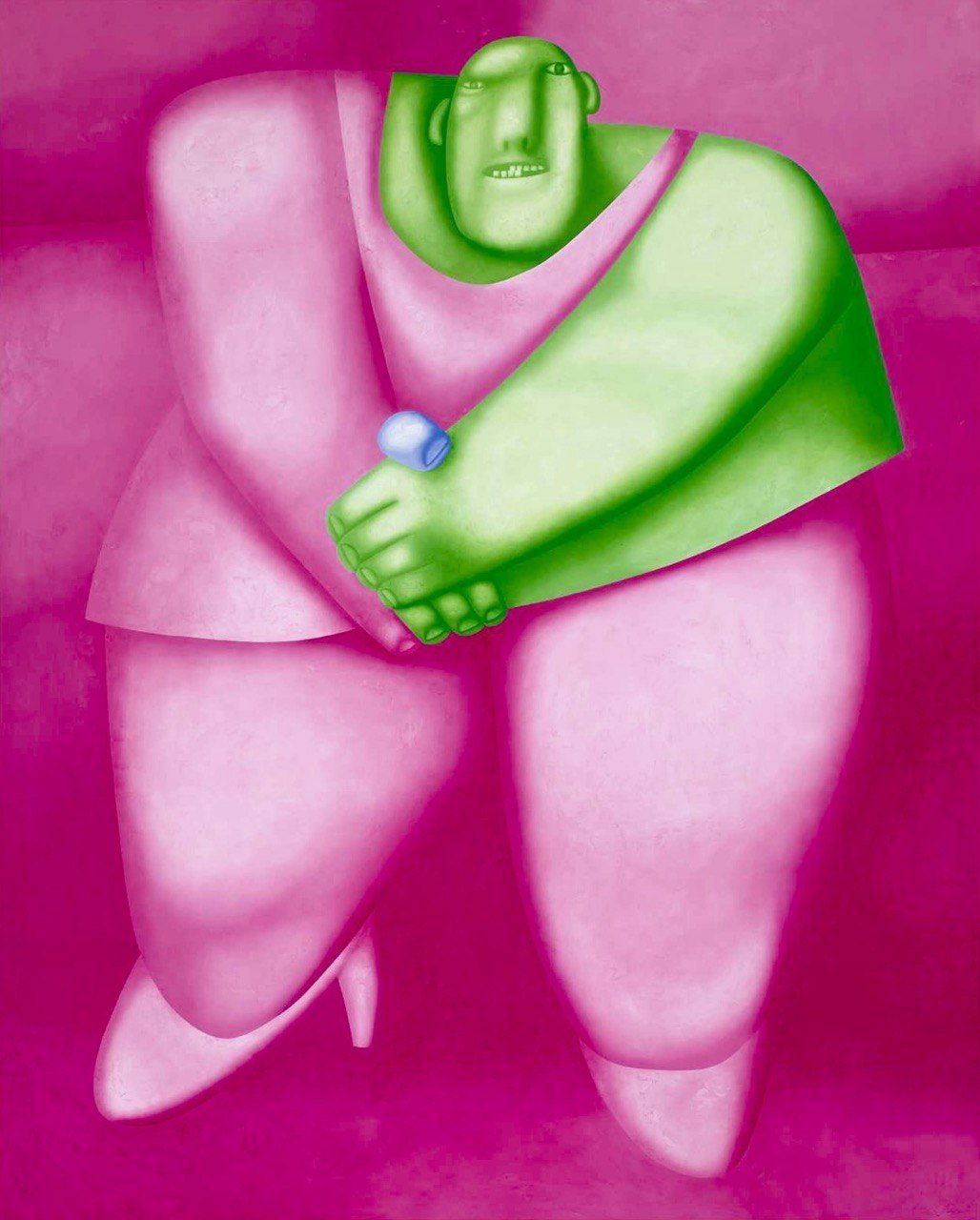
Tselkov returned to a collective, mask-like face from 1960 onward because it gave him a recurring human form through which color, scale and changing situations could produce different encounters.
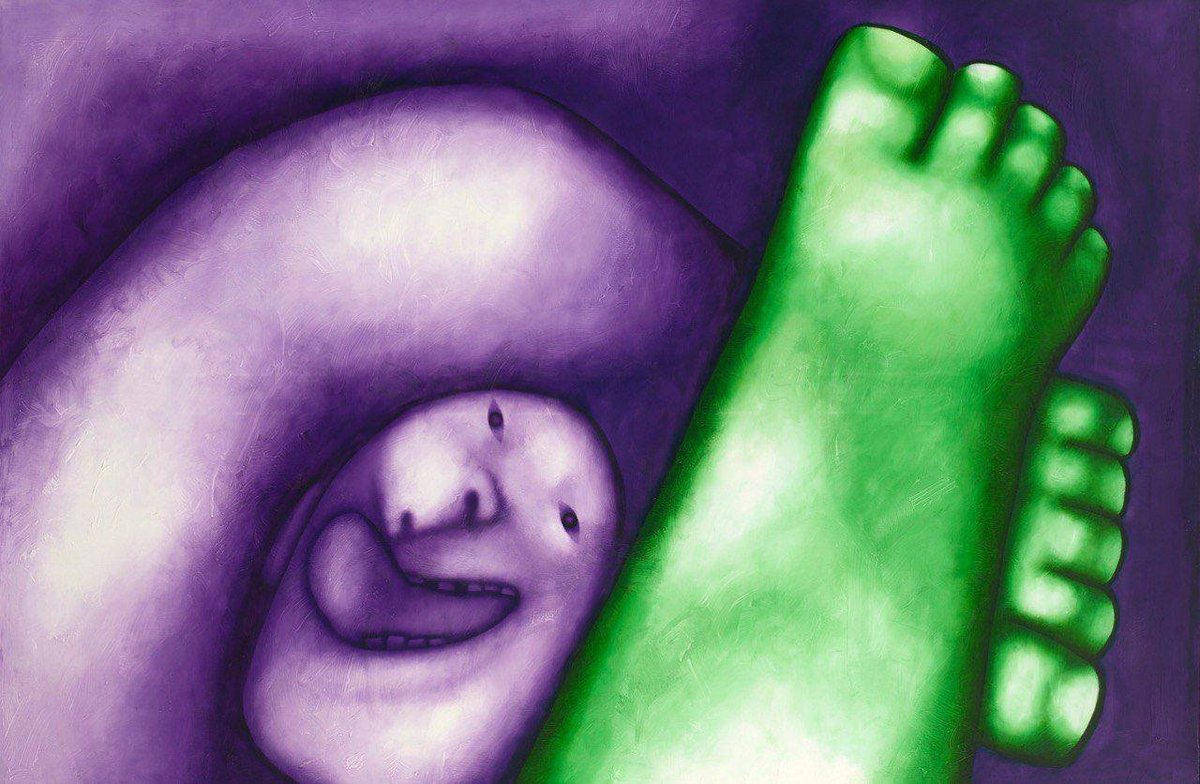
Christie's dates the emergence of that figure to 1960: "a collective figure with a bald head and mask-like face", in the words of its catalog. The heads are not conventional likenesses of particular sitters. They can look swollen, impassive, comic or menacing, sometimes within the same encounter.
I would hesitate before assigning each face a fixed symbolic translation. Calling it a comment on conformity may illuminate something. It can also become a convenient way of deciding we have understood the painting before considering what its color and shape actually do.
The repeated type does not remove differences. A hand, a fork, a nail or a neighboring figure can change the scene. A familiar head can become disturbing precisely because an unfamiliar relationship has appeared beside it.
Try imagining one of these faces looking back at you without a caption. Would it seem hostile, vulnerable or absurd? What in the painting supports your answer? You may discover that a response you first attributed to the expression actually comes from the surrounding color.
What did being an unofficial artist mean in his life?
Being an unofficial artist meant that Tselkov developed and showed his work outside the reliable support of the institutions governing Soviet artistic life.
James Butterwick's biography records his first exhibition in 1956, in Vladimir Slepyan's apartment, and the closure of a later exhibition at the Kurchatov Institute in 1966. Galerie Le Minotaure dates that solo show to January 1966 and says it was shut after two days as ideologically unacceptable. An apartment and an institute could become temporary alternatives to the conventional gallery.
Those settings matter because art history often makes an exhibition sound like a neutral administrative event. In this context, finding a room and keeping it open could be part of the struggle to make the work visible at all.
Tselkov's Moscow studio also attracted visitors, including writers and artists from abroad. Galerie Le Minotaure names Arthur Miller and Joseph Brodsky among them. We can acknowledge those connections without turning every visit into an invented conversation.
He moved to Paris in 1977. A change of country changed the conditions around the work, but it did not require the artist to abandon the language he had developed. Would you expect the masks to become happier after that move? The question itself reveals how readily we make paintings responsible for providing a simple illustration of a biography.
What are five surprising facts about Oleg Tselkov?
Five details connect Tselkov with theater, apartment exhibitions, a major collector, international visitors and an unusually early record painting:
1. He trained for the stage. After his expulsion from the Leningrad academy he completed a diploma in stage design. The studio and the stage were neighbors before his mature paintings became familiar.
2. His first exhibition was in an apartment. In 1956 a private room briefly performed a public cultural function.
3. George Costakis owned his early work. Costakis appears at the beginning of the published provenance of Boy with Balloons: a documented collecting connection, not a famous name added for atmosphere.
4. Arthur Miller came to his studio. Stories about such encounters circulate in several versions; the existence of the connection does not establish every memorable exchange later attached to it.
5. His record painting dates from 1957. The later mask did not erase everything that preceded it, either artistically or in the history of collecting.
Which detail changes your picture of him? I am drawn to the room in an apartment. Imagine seeing the painting there, before the auction result and the retrospective vocabulary. What would have persuaded you to remain and look?
What have Oleg Tselkov's paintings sold for?
Tselkov's highest recorded auction result is £571,600 with fees for Boy with Balloons (1957), sold at Sotheby's London on December 1, 2021, against an estimate of £150,000–200,000.
Sotheby's lists the lot as sold but shows the price only to registered clients; £571,600 is the figure recorded by auction-results databases. Thirteen years earlier, in November 2008, the same canvas had sold at MacDougall's in London for £238,406, which the house still publishes.
Other public sales show the mature vocabulary. At Christie's London in December 2015, Four Persons (1978) sold to the collector Igor Tsukanov for £50,000, the top of its estimate, as Russian Art + Culture reported. At Doyle in New York on April 21, 2026, Head on Chair (1986) sold for $41,600 including buyer's premium, against an estimate of $15,000–25,000.
No separate hammer figure is given where the house does not provide it. Nor is an estimate or an asking price treated as a completed sale. These distinctions matter most when a concise headline threatens to become the whole history.
The record is interesting partly because it redirects attention. If the familiar masks brought you to Tselkov, the boy can introduce a less familiar beginning. A market result occasionally opens a door that a standard illustrated biography has left shut.
Where can you see Oleg Tselkov's paintings?
You can see Tselkov's work in the context of Soviet unofficial art at the Zimmerli Art Museum at Rutgers University in New Jersey, home of the Norton and Nancy Dodge Collection, and through galleries that have represented him in Europe and the United States.
Zimmerli Art Museum, Rutgers University holds the Dodge Collection of Soviet nonconformist art; in June 2026 it launched a new online resource for the collection.
Galerie Le Minotaure, Paris publishes a biography and works.
Aba Gallery documents his career.
Check current displays and appointments before visiting: a work in a collection is not necessarily on the wall that day.
At CoArt Market, our Nonconformists showroom holds two of Tselkov's later paintings: Head with Legs (2014) and Walk (2000). Every object there carries a cryptographic certificate of authenticity that records its path from owner to owner, and we are building a market for fractional ownership of Blue Chip art and collectibles, a core part of the system we are working on now.
If a face refuses to tell you who it belongs to, would you search harder for the person behind it – or begin wondering what it has recognized in you?
Sources
- Sotheby's, Post-War and Contemporary Russian Art from a Private Collection, London, December 1, 2021: Boy with Balloons, provenance and estimate: www.sothebys.com/en/buy/auction/2021/post-war-and-contemporary-russian-art-from-a-private-collection/boy-with-balloons
- MacDougall's, London, November 2008, lot 604: Boy with Balloons, sold for £238,406: macdougallauction.com/en/catalogue/view?id=2860
- Christie's, Oleg Tselkov, Collector and collection: catalog note on the collective figure of 1960: www.christies.com/en/lot/lot-5146361
- Russian Art + Culture, Simon Hewitt, "Russian Auctions in London, 30 November–2 December 2015" (Four Persons at Christie's): izbaarts.com/wp-content/uploads/2015/12/RA-C-Russian-Week-December-2015-report-Simon-Hewitt.pdf
- Doyle, Russian Paintings, New York, April 21, 2026, lot 108: Head on Chair: doyle.com/auction/lot/lot-108---oleg-tselkov/?lot=1467329
- James Butterwick, Oleg Tselkov: biography and exhibitions: www.jamesbutterwick.com/artists/oleg-tselkov/
- Galerie Le Minotaure, Oleg Tselkov: biography: galerieleminotaure.net/artist/tselkov-oleg/
- Aba Gallery, Oleg Tselkov: www.abagallery.com/contemporary-art/oleg-tselkov/
- Zimmerli Art Museum, "Zimmerli Art Museum Launches Global Resource for Soviet Nonconformist Art" (June 3, 2026): zimmerli.rutgers.edu/news/zimmerli-art-museum-launches-global-resource-soviet-nonconformist-art
- CoArt Market, Oleg Tselkov, Head with Legs: coart.market/showcase/nonconformists-head-with-legs-hRFiPwL8
- CoArt Market, Oleg Tselkov, Walk: coart.market/showcase/nonconformists-walk-KUX2BcbJ