

Paul Cézanne: one mountain, many views and a $137.8 million record
One mountain painted again and again, and the view of Mont Sainte-Victoire that sold for $137.8 million
The nineteenth article of our series “Great artists” follows a mountain Cézanne painted repeatedly and one version that passed through collectors' hands before reaching Christie's in New York. In November 2026, another Cézanne made headlines at Sotheby's. They are two different paintings and two different stories.
Who was Paul Cézanne?
Paul Cézanne was a French painter born in Aix-en-Provence in 1839, known for landscapes, still lifes, portraits and figures that influenced generations of modern artists. He died in Aix in 1906.
He studied and worked in Paris but repeatedly returned to Provence. The landscape around Aix gave him subjects he could revisit: roads, trees, buildings and the mountain Sainte-Victoire. His still lifes gave him another kind of territory, contained on a table with fruit, cloth and a few vessels.
Cézanne worked slowly and returned to problems that did not have a single easy solution. How can a painter make a solid object appear on a flat canvas? How can color describe both the surface of an apple and the space around it? What happens if a mountain is seen again under different light?
Those questions may sound more like a workshop discussion than a dramatic biography. The results influenced artists who came after him. A bowl of fruit is capable of more trouble than it first appears.
Recognition grew during his lifetime and especially after his death. Exhibitions and collectors helped bring his work to a wider audience. The quiet mountain and the fruit on the table did not remain private subjects for long.
Why is Cézanne important to modern art?
Cézanne is important to modern art because his approach to color, form and space helped later artists reconsider how a painting could be constructed. His landscapes and still lifes do more than record what was in front of him.
Look at a table in one of his still lifes. Its edges and surfaces may seem to shift as your eye moves. Fruit sits on cloth, but the arrangement does not always behave like a photograph taken from one fixed position. Cézanne worked slowly, and he sometimes painted the objects as if seen from more than one viewpoint.
That does not mean he had forgotten how tables work. He was looking closely at the objects and building the painting through relationships of color and form. A viewer may notice the uncertainty in the space before being able to explain it.
His influence reached artists including Picasso and Matisse, but influence is not the same thing as a direct instruction manual. They looked at his paintings and found possibilities for their own work. The results went in different directions.
I find it useful to begin with the actual apple, mountain or chair rather than the large title “father of modern art.” The titles can wait outside the gallery. The painting is already doing the work.
Why did Cézanne paint Mont Sainte-Victoire repeatedly?
Cézanne returned repeatedly to Mont Sainte-Victoire because the mountain near Aix-en-Provence gave him a familiar subject through which to explore light, color and structure. He painted it from different viewpoints and at different stages of his career.
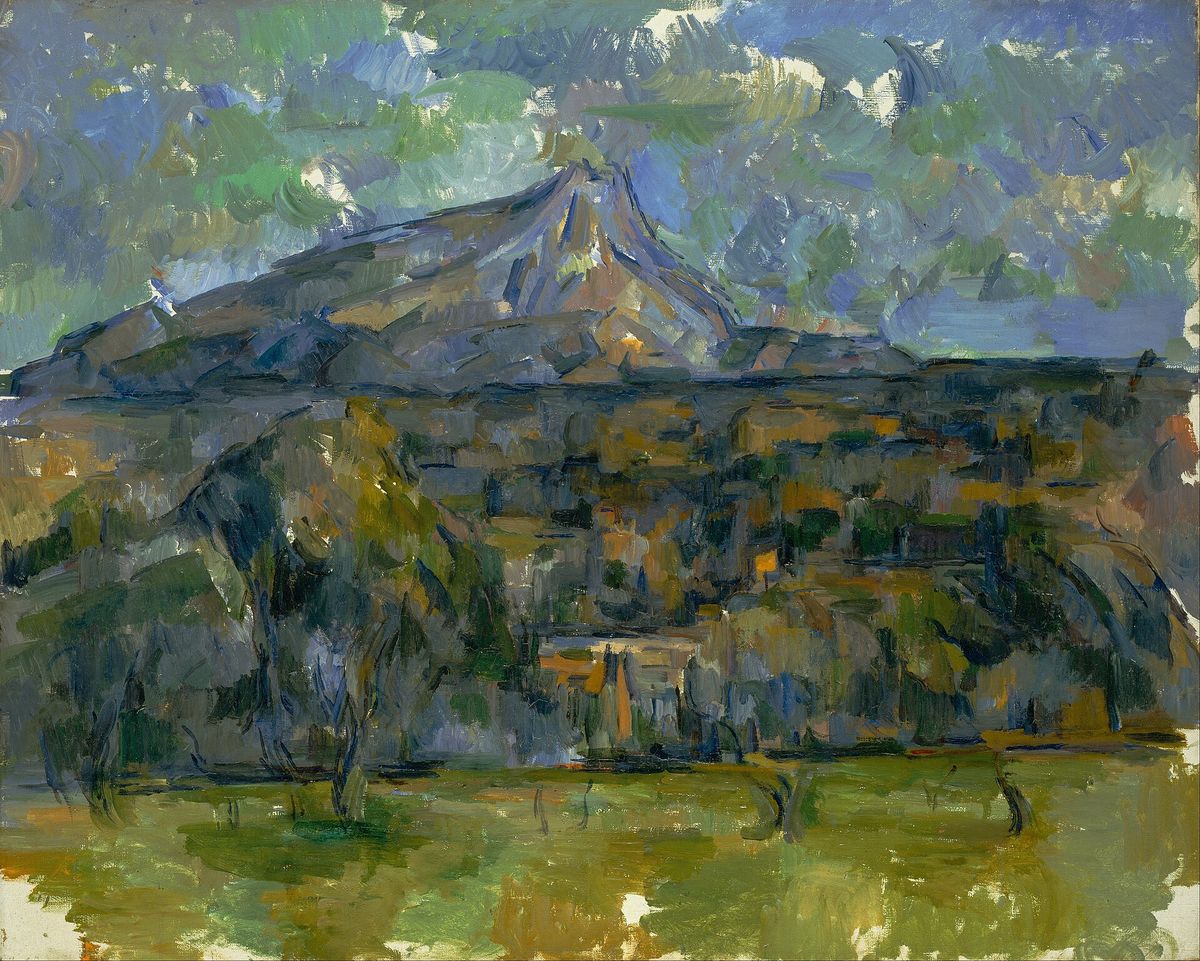
A mountain stays in approximately the same place. The light does not. Neither do the artist's position, the weather, the surrounding buildings or the questions he brings to the canvas. A familiar subject can therefore provide a series of different paintings rather than one definitive answer.
In the version later sold from the Paul G. Allen collection, Christie's dates the canvas to 1888–1890. It shows the mountain beyond the landscape of Provence. Areas of color and the arrangement of foreground and distance give the scene its structure.
Cézanne did not have to invent a spectacular event on the mountain to make it worth painting. He had to keep looking. I suspect that was harder than it sounds, especially after he had already painted the view more than once.
This is also why a title alone is not enough when reading about an auction. Several Cézanne works depict Sainte-Victoire. A particular sale belongs to a particular canvas, date and provenance.
Where did the record Sainte-Victoire painting travel?
The record-setting La Montagne Sainte-Victoire passed through the Paris dealer Ambroise Vollard and several collectors before entering Paul G. Allen's collection in 2001, according to Christie's provenance. It returned to auction in 2022.
Christie's lists Auguste Pellerin and his descendant Jean-Victor Pellerin, followed by Georges A. Embiricos and Heinz Berggruen. The painting was offered at Phillips, de Pury & Luxembourg in New York on 7 May 2001, when it was acquired by the collector whose estate later offered it in the Allen sale.
That sequence gives the mountain a second geography. The subject is in Provence, but the canvas moved through dealers, collections and a New York auction room. Each owner saw the same painted mountain in a different setting.
The documentation also shows why two paintings of the same subject need separate records. A visitor can recognize Sainte-Victoire immediately and still need to ask which version is being discussed. Provenance answers questions a title cannot.
Paul Allen was a collector as well as a Microsoft co-founder. His collection brought together works from different centuries. When it was offered at Christie's after his death, Cézanne's mountain appeared alongside paintings by artists including Seurat, Van Gogh, Gauguin and Klimt.
What is Cézanne's auction record?
Cézanne's auction record is $137,790,000 including fees for La Montagne Sainte-Victoire, sold at Christie's New York on 9 November 2022 from the Paul G. Allen collection. Christie's identified it as an artist record.
In the same sale, five paintings exceeded $100 million, which Christie's said had never happened in a single sale. That context explains why the evening attracted so much attention, but it should not turn the individual works into interchangeable numbers. Cézanne's mountain has its own date, subject and ownership history.
A more recent result came on 18 November 2026, when Arlequin sold at Sotheby's New York for $99 million at the hammer, $111 million including fees, below its estimate of about $120 million, The Art Newspaper reported. It was a different painting and did not replace the 2022 Cézanne record.
On 17 November 2026, Tasse, verre et fruits, a still life from around 1877, sold at Christie's New York for $13,905,000 including fees. Two New York auction houses, two consecutive evenings and two very different works by the same artist.
These figures are public sale results, not predictions. A still life, a portrait and a landscape each need their own comparison. Date, condition, provenance, exhibition history and the painting's place in Cézanne's career all matter.
What are five surprising facts about Cézanne?
Five details help connect the mountain painter with the broader history of modern art:
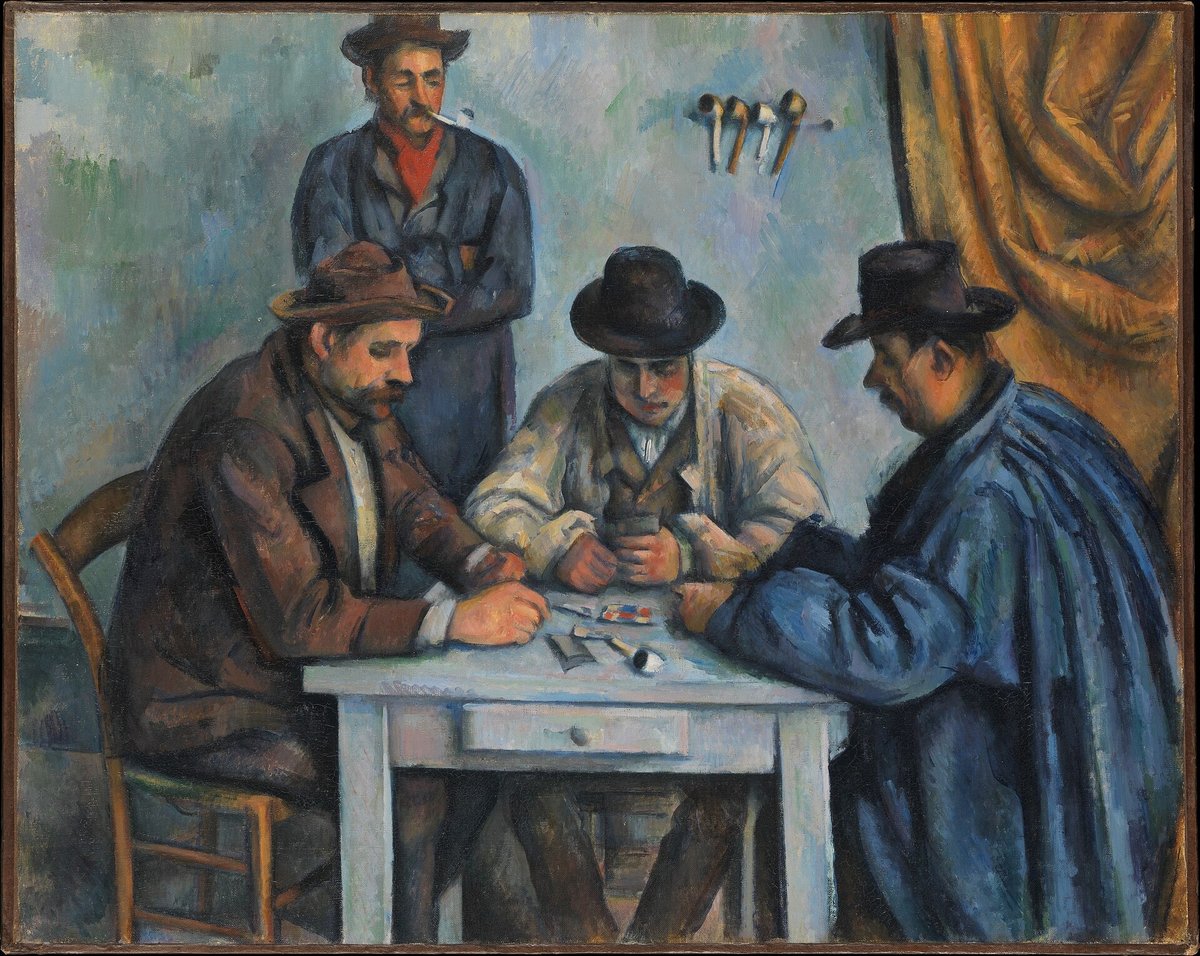
1. He returned to the same mountain many times. Sainte-Victoire offered different views and conditions rather than a single finished subject.
2. His tables can seem unstable. Looking from different viewpoints helped produce still lifes in which familiar objects occupy subtly shifting spaces.
3. He painted several versions of card players. The Metropolitan Museum of Art describes five versions of the subject from the early 1890s.
4. A dealer appears early in the record painting's history. Christie's provenance begins with Ambroise Vollard in Paris.
5. Two major Cézanne works sold on consecutive days in November 2026. Tasse, verre et fruits sold at Christie's and Arlequin at Sotheby's.
The fourth detail matters because artists do not build a public reputation alone. Dealers, collectors, museums and writers all help decide which works are shown, preserved and discussed. Their records can later help reconstruct a painting's journey.
Where can you see Cézanne's work?
You can see significant Cézanne paintings in Paris, Philadelphia, New York, Washington and London. Displays change and works travel, so check the official museum page before planning a visit.
Musée d'Orsay, Paris holds paintings from different periods of his career.
The Barnes Foundation, Philadelphia holds a substantial Cézanne collection.
The Metropolitan Museum of Art, New York holds a version of The Card Players and still lifes.
National Gallery of Art, Washington holds Still Life with Apples and Peaches.
The Courtauld Gallery, London holds Cézanne paintings including landscapes and still lifes.
If you visit more than one, look at how a similar subject changes from one work to another. The differences are often more interesting than the label they share.
Why does a painting's history matter?
A painting's history matters because ownership, exhibition records and documented sales tell us how a particular canvas moved from the artist's studio to the present. The Allen collection's Sainte-Victoire is not simply “a Cézanne mountain”; it is a specific painting with a traceable route.
At CoArt Market, I want objects that have spent years in private hands to become visible again. Each object receives a cryptographic certificate of authenticity that records its path from owner to owner on the platform, and we are building a market for fractional ownership of Blue Chip art and collectibles, a core part of the system we are working on now.
Cézanne returned to a mountain and to fruit on a table, looking again each time. Which would you choose to look at for an hour: Sainte-Victoire or one of his apples?
Sources
- Christie's, record painting and provenance: www.christies.com/lot/lot-6397105
- Christie's, 2022 Allen collection result: www.christies.com/stories/paul-g-allen-collection-sale-results-c2e2ad48c4154b428a78b0995826ee5f
- Christie's, artist and auction overview: www.christies.com/en/stories/paul-cezanne-collecting-guide-fcb1394bab6044b28405b28fa6510ce1
- Christie's, 17 November 2026 still-life sale: www.christies.com/en/stories/artist-museum-moments-november-2026-ba00dc3a1af34a5b9410e3921a64f031
- The Art Newspaper, 18 November 2026 Arlequin sale: www.theartnewspaper.com/2026/11/19/van-gogh-painting-sells-for-record-7778m-after-nazi-loot-claims
- National Gallery of Art, Still Life with Apples and Peaches: www.nga.gov/artworks/45986-still-life-apples-and-peaches
- The Metropolitan Museum of Art, The Card Players: www.metmuseum.org/exhibitions/listings/2007/clark-brothers/photo-gallery