

Pierre-Auguste Renoir: two dance gardens and a $78.1 million record
Two versions of a Paris dance garden, painted in sunlight and shade, and a $78.1 million sale
The twentieth article of our series “Great artists” takes us to a dance garden in Montmartre, then to a New York auction in 1990. Before we begin, a useful detail: the painting sold at auction is a different version from the one you can see at the Musée d'Orsay.
Who was Pierre-Auguste Renoir?
Pierre-Auguste Renoir was a French painter and a leading figure of Impressionism, known for portraits, landscapes and scenes of people enjoying contemporary life. He was born in Limoges in 1841 and died in Cagnes-sur-Mer in 1919.
As a young man he painted porcelain before studying art in Paris. He became associated with Claude Monet and other artists who wanted to show their work outside the official Salon. They painted modern life and landscapes with a fresh interest in light and color.
Renoir's career did not stop with the first Impressionist exhibitions. He traveled, changed his approach to drawing and form, painted portraits and nudes, and kept working as his health became more difficult. An artist can belong to a movement without spending a lifetime producing the same painting for its brochure.
His pictures often show people together: a conversation at a table, a gathering by the river or a crowded dance garden. They look sociable. The paintings themselves required serious decisions about how many figures to include, where to place them and how light would move across a busy scene.
Why is Renoir famous?
Renoir is famous for Impressionist paintings that combine lively brushwork, changing light and close attention to people, particularly in scenes of leisure and portraits. His pictures helped make modern Parisian life a subject worthy of ambitious painting.
At the Musée d'Orsay, Bal du moulin de la Galette shows people gathered in a Montmartre dance garden. Friends of the artist appear among the figures, but the painting is more than a group portrait. The crowd, the tables and the patches of sunlight create the feeling of a place full of movement.
The painting was shown at the third Impressionist exhibition, in 1877. Its loose brushwork and scattered light were exactly what the Impressionists were arguing for, and exactly what made some viewers of the time think a painting was not finished. That is one way to describe a new visual language. It is not necessarily the best way to recognize one.
In Washington, Luncheon of the Boating Party brings another group together around a table. The setting is sociable, but the composition has to keep many figures, objects and directions of attention in balance. Making a gathering look natural can require considerable planning.
I like pictures in which I can spend time with the people at one table and then discover another conversation taking place nearby. Renoir gives us more than one reason to stay.
What is the difference between the two Moulin de la Galette paintings?
Renoir made two versions of the Moulin de la Galette subject: the larger painting is at the Musée d'Orsay in Paris, while a smaller version sold at Sotheby's New York in 1990. Both depict the Montmartre dance garden, but they are separate canvases.
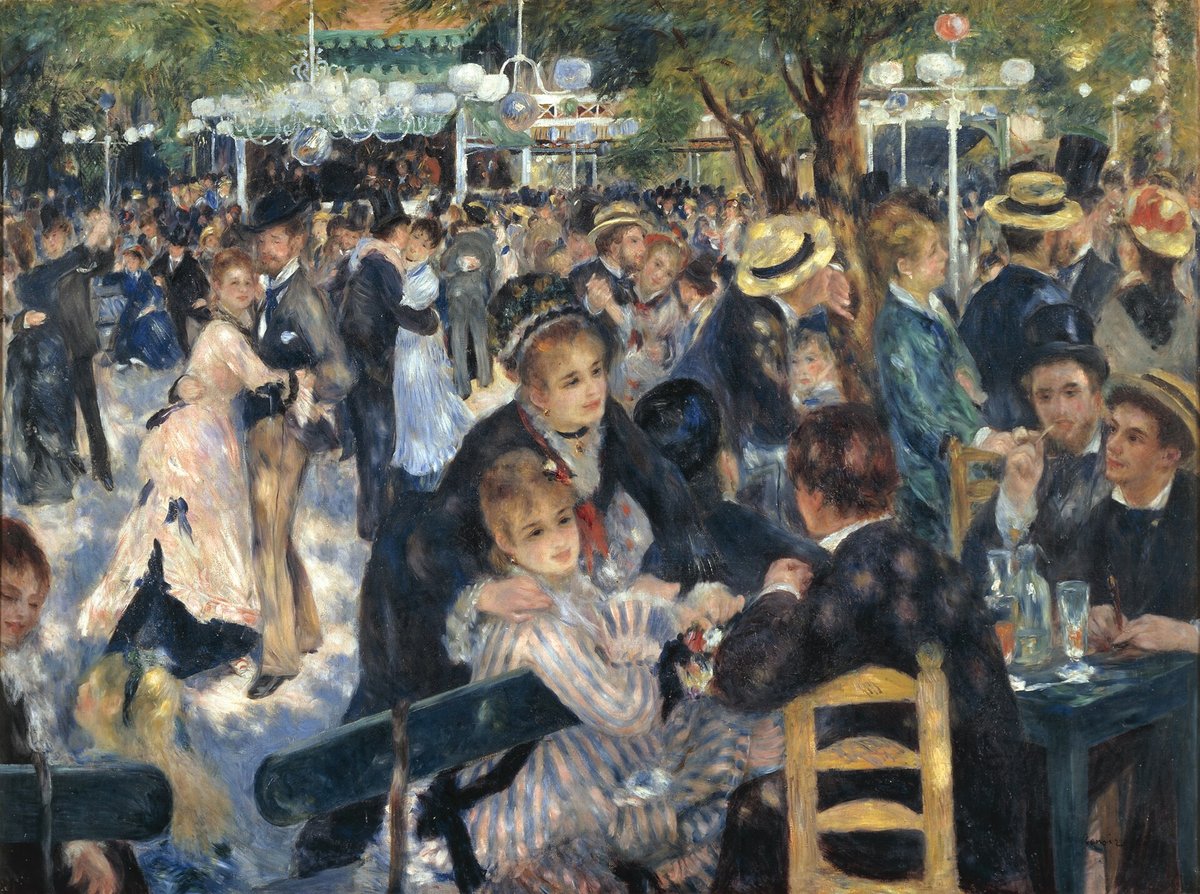
The Orsay painting, dated 1876, measures approximately 131.5 by 176.5 centimeters. The museum records its presence at the Impressionist exhibition of 1877 and its later passage through the collection of the painter and collector Gustave Caillebotte.
The auction version shares the subject and many of the figures. It is tempting to write that “the Moulin de la Galette sold” and leave the reader to assume that the museum painting changed hands. It did not. The title is not enough to identify which canvas we mean.
A picture's size and documented ownership can be as important to identification as the scene itself. When several versions exist, I want the museum, the auction house and the dates attached to the correct one.
The dance garden was a real place. People came to meet, talk and dance beneath the trees. Renoir turned that ordinary leisure into a composition with figures near and far, light scattered across clothing and an atmosphere that feels as if it might continue beyond the edges of the canvas.
How did the Orsay painting enter a museum?
The larger Bal du moulin de la Galette entered the French national collection through Gustave Caillebotte's bequest, accepted by the state in 1896. It later moved through several museum settings before becoming part of the Musée d'Orsay collection in 1986.
Caillebotte was both an artist and a collector who supported fellow painters. His collection included works that are now familiar to visitors of French museums. A collector's decision to live with a painting, preserve it and leave it for public access can shape what later generations are able to see.
The Orsay records the painting in Caillebotte's collection from the late 1870s until his death, then in the Musée du Luxembourg, the Louvre and the Jeu de Paume before Orsay. That is a documented route, with names and institutions rather than a vague sentence saying the work “eventually reached a museum.”
The 1990 auction canvas followed another route. Similar subjects can lead separate lives for more than a century. Mixing those lives together does not make the story simpler; it makes it wrong.
What is Renoir's auction record?
Renoir's auction record is $78.1 million including the buyer's fee ($71 million at the hammer) for the smaller Au Moulin de la Galette, sold at Sotheby's New York on 17 May 1990. Contemporary reporting identified the buyer as Japanese collector Ryoei Saito.
The sale came two days after Van Gogh's Portrait of Dr. Gachet sold at Christie's in New York. Both results became landmarks of the 1990 auction season. A crowded dance garden painted in 1876 was suddenly part of a conversation about the international art market more than a century later.
At Christie's Paris on 22 October 2026, Jeunes Filles au bord de la mer sold for €5,839,000 including fees. Christie's reported the result as close to Renoir's auction record in France. That is a geographic category; the artist's overall auction record remains the 1990 New York result.
Two public sales, two countries and two different paintings. Each number answers a specific question. None tells us what an unrelated Renoir will sell for tomorrow.
What are five surprising facts about Renoir?
Five details show the range of a career often summarized through a single sunny scene:
1. He painted porcelain as a young man. Working with decorative objects came before his mature painting career.
2. There are two Moulin de la Galette versions. The Orsay canvas and the work sold in 1990 are separate paintings.
3. A fellow artist helped bring one version into a museum. Gustave Caillebotte owned the larger painting and included it in his bequest.
4. The dance scene was shown with the Impressionists. The larger canvas hung at their third exhibition, in 1877.
5. The 1990 sale followed another famous auction by two days. The same buyer had acquired Van Gogh's Portrait of Dr. Gachet at Christie's earlier that week.
The third fact is the one I would keep when telling the story to a new collector. Artists, collectors and institutions can all play a role in ensuring that a painting is still available to be seen long after its first exhibition.
Where can you see Renoir's paintings?
You can see important Renoir paintings in Paris, Washington, New York and other cities. Museum displays and loans change, so check the official website before traveling for a specific work.
Musée d'Orsay, Paris holds the larger Bal du moulin de la Galette.
The Phillips Collection, Washington holds Luncheon of the Boating Party.
National Gallery of Art, Washington holds A Girl with a Watering Can.
The Metropolitan Museum of Art, New York holds paintings by Renoir from different periods.
The National Gallery, London holds works by the artist.
The Orsay and Washington paintings are good companions for a conversation: one crowded garden and one gathering around a table. Both reward looking at the relationships between the people as well as the paint.
Why does a painting's history matter?
A painting's history matters because ownership, exhibitions, transfers and sale records identify the particular object we are discussing. The two Moulin de la Galette canvases show why a shared title must not be allowed to blur two separate histories.
At CoArt Market, I want objects that have spent years in private hands to become visible again. Each object receives a cryptographic certificate of authenticity that records its path from owner to owner on the platform, and we are building a market for fractional ownership of Blue Chip art and collectibles, a core part of the system we are working on now.
Renoir painted a garden full of people talking, dancing and looking at one another. If you could join the scene for an afternoon, which table would you choose?
Sources
- Musée d'Orsay, larger Bal du moulin de la Galette and provenance: www.musee-orsay.fr/en/artworks/bal-du-moulin-de-la-galette-497
- Sotheby's, 1990 sale: www.sothebys.com/en/articles/the-most-iconic-impressionist-artworks-sold-at-sothebys
- UPI, 1990 buyer and fee-inclusive total: www.upi.com/Archives/1990/05/18/Japanese-business-man-buys-Renoir-painting-for-781-million/4804643003200/
- Christie's, October 2026 Paris sale: press.christies.com/en-postsales-durand-ruel-generations-of-vision/?lang=eng
- The Phillips Collection, Luncheon of the Boating Party: www.phillipscollection.org/collection/luncheon-boating-party
- National Gallery of Art, A Girl with a Watering Can: www.nga.gov/artworks/46681-girl-watering-can