

Rembrandt: a painting cut to fit, a lion on paper, and the price of a name
A painting cut down to fit a wall, a lion drawn on paper and what Rembrandt's name is worth
The tenth article of our series “Great artists” begins with a painting so large that someone cut pieces off it to fit a new room. It continues with a drawing of a resting lion that sold for $17.86 million nearly four centuries later.
Who was Rembrandt van Rijn?
Rembrandt van Rijn was a Dutch painter, draftsman and printmaker, born in Leiden in 1606, whose portraits, biblical scenes and studies of human character made him one of the central artists of the Dutch Golden Age. He died in Amsterdam in 1669.
By the early 1630s he had moved to Amsterdam, a city of merchants, ships and people wealthy enough to commission their own portraits. Rembrandt painted them, taught pupils and built a workshop. He also collected art and objects, made prints and returned repeatedly to his own face in self-portraits.
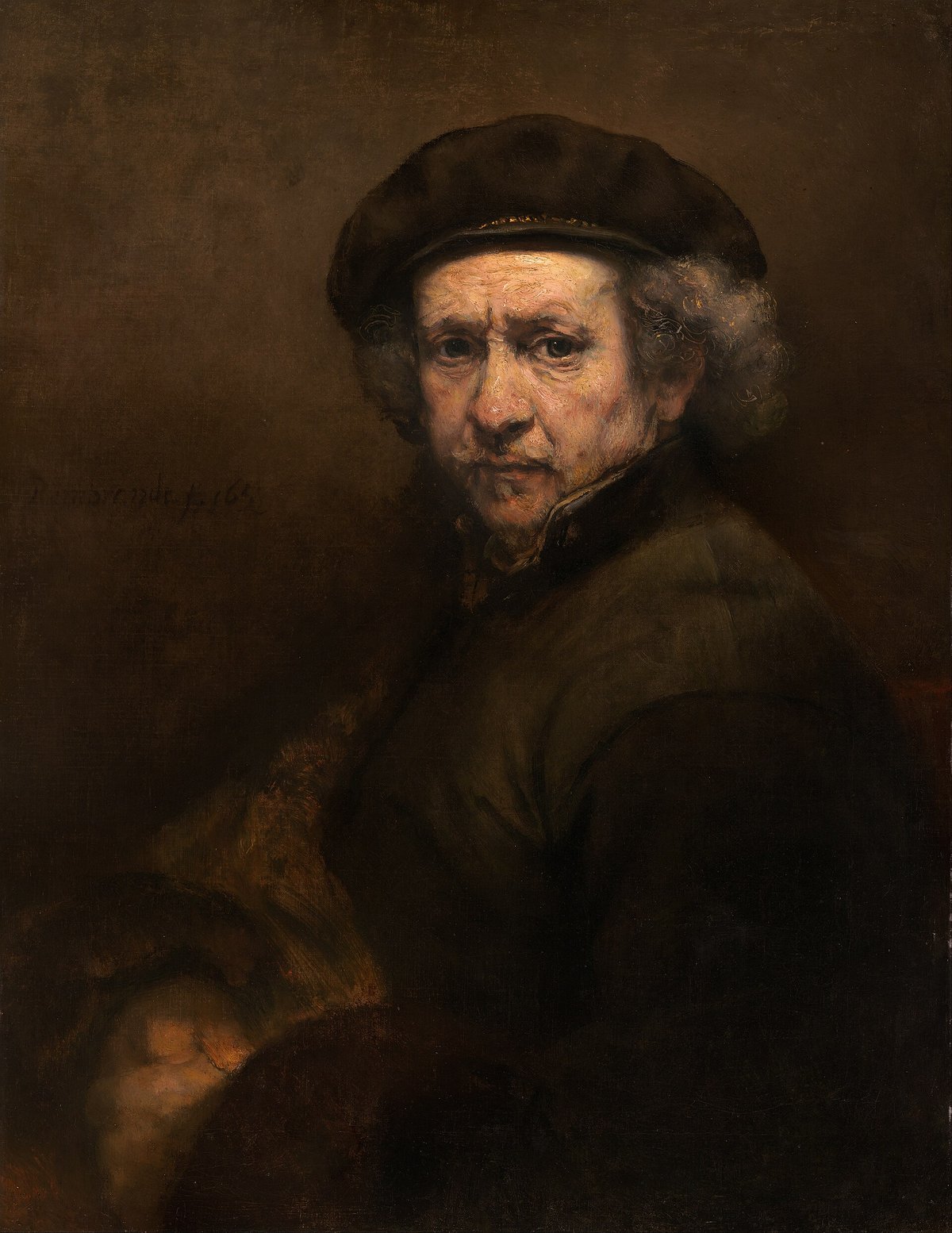
Success did not keep financial trouble away. In the 1650s his finances collapsed and his possessions were inventoried and sold. At the National Gallery of Art in Washington, a self-portrait from 1659 shows an artist who had already experienced both public success and financial failure.
I am always interested in that distance between the life of an artist and the later life of the work. The man who painted the self-portrait could not know how carefully people centuries later would study his brushstrokes, his finances and even the objects in his house.
Why is Rembrandt famous?
Rembrandt is famous for using light, shadow and expressive brushwork to give portraits and stories an unusually powerful sense of human presence. He worked in painting, drawing and printmaking, and each medium reveals a somewhat different side of him.
In some portraits, light falls on a face while clothing and background seem to emerge slowly from darkness. In a drawing, a few lines can do work that a museum label needs a paragraph to explain. Neither effect happened by accident. A face that feels spontaneous can be the result of very deliberate decisions.
His best-known painting, The Night Watch (1642), is a group portrait of an Amsterdam civic guard company. Its familiar title is misleading: the painting had no title at first, the Rijksmuseum notes, and the name Night Watch first appears in a document in 1797, long after darkened varnish had made a scene of a company setting out look like a night patrol.
The company paid for a group portrait. Rembrandt gave it movement, gesture, light and a composition that does not look much like a neat row of people waiting for a photograph. The difference is one reason we are still talking about it.
What happened to The Night Watch?
The Night Watch was cut down in 1715 to fit a new location, later damaged by attacks, and is now the subject of an extensive research and conservation project at the Rijksmuseum. Its history is not as still as its long stay on a museum wall might suggest.
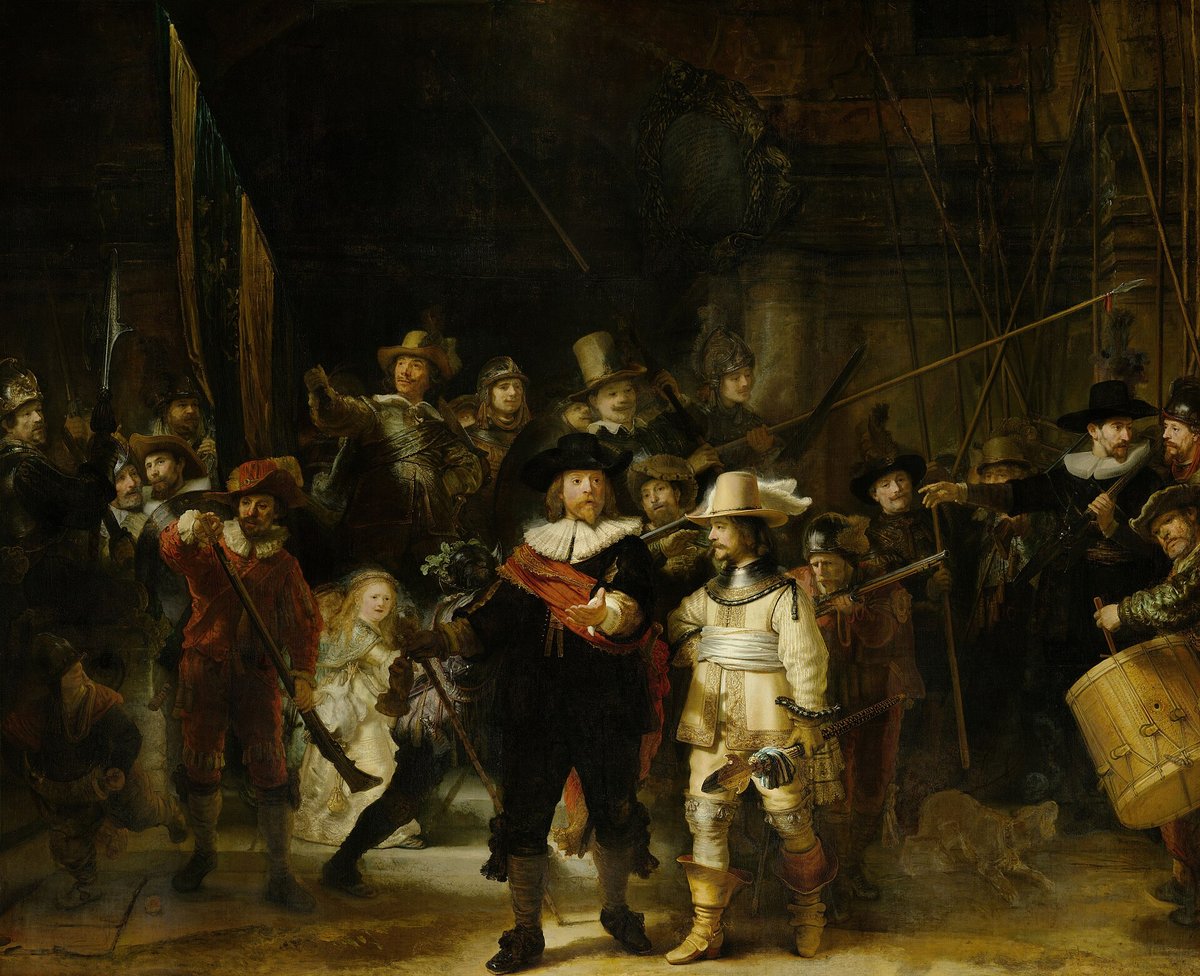
When the painting was moved to Amsterdam's Town Hall on the Dam, four pieces were cut from its edges so that it would fit between two doors. The largest came from the left side and has never been found. This altered the composition Rembrandt had designed. Today, an early copy attributed to Gerrit Lundens helps researchers understand what was lost.
In 1975 a visitor attacked the canvas with a knife, leaving twelve cuts. The painting was restored, and the Rijksmuseum continues to document its treatment. It has also survived an earlier knife attack, in 1911, and acid in 1990.
In 2021, the museum presented reconstructions of the missing edges using the early copy and modern imaging. They were mounted around the original canvas; they were not the long-lost seventeenth-century pieces suddenly rediscovered in a cupboard.
The distinction matters. A reconstruction can help us understand a composition without becoming the original material. I would rather know exactly what has been recreated than be offered a tidier story.
Imagine commissioning a painting, keeping it for decades and then finding that the next room requires a little alteration. Most of us would measure the door first. Someone in 1715 appears to have considered another solution.
What is Rembrandt's most expensive painting at auction?
Rembrandt's auction record for a painting is £20,201,250 including fees for Portrait of a Man with Arms Akimbo, sold at Christie's London on 8 December 2009. The 1658 painting brought about $33 million at the exchange rate of the day.
The man stands confidently with his arms set wide. His identity has been discussed by specialists, but the painting's particular appeal does not depend on pretending that every question has been settled. The pose, costume, light and handling of paint are all there to examine.
Two much smaller portraits, of Jan Willemsz van der Pluym and his wife Jaapgen Carels, appeared at Christie's London on 6 July 2023. Sold together for about £11.2 million including fees, they had been rediscovered in a British private collection. They are now on long-term loan to the Rijksmuseum, which has published its research into the sitters: their son married Rembrandt's cousin.
A different kind of result came on 4 February 2026, when Young Lion Resting sold at Sotheby's New York for $15 million at the hammer and $17,860,000 including fees. It set the auction record for a Rembrandt drawing, more than four times the previous one. It did not replace the higher auction record for a painting. All proceeds went to Panthera, the wild cat conservation charity of its seller, the Leiden Collection.
A lion on paper and a man on canvas are not interchangeable comparisons. Medium, size, condition, attribution, ownership history and the circumstances of each sale all matter. Even the currency matters: a pound result from 2009 should not quietly become a dollar price at today's exchange rate.
Why are some Rembrandt attributions disputed?
Some Rembrandt attributions are disputed because he worked with pupils and assistants, and scholars must distinguish his own hand from works produced in or around his workshop. A famous signature, on its own, is not the entire answer.
Researchers examine the surface, materials, working method, historical documents and comparisons with other works. They can reach different conclusions, especially when a painting has been altered, damaged or restored over centuries. An attribution is a reasoned judgment supported by evidence; it may change when new evidence appears.
This is not an unusual problem for a seventeenth-century studio. A successful artist had pupils and commissions, and the surviving records do not explain every brushstroke. The question can be whether a painting was made entirely by Rembrandt, partly with his participation or by someone close to him. Those are different claims and deserve different words.
For collectors, the practical consequence is that a picture's history should be read together with the picture itself. Who owned it? What was it called in earlier catalogues? Has it been exhibited? What did examination reveal? Good questions do not make a painting less interesting. Usually they make it more so.
What are five surprising facts about Rembrandt?
Five details show how much can happen to an artist's work after it leaves the studio:
1. A daylight scene acquired a night-time name. The Night Watch does not depict a night patrol; the title first appears in a document in 1797.
2. The museum's most famous painting was trimmed. Four pieces were cut from it in 1715 when it was moved to the Town Hall on the Dam.
3. An old copy helped show the missing composition. Researchers used it to reconstruct the lost edges for a modern presentation.
4. A lion created a different record. Young Lion Resting became Rembrandt's highest-priced drawing at auction in 2026, and the money went to protect big cats.
5. Two family portraits returned to public view. The Rijksmuseum studied the small 1635 portraits sold in 2023 and identified the sitters' connection to the artist's family circle.
The lion interests me because it asks for no elaborate story to begin with. There is an animal at rest. Rembrandt looked, drew and left us enough to keep looking too.
Where can you see Rembrandt's work?
You can see major Rembrandt paintings and works on paper in Amsterdam, London, Paris, Washington and many other cities. Check current displays before traveling, especially for drawings and prints, which may be shown only periodically.
Rijksmuseum, Amsterdam holds The Night Watch and documents its conservation through Operation Night Watch.
The National Gallery, London holds paintings from different stages of the artist's career.
The Louvre, Paris includes Rembrandt paintings in its collections.
The National Gallery of Art, Washington holds the 1659 Self-Portrait.
The Rembrandt House Museum, Amsterdam preserves the house where the artist lived and worked for part of his career.
A painting in a museum and a drawing temporarily brought out for an exhibition offer different encounters. One invites a step back; the other can require you to come very close.
Why does an object's history matter?
An object's history matters because its ownership, condition, exhibitions and attribution help us understand what we are looking at. Rembrandt's workshop, the history of The Night Watch and the rediscovered family portraits each show a different part of that work.
At CoArt Market, I want objects that have spent years in private hands to become visible again. Each object receives a cryptographic certificate of authenticity that records its path from owner to owner on the platform. We want people beginning to collect, professionals and established collectors to be able to participate in the market.
A vast group portrait survived having its edges removed. A small drawing of a lion survived long enough to help fund big-cat conservation. Which would you choose to spend an hour with?
Sources
- Rijksmuseum, 10 things about The Night Watch (title, 1715 trimming, attacks): www.rijksmuseum.nl/en/stories/10-things/story/10-things-about-rembrandt-s-night-watch
- Rijksmuseum, how The Night Watch survived a knife attack: www.rijksmuseum.nl/en/stories/operation-night-watch/story/how-the-night-watch-survived-a-knife-attack
- Rijksmuseum, the 2021 reconstruction of the missing edges: www.rijksmuseum.nl/en/press/press-releases/for-the-first-time-in-300-years-the-night-watch-is-complete-again
- Christie's, Portrait of a Man with Arms Akimbo, 8 December 2009: www.christies.com/en/lot/lot-5277765
- Guinness World Records, most expensive painting by Rembrandt sold at auction: www.guinnessworldrecords.com/world-records/381781-most-expensive-painting-by-rembrandt-sold-at-auction
- Artnet News, the rediscovered portraits at Christie's London, July 2023: news.artnet.com/market/rediscovered-rembrandt-portraits-14m-christies-london-2335233
- Rijksmuseum, the rediscovered portraits on long-term loan and the research into the sitters: www.rijksmuseum.nl/en/press/press-releases/rediscovered-rembrandt-portraits-go-to-rijksmuseum
- Sotheby's, Young Lion Resting, Master Works on Paper from Five Centuries, 2026: www.sothebys.com/en/buy/auction/2026/master-works-on-paper-from-five-centuries/young-lion-resting
- The Art Newspaper, New York Old Masters sales, 6 February 2026 (hammer and total for Young Lion Resting): www.theartnewspaper.com/2026/02/06/artemisia-gentileschi-michelangelo-rembrandt-new-york-old-masters-auctions
- The Leiden Collection, Sotheby's sets record for Rembrandt drawing with $18M Young Lion Resting: www.theleidencollection.com/news-media/sothebys-sets-record-for-rembrandt-drawing-with-18m-young-lion-resting/
- National Gallery of Art, Self-Portrait, 1659: www.nga.gov/artworks/79-self-portrait