

René Magritte: this is not a biography
A pipe that is not a pipe, banknotes forged and banknotes with his face, and a $121.2 million record
The second article of our series "Great artists": the Belgian who painted a pipe and wrote that it was not one, forged banknotes after the war, ended up on one, and set an auction record of $121 million.
Who was René Magritte?
This week is Magritte week on our pages. On 21 November 1898 René Magritte was born in Lessines, a small town in Belgium. A good moment to look at the man behind the bowler hats, the clouds and the apples. I should confess at once: I have not been to the Magritte Museum in Brussels yet. It is on my list. So this time there are no photographs of mine, only his life, which is strange enough on its own.
René Magritte was a Belgian surrealist painter, born on 21 November 1898 in Lessines and died on 15 August 1967 in Brussels. He painted familiar objects in places where they do not belong: men in bowler hats hanging in the sky like rain over a town, a night street under a daytime sky, an apple in front of a face.
His best-known joke is a pipe. In The Treachery of Images (1928–29) he painted a pipe as neat as a tobacconist’s advertisement and wrote under it: "Ceci n’est pas une pipe", this is not a pipe. A contradiction? No. It is a picture of a pipe. Asked about it, Magritte said, more or less: of course it is not a pipe, just try to fill it with tobacco.
I like this painting for a professional reason. A marketplace like ours lives with the same question every day. A photograph of an object is not the object. That is why every serious buyer looks past the picture: at the documents, at the history of ownership, and, when they can, at the thing itself.
Five things about Magritte that surprise people
He started in wallpaper and advertising. In 1922–23 he worked as a draftsman in a wallpaper factory, then designed posters and advertisements. Only in 1926 did a contract with the Brussels gallery Le Centaure let him paint full time. That same year he painted his first surrealist picture, The Lost Jockey. When the money ran out again, he went back to advertising and opened an agency with his brother Paul. Every great surrealist needs a day job.
One reproduction made him cry. In 1922 the poet Marcel Lecomte showed him a reproduction of Giorgio de Chirico’s The Song of Love. Magritte called it "one of the most moving moments of my life: my eyes saw thought for the first time". Not the painting itself, note. A printed copy. (Which, by his own logic, was not a painting at all.)
He married the girl he met as a boy. He first met Georgette Berger in 1913, when she was 13 and he was 15. They met again in Brussels in 1920 and married in 1922. She became his model and his muse, and she is in many of his paintings.
The market did not want him for years. His first solo show, in Brussels in 1927, got poor reviews. He moved to Paris, joined the surrealists around André Breton, made little impact and came back in 1930. Between 1930 and 1932 he had no exhibitions and sold no work at all. Hold on to that figure, we will come back to it.
He forged banknotes, and then he became one. After the war, in lean years, he painted fake Picassos, Braques and de Chiricos, and later printed forged banknotes, together with his brother Paul and the surrealist Marcel Mariën, who had the job of selling them. In the 1990s the National Bank of Belgium put Magritte on the 500-franc note for his 100th birthday. I cannot think of a better surrealist ending. The forger made it onto the money legally.
And a bonus, for music lovers: the green apple of Apple Corps, the Beatles’ company, was inspired by his 1966 painting Le Jeu de Mourre.
Where can you see Magritte in Brussels?
In two places. The Magritte Museum opened in 2009 on the Place Royale, in an 18th-century townhouse belonging to the Royal Museums of Fine Arts of Belgium. It is the biggest Magritte archive anywhere, with some 200 of his paintings, drawings and sculptures, much of it from his widow Georgette and from Irène Hamoir Scutenaire, his main collector. Besides paintings there are drawings, sculptures, his photographs and the short films he shot from 1956.
The second place is quieter: the house at 135 Rue Esseghem in Jette, where Magritte and Georgette lived from 1930 to 1954. It is a museum now too.
That house has a story I would tell any collector. On the morning of 24 September 2009 two armed men walked in and took Olympia (1948), a nude portrait of Georgette, then valued at about $1.1 million. Two years and four months later, in January 2012, the painting came back, for a payment of €50,000 from the museum’s insurer. Why so cheap? Reportedly because the thieves could not sell it: the painting was too famous. A Magritte everyone knows has nowhere to hide. Fame, it turns out, is the best alarm system.
Why do Magritte’s paintings cost so much?
Remember the figure I asked you to hold on to? Between 1930 and 1932 Magritte sold nothing.
Now the other figure. In November 2024, at Christie’s in New York, his L’empire des lumières (1954) from the collection of Mica Ertegun sold for $121.16 million with fees. It is the auction record both for Magritte and for any surrealist painting. The painting shows a dark street with a lit lamp under a bright daytime sky: night and day in one picture. The record before it was also an Empire of Light, another version of the series, sold at Sotheby’s in London in 2022 for £59.4 million.
The hammer fell at $105 million, and, as TheValue reported, the room broke into applause so loud that the paddle number could not be heard.
What did a Magritte sell for in November 2026?
Three days before his birthday, on 18 November 2026, L’Ami de l’ordre (The Friend of Order, 1964) was the top lot of the Modern Evening sale at Sotheby’s in New York. The hammer stopped at $39 million, which is $45.5 million with fees, against an estimate of $25–35 million. The Art Newspaper called it the most valuable Magritte with a bowler hat ever sold at auction.
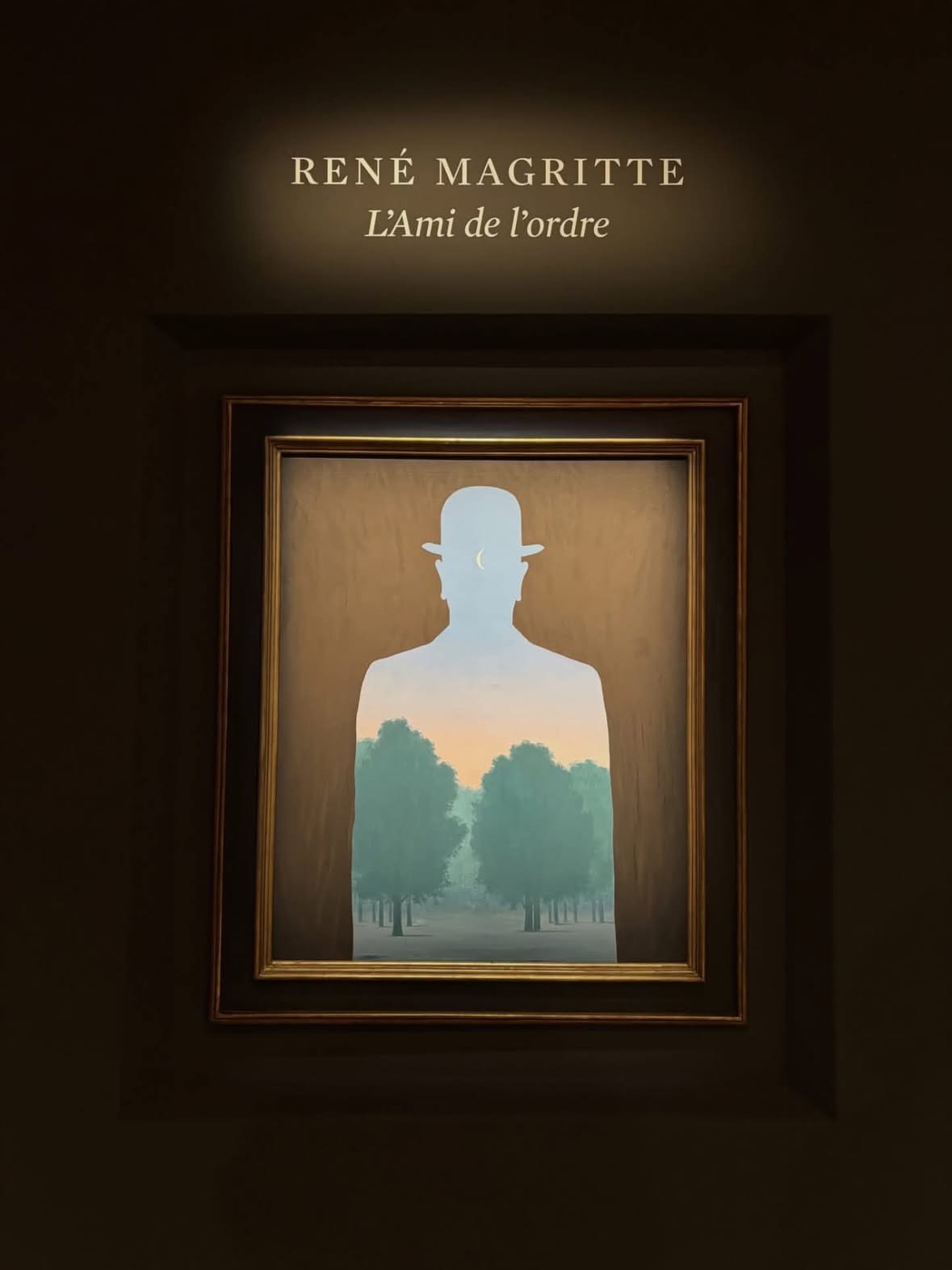
Look at what was bought. A brown surface, something like the bark of a tree, and in it the cut-out silhouette of a gentleman in a bowler hat. Inside the silhouette: trees, an evening sky and a thin crescent moon exactly where the forehead should be. No face, no eyes, no gentleman. Forty-five million dollars for an Absence in a hat. Magritte gave the trick away himself, in a 1965 interview: "Each thing we see hides another, we always want to see what is being hidden."
The painting came from the collection of the late Sydell Miller and stood at auction for the first time. That is the part I like most. The best things live in closed rooms for decades, and then one day they walk out to meet people. On CoArt Market we help collectible objects hidden from the public eye for decades step onto the public stage too. After that each one receives a cryptographic certificate of authenticity, and its path from owner to owner is recorded from then on: once back in cultural circulation, an object is never lost again.
Why do his paintings cost this much? For the same reason as with any artist: there are no objective prices on the Art and Collectibles Market, only comparisons and the judgment of the people who pay. With Magritte the judgment has been the same for decades. You recognize his paintings at once, and you cannot forget them. Advertisers, album designers and filmmakers have borrowed from him for sixty years. Every borrowing reminds the world of the original.
The man who painted fake Picassos for a living and forged banknotes in hard times now makes real money change hands by the million, and once by more than a hundred million. Night and day in one picture, again.
What will the next Magritte cost? Nobody knows. But if you happen to own a sketch of a bowler hat with a cloud inside it, please, write to me first.
Next stop: Brussels
I owe the Magritte Museum a visit, and I will report back. And you: which Magritte would you hang at home, if you could? Write and tell me. This is not a survey.
Sources
- Wikipedia, "René Magritte": en.wikipedia.org/wiki/Ren%C3%A9_Magritte
- Magritte Museum, Brussels: musee-magritte-museum.be/en
- Wikipedia, "Magritte Museum": en.wikipedia.org/wiki/Magritte_Museum
- Wikipedia, "The Empire of Light": en.wikipedia.org/wiki/The_Empire_of_Light
- TheValue, "Magritte’s ‘Empire of Light’ sells for US$121 million in New York, setting auction record for the Surrealist master": en.thevalue.com/articles/christies-new-york-fall-evening-sale-result-mica-collection-magritte
- Hyperallergic, "Magritte Painting Becomes Most Expensive Surrealist Work Ever Sold": hyperallergic.com/magritte-painting-becomes-most-expensive-surrealist-work-ever-sold/
- The Guardian, "Magritte painting stolen at gunpoint" (24 September 2009): www.theguardian.com/artanddesign/2009/sep/24/magritte-painting-stolen-brussels-olympia
- The Independent, "Ceci n’est pas an artist" (28 February 1998): www.independent.co.uk/life-style/ceci-nest-pas-an-artist-1147477.html
- National Bank of Belgium Museum, "The last series of Belgian franc notes": museum.nbb.be/en/resources/last-series-belgian-franc-notes
- The Art Newspaper, "Van Gogh painting sells for record $190m at Sotheby’s following Nazi loot claims" (19 November 2026): www.theartnewspaper.com/2026/11/19/van-gogh-painting-sells-for-record-7778m-after-nazi-loot-claims
- USA Art News, "Magritte’s L’Ami de l’ordre Heads to Sotheby’s for $25M+" (16 November 2026): usaartnews.com/auctions/magritte-painting-lami-de-lordre-heads-to-auction-for-first-time/