

Richard Dadd: a fairy kingdom behind hospital walls
A fairy kingdom painted behind hospital walls, and the contradiction at the heart of Richard Dadd's life
The thirty-fourth article of our series “Great artists” follows Richard Dadd from a promising London career to Bethlem Hospital, where he painted a fairy kingdom that later became the subject of a major auction. It is a story about imagination, a terrible crime and the danger of mistaking an artist's life for a simple explanation of his work.
Who was Richard Dadd?
Richard Dadd was an English Victorian painter known for extraordinarily detailed fairy scenes, as well as portraits, watercolors and subjects inspired by the Middle East. He was born in Chatham, Kent, in 1817 and studied at the Royal Academy schools in London.
By his twenties, Dadd had already attracted attention. He exhibited fairy subjects and belonged to a group of young artists known as the Clique. His skill and imagination were visible before the events that would dominate later accounts of his life.
In 1842 he traveled through Greece and the Middle East with Sir Thomas Phillips, serving as a companion and draftsman. The journey gave him material for drawings and paintings that he would revisit in later years. During the trip, he also began experiencing severe mental distress.
In August 1843, after returning to England, Dadd killed his father. He fled to France, where he was arrested after attacking another man, and was eventually returned to Britain. In 1844 he was committed to Bethlem Hospital in London. In 1864 he was transferred to Broadmoor, where he remained until his death in 1886.
These events cannot be left out. Nor should they be turned into entertainment, or used to suggest that illness automatically produces artistic insight. Dadd had been a talented artist before his confinement. He continued working through decades in institutions, producing works that deserve to be looked at closely on their own terms.
What is The Fairy Feller's Master-Stroke?
The Fairy Feller's Master-Stroke is an intricately detailed painting of figures gathered around a fairy woodsman about to split a hazelnut, which Dadd worked on from 1855 to 1864 while he was at Bethlem. It is now in the Tate collection.
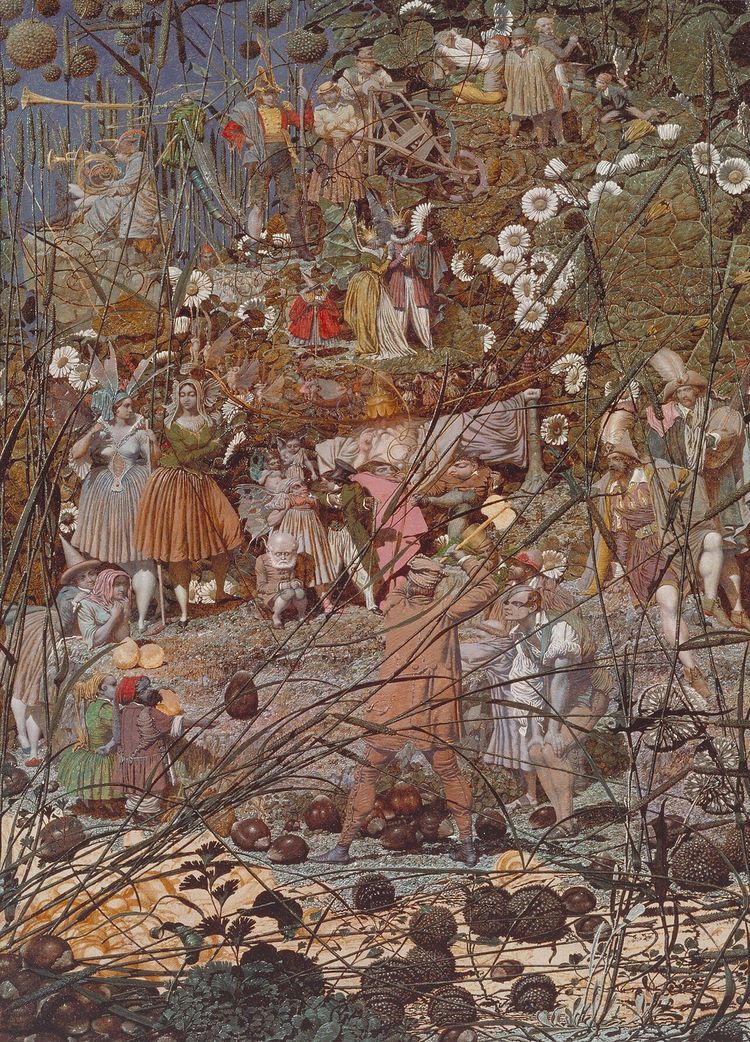
The figures crowd the space. Leaves and grasses become a kind of architectural structure, while tiny faces, costumes and gestures ask for more attention than the painting's modest dimensions initially suggest. It is the sort of work that seems to get larger the longer you look at it.
The figure with the raised axe gives the scene a center. The action has not yet happened. Everyone appears caught in the moment before the stroke, and that pause allows Dadd to fill the surrounding space with people and possibilities.
Dadd also wrote a long explanatory poem associated with the painting. It names characters and offers another way into the scene, although it does not necessarily settle every question a viewer might have. A key to a painting can open one door and leave several others closed.
The picture was still not quite finished when Dadd left Bethlem for Broadmoor in 1864, according to Christie's catalogue. In 1963 the poet Siegfried Sassoon presented it to Tate. It has also reached audiences in an unexpected way: Queen recorded a song named after it in the 1970s. A Victorian fairy painting and a rock album make an unusual introduction. Sometimes unusual introductions are the ones people remember.
Why did Dadd paint Oberon and Titania?
Dadd painted Contradiction: Oberon and Titania in 1854–1858 for William Charles Hood, the physician superintendent at Bethlem, drawing on the fairy king and queen of Shakespeare's A Midsummer Night's Dream.
Oberon and Titania are caught in disagreement amid a dense gathering of figures. The title tells us to look for conflict, but it does not tell us to ignore everything else. Dadd fills the scene with a world around the central encounter.
Hood took an interest in Dadd's work and acquired a number of his pictures. Bethlem's steward, George Henry Haydon, admired Contradiction and asked for something similar; Christie's account links that request to the creation of The Fairy Feller's Master-Stroke.
It is a complicated relationship. These were paintings made by a man confined in a hospital, and their patrons included the people who worked there. The presence of patronage and encouragement is part of the record. So is the fact of confinement. Neither should be made to cancel the other.
The two paintings are often mentioned together, but they are different objects. The Fairy Feller is the Tate painting; Contradiction is the work that appeared in Christie's 1992 sale. The difference becomes important when we look at the price.
How much have Richard Dadd's paintings sold for?
Richard Dadd's auction record is £1,650,000 for Contradiction: Oberon and Titania, sold at Christie's London on 12 June 1992; Christie's own later catalogue calls it "a record price". I found no later public sale that beats it.
The painting's road to that evening is a small history of the market in itself. After Hood's death it sold at Christie's on 28 March 1870 for 136 guineas. In 1964 it appeared at Sotheby's and made £7,000. In 1983, again at Sotheby's, it sold for £550,000, which Christie's catalogue records as a world record for a Victorian painting at the time. In between, it hung on extended loan at the Minneapolis Institute of Arts and then the Art Institute of Chicago.
136 guineas, £7,000, £550,000, £1.65 million. Same painting, same fairies, same quarrel. What changed is how many people knew why it mattered.
A work can be seen by the public, return to private hands and later appear on the market. Each change is another part of its documented journey. That is also why I am wary of database rankings of an artist's "top lots": many of them start in the late 1990s and simply do not see a sale made in 1992.
What are five things to know about Richard Dadd?
Five details are worth keeping in mind:
1. He was a success before 1843. Dadd was already an exhibiting artist and a member of the Clique before the events of that year.
2. The journey east never left him. His travels in Greece and the Middle East continued to inform works he painted decades later in hospital.
3. There are two great fairy paintings, not one. Contradiction and The Fairy Feller's Master-Stroke are separate works, and the second was commissioned because of the first.
4. A poet gave the Fairy Feller to the nation. Siegfried Sassoon presented it to Tate in 1963.
5. A rock band carried the title around the world. Queen's song introduced The Fairy Feller to an audience far beyond a Victorian art gallery.
Where can you see Richard Dadd's work?
You can see Dadd's paintings and watercolors at Tate Britain in London, which holds The Fairy Feller's Master-Stroke, at the Metropolitan Museum of Art in New York and at the Bethlem Museum of the Mind in Beckenham. Check current displays with each museum: an object in a collection may be on loan or in storage.
In 2026 the Royal Academy of Arts in London showed Richard Dadd: Beyond Bedlam (25 July–25 October), the first major survey of his work in about fifty years. If you missed it, Tate Britain is a good place to begin.
Why does a painting's history matter?
A painting's documented history matters because it tells us who made it, for whom, and how it traveled afterward. With Dadd, that history runs from a hospital superintendent's collection through three auction rooms and two American museums.
At CoArt Market, every object carries a cryptographic certificate of authenticity that records its path from owner to owner, and we are building a market for fractional ownership of Blue Chip art and collectibles, a core part of the system we are working on now.
Dadd's story contains tragedy, confinement and a lifetime of painstaking work. None of those facts needs to be hidden, and none should prevent us from looking at the paintings themselves. If you could stand before one of his crowded fairy scenes, which would you examine first: the figures at the center, or the small world he built around them?
Sources
- Christie's, Contradiction. Oberon and Titania, lot description and provenance (1870, 1964, 1983, US loans): www.christies.com.cn/lot/lot-2955278
- Christie's, The Rabbit Hutch, catalogue note confirming the 1992 sale "for a record price of £1,650,000": www.christies.com/lot/lot-richard-dadd-the-rabbit-hutch-2074804/
- Tate, Richard Dadd, artist page: www.tate.org.uk/art/artists/richard-dadd-130
- Tate, The Fairy Feller's Master-Stroke, 1855–64: www.tate.org.uk/art/artworks/dadd-the-fairy-fellers-master-stroke-t00598
- Metropolitan Museum of Art, Sketch to Illustrate the Passions – Ambition: www.metmuseum.org/art/collection/search/753517
- Apollo, Susan Owens on Richard Dadd: Beyond Bedlam at the Royal Academy (September 2026): apollo-magazine.com/?p=1046926
- The Art Newspaper, a fresh appreciation of Richard Dadd (21 July 2026): www.theartnewspaper.com/2026/07/21/a-fresh-appreciation-of-victorian-painter-richard-dadd-who-was-haunted-by-mental-illness
- American Journal of Psychiatry, Dadd and the painting's later reception: psychiatryonline.org/doi/10.1176/appi.ajp.2015.15070913