

Vincent van Gogh: one painting sold in a lifetime, $190.4 million in one evening
He sold one painting in his lifetime. In November 2026 a canvas hidden for sixty years sold for $190.4 million
The third article of our series "Great artists" follows one Van Gogh painting from a village near Paris in May 1890 to a New York saleroom in November 2026, and asks why the man who could not sell his work now breaks records.
Who was Vincent van Gogh?
Vincent van Gogh was a Dutch painter, born on 30 March 1853. He decided to become an artist at the age of 27, which by the standards of the profession is late, and he died at 37, which by any standard is early. That leaves ten years. In those ten years he made over 850 paintings and almost 1,300 works on paper, the Van Gogh Museum counts.
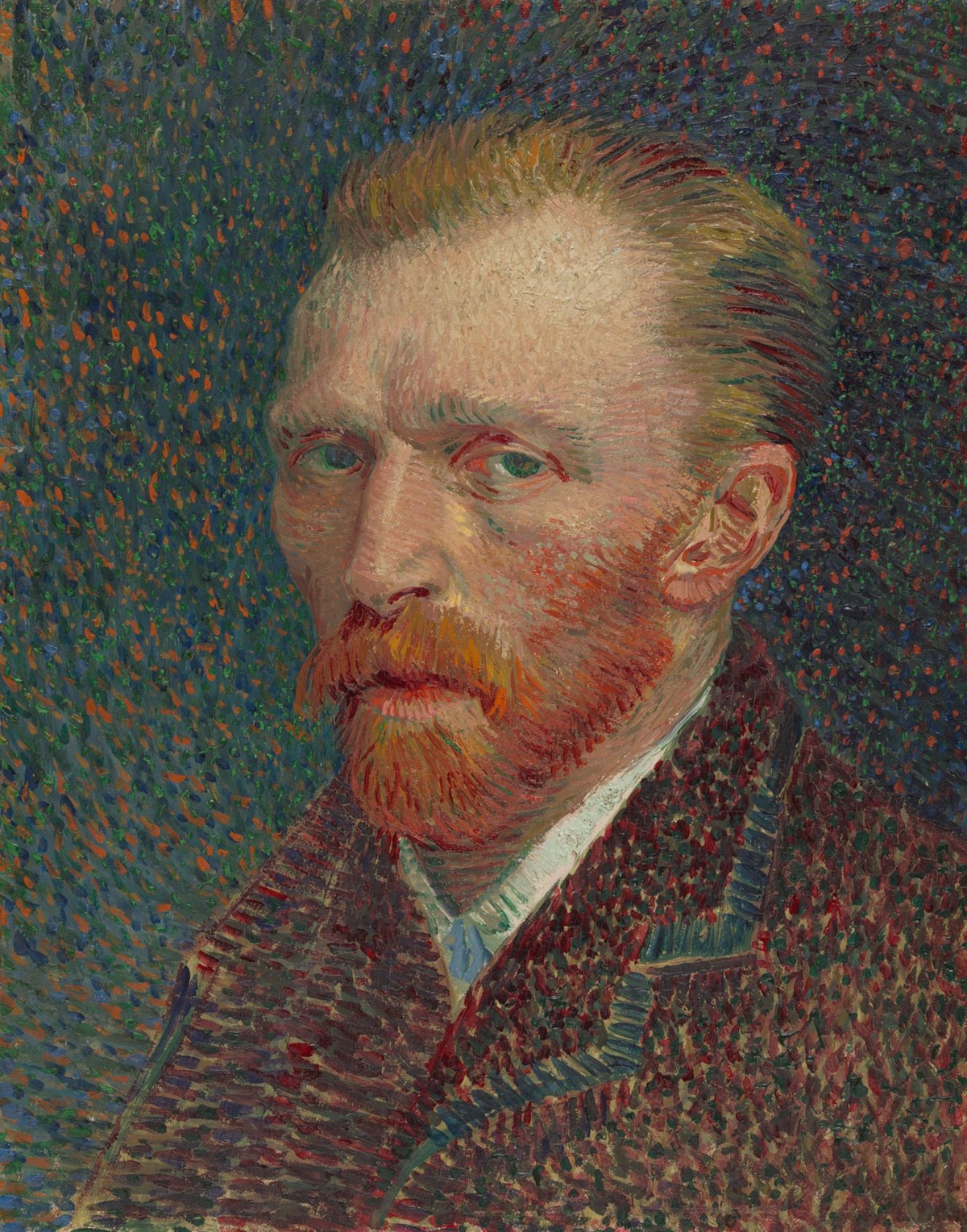
Everybody knows the Sunflowers and the Starry Night. Fewer people remember the arithmetic behind them. Of all those paintings, only one sale during his lifetime is recorded: The Red Vineyard, painted in November 1888. One. I know artists who complain after a slow month.
So here is a man who worked for a decade almost without buyers and kept painting anyway. Keep that in mind. We will come back to the buyers.
What happened in Auvers-sur-Oise in 1890?
In May 1890 Van Gogh left the hospital in Saint-Rémy and went north to Auvers-sur-Oise, an artists' village near Paris. It was quiet, it was close to his brother Theo, and there was a doctor, Paul Gachet, an amateur painter himself, who gave him the only prescription he was ready to follow: paint.
He did. The Van Gogh Museum describes him painting the gardens and wheatfields around the village "at a feverish rate", completing virtually a work a day. Blossoming Chestnut Trees comes from those first weeks: a flowering tree built up in thick strokes of green, blue and yellow. May, sun, a village street. Nothing in it tells you how the summer will end.
It ended on 29 July 1890, when Vincent died in his room at the Auberge Ravoux, with Theo beside him. He was buried in Auvers the next day. About seventy days in the village, and about as many paintings.
What did Blossoming Chestnut Trees sell for in November 2026?
On 18 November 2026, at Sotheby's in New York, Blossoming Chestnut Trees (Châtaigniers en fleurs, May 1890) sold for $165 million at the hammer, $190.4 million with fees. It is the new auction record for Van Gogh. The previous one, $117 million, was set in 2022 by Orchard with Cypresses at Christie's.
The bidding opened at $135 million. Two bidders fought on the telephones, and a third, in the room, won: the New York dealer William Acquavella. Only three works of art have ever sold for more at auction, The Art Newspaper notes: Leonardo's Salvator Mundi, Klimt's Portrait of Elisabeth Lederer and Warhol's Shot Sage Blue Marilyn.
The house had hoped for a hammer price of around $180 million, so somewhere a specialist was a little disappointed with $165 million. I would like to have such disappointments.
And now the arithmetic again. A man with one recorded sale in his lifetime. One of his roughly seventy Auvers paintings. One hundred and ninety million dollars, 136 years later. Vincent would not have believed it. Theo, who was an art dealer, might have.
Where had the painting been all this time?
This is the part I find most interesting, because a painting's road is a story of its own.
Blossoming Chestnut Trees belonged to the Berlin publisher Samuel Fischer and his wife Hedwig, and hung in their home for about a quarter of a century. In 1936 it was sold to the Paris collectors Henriette and Marcel Kapferer for $22,000. In 1938 they lent it to a London exhibition with a title that fits too well: "Artists who Died Young". A few months before the war it crossed the ocean to the New York dealers Wildenstein & Co, passed through two American private collections, and in 1964 was shown at the Guggenheim.
That was the last time the public saw it. In 1975 it went to Argentina, to the collection of Nelly Arrieta de Blaquier and Carlos Pedro Blaquier, which was reportedly kept "under lock and key" at the family estate near Buenos Aires. More than sixty years out of sight.
And when it finally came out, its past came with it. The Fischers were a Jewish family persecuted by the Nazis, and six days before the auction a researcher acting for their heirs asked how free that 1936 sale had really been. On 17 November, the day before the sale, the two families reached an agreement, and the auctioneer Oliver Barker opened the lot by saying so. The terms are confidential.
I tell this not for the drama. Look at how much work it took to reconstruct ninety years of one painting's life: archives, old catalogues, letters, researchers on two continents. And this is a Van Gogh, one of the best documented artists in the world. Now think of all the objects that are not Van Goghs.
This is exactly what we do at CoArt Market. We help objects hidden from the public for decades come back to the stage, onto our showcases. And each of them receives a cryptographic certificate of authenticity, so that from that moment its path from owner to owner is recorded and the object is never lost again.
Why do Van Gogh's paintings cost so much?
Because the people who buy them agree that they are worth it. On the market of art and collectibles there are no objective prices. There are only comparisons, and the judgment of the people who pay.
The comparisons, though, are worth a look. Martin Bailey of The Art Newspaper collected them:
In 1924 the National Gallery in London bought the Sunflowers for the equivalent of $5,800.
In 1935 Orchard with Cypresses sold at auction in New York for $15,000. In 2022 the same painting sold for $117 million.
In 1936 Blossoming Chestnut Trees sold for $22,000. In 2026, for $190.4 million.
In my view, Van Gogh is the strongest argument there is for art as an investment, and also the saddest one: the artist saw none of it. (My personal opinion, not investment advice.)
The paintings did not change. The same strokes, the same chestnut tree, the same May of 1890. What changed is how many people know why they matter. That knowledge was built by Theo's widow Jo, by dealers, by museums, by collectors who bought early and waited. A Blue Chip artist is not born on the day he picks up a brush. He is made later, by everybody who keeps his work alive.
What will a Van Gogh cost tomorrow? Nobody knows. Not the auction houses, and not me.
One sale in a lifetime
So, the buyers. Somebody did buy The Red Vineyard, the only one, while Vincent was alive. I often think about that person: no records, no catalogues, no experts nodding. Just eyes.
Would you have bought a Van Gogh in 1890? Be honest. And who should be next in this series? Write and tell me.
Sources
- The Art Newspaper, Carlie Porterfield, "Van Gogh painting sells for record $190m at Sotheby's following Nazi loot claims" (19 November 2026): www.theartnewspaper.com/2026/11/19/van-gogh-painting-sells-for-record-7778m-after-nazi-loot-claims
- The Art Newspaper, Martin Bailey, "Van Gogh's record-breaking 'Blossoming Chestnut Trees': the $190m sale and the restitution claim that nearly upended it" (20 November 2026): www.theartnewspaper.com/2026/11/20/deeper-look-van-goghs-record-breaking-blossoming-chestnut-trees-190m-sale-restitution-claim
- The Art Newspaper, "Sotheby's makes last-minute deal to sell $180m Van Gogh painting following dispute" (17 November 2026): www.theartnewspaper.com/2026/11/17/sothebys-makes-last-minute-deal-with-jewish-heirs-to-sell-180m-van-gogh-painting
- The Art Newspaper, "$450m Impressionist collection, including a potentially record-breaking Van Gogh painting, to be sold at Sotheby's New York" (30 September 2026): www.theartnewspaper.com/2026/09/30/450m-impressionist-collectionincluding-a-potentially-record-breaking-van-gogh-paintingto-be-sold-at-sothebys-new-york
- Van Gogh Museum, "The Life of Vincent van Gogh, 1853-1890" and "Vincent van Gogh's Final Months": www.vangoghmuseum.nl/en/art-and-stories/vincents-life-1853-1890/vincents-final-months