

Vladimir Yankilevsky: the space between three panels
A triptych gives the viewer three fields, two interruptions and a relationship to reconstruct
The ninety-seventh article of our series “Great artists” begins with arithmetic. Three panels give you two gaps before the painter has made a mark. Vladimir Yankilevsky understood the possibilities of those gaps. Look from the left panel to the right and your eye has already crossed a middle territory. You have supplied a direction, possibly even a little story. Would a reader accustomed to scanning a page in the opposite direction tell the same one?
Who was Vladimir Yankilevsky?
Vladimir Yankilevsky was a painter and graphic artist whose triptychs, multipart compositions and reliefs examine relationships through separated but connected fields.
His father Boris gave him his first lessons. In 1956 Vladimir visited the Picasso exhibition at Moscow’s Pushkin Museum. He was finishing school. According to the Ludwig Museum, he worked as a book illustrator from the age of eighteen. Think about what a triptych could offer a young illustrator. You could keep the sequence of a book and let the reader see three pages at once. Nobody had to wait for a page to turn. There is an extra pleasure in knowing that this experiment came from somebody who knew the feel of the original job.
The format is a good place to meet him because it gives looking a visible structure. We can move among parts without pretending that they are independent paintings accidentally hung near one another. The separation has been designed.
He was born in Moscow in 1938 and died in Paris in 2018. The movement between places belongs to his biography; the relation among parts belongs to the paintings. One does not need to become a simple illustration of the other.
When did the triptychs begin?
The triptychs began in the early 1960s, with Classical identified as the first in the numbered sequence.
Budapest’s Ludwig Museum dates Triptych No. 1 (Classical) to 1961. The artist’s catalog on OAM lists a Classical first triptych under 1962. Both dates deserve to accompany a discussion of the work until the underlying records can be reconciled. The discrepancy places the picture close to the very beginning of the public career of an artist trained at the Moscow Polygraphic Institute.
The two dates in the existing records should remain visible. A year can look like a trivial discrepancy until a writer starts building a causal story around it. Put the first triptych before or after an exhibition and a confident explanation may suddenly rest on the uncertain part of the evidence.
We do not need that explanation to begin looking. The early work already offers the basic possibility of putting a relationship across three fields. A figure on either side can establish a polarity; the middle can become a place of contact, resistance or attempted connection. These are compositional possibilities rather than a fixed dictionary for every later painting.
I would approach the sequence with a question about variation. What remains recognizably part of the format, and what changes in the way the parts communicate? A numbered series allows a painter to return to a structure without treating the first solution as a rule that can never be revised.
There is a useful difference between a format and a formula. A formula promises to settle the problem in advance. A format supplies the conditions under which the problem can continue. Yankilevsky seems much more interesting to me when we allow the triptych to remain the second kind of thing.
What does the middle do?
The central panel creates a relationship between the outer fields while making the viewer aware that the relationship has to be constructed.
It can join the outer panels or keep them apart. The traditional triptych prepares us to give special weight to its center. A painter can use that expectation before we have identified a single figure. Try covering the middle panel with your hand, then moving it over one of the wings. Which absence changes the work more? That seems to me a better introduction to Yankilevsky’s visual thinking than memorizing the name of a movement.
The Ludwig Museum explains the early Classical arrangement through a man and a woman on the sides and the contact between them in the middle. That gives us a specific reading of this work. It need not turn the whole career into an illustrated lesson about two fixed identities.
Later multipart structures can make space feel almost bodily. A wide composition requires the eye to travel. We cannot give every part exactly the same attention at exactly the same instant. Even when the work remains wholly visible, our concentration arrives in sequence.
That is why the gaps matter. They interrupt a continuous sweep without necessarily destroying the relationship. The viewer remembers one side while attending to another. We perform a small act of connection every time we return across the middle.
I would also notice what happens when a reproduction becomes very small. The overall scheme may remain legible while the physical distance between parts loses force. A catalogue is useful, but it can make a large, demanding encounter feel conveniently manageable. Dimensions restore some of the inconvenience. In this case inconvenience can be part of understanding.
Why do Yankilevsky's multipart paintings matter?
They make the relationship among separate elements an active part of the viewer's experience rather than a meaning supplied only by the title.
The Zimmerli records Triptych No. 7: Song of Songs from 1967 and the five-part Adam and Eve of 1980. The latter extends over eleven meters overall. A five-part Adam and Eve is not the same object as the 1965 Triptych No. 5 sold through Vladey. The returning title should make us more attentive to numbers and dates.
I like the persistence of the question across changes of scale. How much can separate two things while they still belong to one experience? In a small drawing the distance might be crossed with a glance. In a vast multipart painting the relation becomes something the viewer has to keep in mind while looking elsewhere.
This is an interpretation of what the arrangements ask us to do. It does not require us to identify a personal confession behind every panel.
What are five facts about Vladimir Yankilevsky?
These five details connect the work with specific events, materials and collections.
1. His father Boris gave him his first lessons.
2. He visited the Picasso exhibition in Moscow in 1956.
3. He studied at the Moscow Polygraphic Institute from 1957 to 1962.
4. Ludwig dates Classical to 1961, while the artist's OAM catalogue gives 1962.
5. The Zimmerli holds both Triptych No. 7 and a later five-part Adam and Eve; these are distinct from Vladey's Triptych No. 5.
What have Vladimir Yankilevsky's works sold for?
Adam and Eve. Triptych No. 5 was lot 19 in the Vladey X evening sale in 2017, estimated at €150,000 to €200,000. Vladey's own page confirms the title, the 1965 date, the medium and the sale. MutualArt reports $289,768 for it and lists it as his auction record.
A separate reference is Triptych No. 10, which Art.Salon records at £133,250 in Phillips' London BRIC Theme Sale, April 23–24, 2010. The triptych number is indispensable: a reader following only Adam and Eve or only the artist's name can easily join different objects into an imaginary provenance.
Where can you see Vladimir Yankilevsky's works?
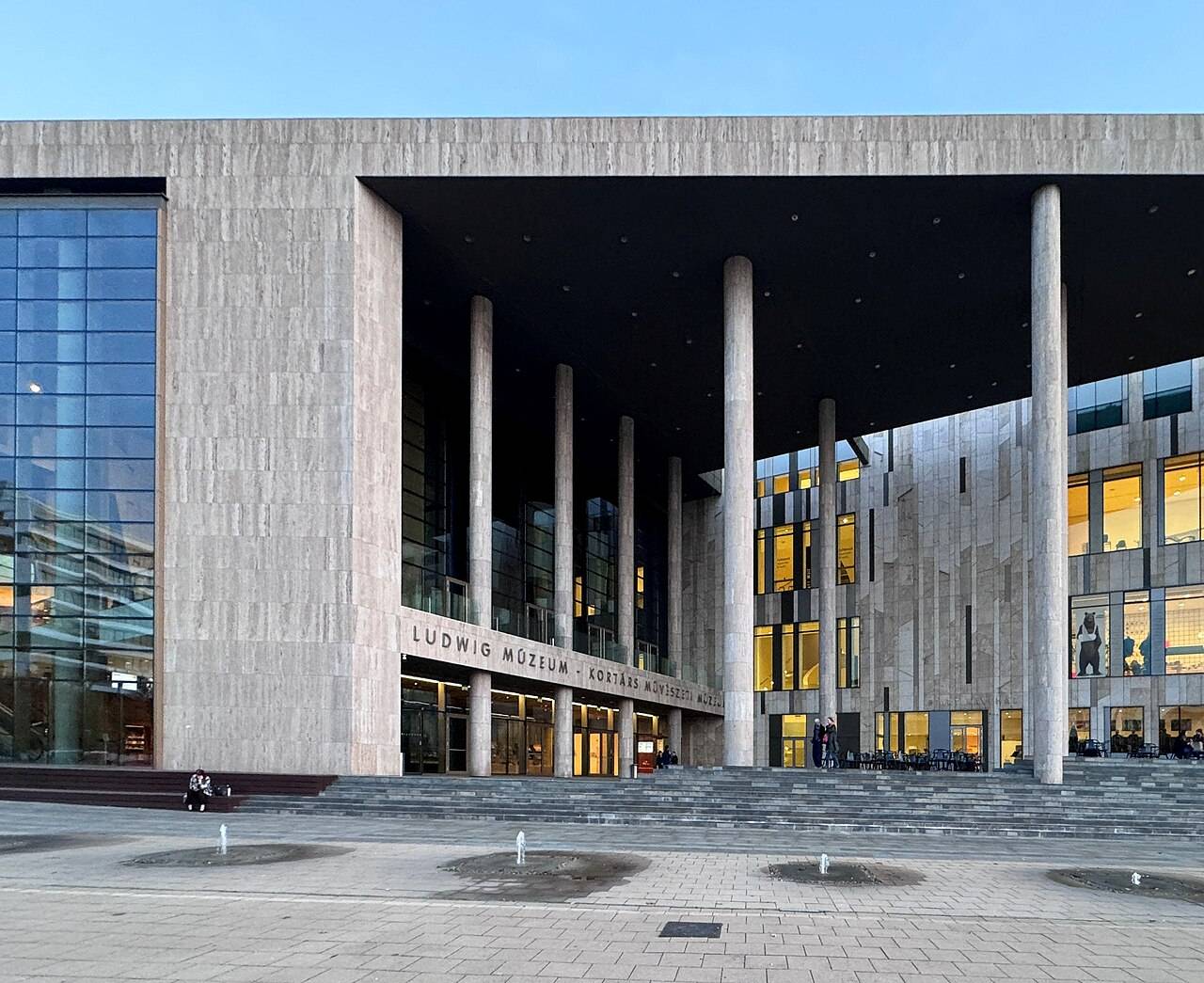
You can explore Yankilevsky through the Ludwig Museum in Budapest, the Zimmerli Art Museum and the Centre Pompidou.
Budapest provides the early triptych; Zimmerli's catalogue supplies the broader range and multipart scale. The Pompidou's Portrait d'homme offers another entry into the career. Check current displays separately from collection ownership.
An installation record, an old photograph and a numbered title can preserve how the parts belong together. That documentation matters when a composition travels. Three panels should arrive with more than the assurance that all three were once in the same room.
At CoArt Market, every object carries a cryptographic certificate of authenticity, and we are building a market for fractional ownership of Blue Chip art and collectibles, a core part of the system we are working on now.
When you look at the triptych again, do you feel the middle bringing the two sides together or holding them apart?
Sources
- Ludwig Museum, Budapest: www.ludwigmuseum.hu/en/work/triptych-no-1-classical
- OAM, Vladimir Yankilevsky: oam.io/artistes/vladimir-yankilevsky/catalogue/volume-1
- Zimmerli Art Museum, Dodge Collection, Vladimir Yankilevsky: dodge.zimmerli.rutgers.edu/artists/vladimir-yankilevsky
- Vladey: vladey.net/en/lot/3551
- Van Abbemuseum archive, Vladimir Yankilevsky: ls.vanabbemuseum.nl/Y/yankilevsky/text/yankilevsky.htm
- Centre Pompidou, Portrait d'homme: www.centrepompidou.fr/en/ressources/oeuvre/cdKokBE
- MutualArt, Vladimir Yankilevsky auction record: www.mutualart.com/Artist/Vladimir-Yankilevsky/A7A531BEC9087F15
- Art.Salon, Triptych No. 10: www.art.salon/artwork/vladimir-yankilevsky_tryptich-n10_AID401371