

Wassily Kandinsky: a painting, a museum sale and a new $85.8 million record
A painting sold by a museum and a new $85.8 million record for the pioneer of abstraction
The fourteenth article of our series “Great artists” follows a Kandinsky painting from the Bauhaus to the Guggenheim and a New York auction on 17 November 2026. The winning bid was $74 million. The journey to that bid took more than a century.
Who was Wassily Kandinsky?
Wassily Kandinsky was a painter, teacher and writer born in Moscow in 1866 who became a major figure in the development of abstract art. He worked in Germany, Russia and France and died near Paris in 1944.
He studied law and economics before pursuing art. That detail is not a recipe for becoming an abstract painter, but I enjoy the change of direction. Kandinsky eventually moved to Munich, where his artistic experiments brought him into contact with other artists looking for new ways to paint.
With Franz Marc, he was associated with Der Blaue Reiter, or The Blue Rider. He wrote about the relationship between art and inner experience, returned to Russia during the First World War and later taught at the Bauhaus in Germany. After the Nazi closure of the school, he settled in France.
His paintings changed over those years. Some early works still contain identifiable mountains, riders and buildings. Later compositions give more space to lines, circles, angles and color. He did not simply wake up one morning, discard every recognizable subject and spend the rest of his life repeating the same experiment.
Why is Kandinsky famous?
Kandinsky is famous for paintings and theories that helped establish abstract art, using color and form to create relationships that do not depend on a recognizable subject. Music was important to the way he thought about painting.
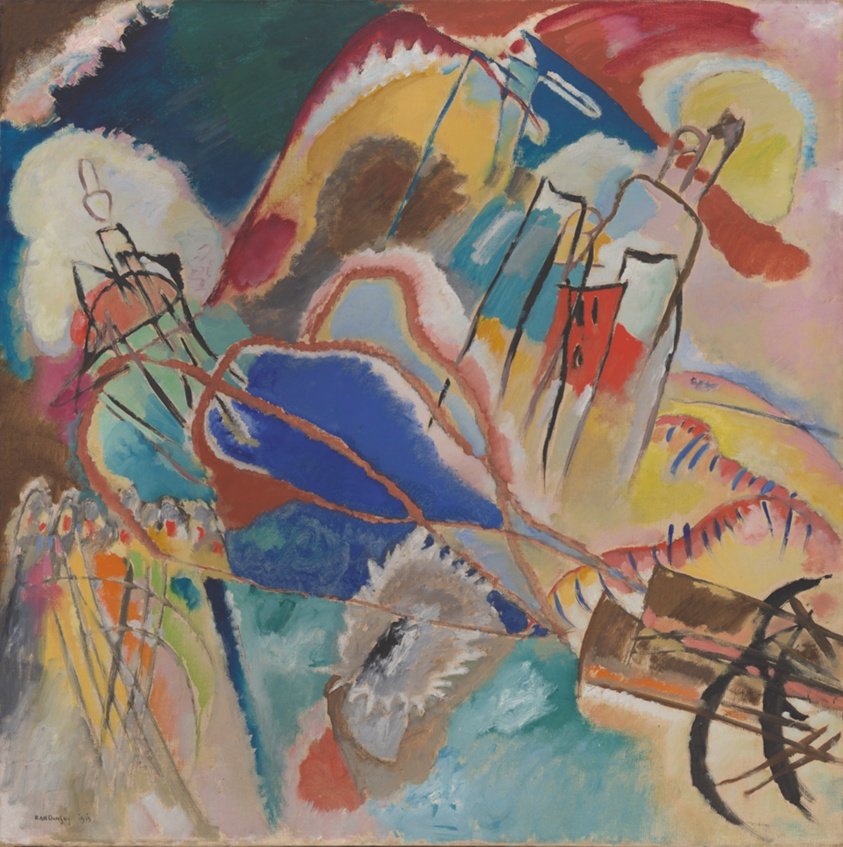
A piece of music can move us without depicting a chair or a mountain. Kandinsky explored whether color, line and shape could also produce an experience without needing to serve as a description of an object. That is a large ambition for a canvas and a few tubes of paint.
In an early composition we may recognize a landscape before its shapes begin to come apart. In a later work, a circle may meet a diagonal line without representing anything we can confidently name. The relationship between those forms becomes part of the subject.
There is a temptation to turn art history into a race and award a medal to the first person who painted an abstract picture. The development was more complicated: artists in different places were experimenting with nonrepresentational art. Kandinsky's importance does not require us to erase the others.
A useful first question is not “What object is this supposed to be?” but “What happens when these colors and shapes meet?” You may still decide you prefer a landscape. At least the painting has had a chance to make its case.
What is Betonte Ecken?
Betonte Ecken, often translated as Accentuated Corners, is a square Kandinsky painting made in Weimar during the winter of 1922–1923, early in his Bauhaus years. It brings together geometric forms, lines and vivid colors across a canvas measuring 130 by 130 centimeters.
A viewer may notice triangles, circles, lines and areas of blue, red, yellow and other colors, with diagonals that send the eye from the center toward the corners. Their meeting is not as quiet as a list of shapes makes it sound.
Kandinsky had joined the Bauhaus in 1922. The school brought together artists, architects and designers interested in the relationship between different forms of creative work. Betonte Ecken belongs to a moment when his earlier exploration of color and abstraction was developing in that environment. Its preparatory watercolor dates from November 1922, and the canvas was begun the following month.
The title draws attention to the corners. That is useful: it reminds us to look beyond the center, where a painting often seems to ask for our attention first. Here the edges are part of the action.
I would not suggest that there is only one correct route through the painting. The title, the historical context and the artist's ideas offer ways in. After that, your own eyes have some work to do.
How did Betonte Ecken leave the Guggenheim?
Betonte Ecken was the first Kandinsky oil bought by Hilla Rebay, who sent it to New York in 1929; it entered the Solomon R. Guggenheim Foundation in 1941 and was sold in 1964, when the foundation put fifty of its Kandinsky paintings up for auction. Rebay was an artist and adviser who played a major role in the development of the Guggenheim's collection.
The museum had kept it for more than two decades. The sale of works from an institutional collection is called deaccessioning: a decision that can itself become part of an object's history. The reason given was space: the foundation had more Kandinskys than walls. Betonte Ecken went for about $62,000, CNN reported.
It later passed through private hands and appeared again at Sotheby's New York in May 1986, where its last owner bought it for $1 million and kept it for forty years. The painting's route therefore runs through an artist's studio, an influential adviser, a museum, dealers or collectors, and successive auctions.
It is easy to see a museum's name in a provenance and assume the story ends there. It may instead be one chapter. Museums acquire, lend and sometimes sell works; private collectors buy, keep, exhibit and sell them. The useful question is what the documents say about this particular painting at each stage.
The work's return to public auction in 2026 brought that long history back into view, along with a rather large new number.
What is Kandinsky's auction record?
Kandinsky's auction record is $85,780,000 including fees for Betonte Ecken, sold at Christie's New York on 17 November 2026. It reached $74 million at the hammer, against an estimate of $60–80 million, according to The Art Newspaper.
The earlier artist record was set on 1 March 2023 by Murnau mit Kirche II, sold at Sotheby's London for £37.2 million including fees, approximately $44.9 million at the time. That painting had been restituted to the heirs of its former Jewish owners before the sale. The new result nearly doubled it.
Another result came only a month earlier, on 14 October 2026, when Das bunte Leben (1907) sold at Christie's London for £31,560,000 including fees, above its estimate of £18–25 million. It is an earlier work with a different subject and a different history: looted during the Nazi occupation of the Netherlands and recently restituted to the heirs of its Jewish owners.
Those comparisons matter because the record changed only days before this article was written. An older source calling the 2023 result the current record may have been entirely correct when published. Dates are not decorative details in a market section.
The paintings also differ substantially. Murnau mit Kirche II connects to a recognizable place; Betonte Ecken belongs to Kandinsky's Bauhaus period. A single record does not tell us the value of every work he made. It tells us what happened to one work at a particular auction.
What are five surprising facts about Kandinsky?
Five details show how many different lives can fit inside one artistic career:
1. He began in another profession. Kandinsky studied law and economics before turning to painting.
2. He wrote as well as painted. His book On the Spiritual in Art, published in 1911, explored ideas about art and inner experience.
3. He helped organize The Blue Rider. With Franz Marc and others, he contributed to a group and publication that brought together varied approaches to modern art.
4. He taught at the Bauhaus. He joined the school in 1922 and moved with it from Weimar to Dessau.
5. His record painting once belonged to a museum. Betonte Ecken sold for about $62,000 when the Guggenheim Foundation let it go in 1964, and for $85.78 million in 2026.
The fifth fact is the one that keeps me looking at the paperwork. A painting's story continues after a collector or institution acquires it. Sometimes the next chapter is written forty years later.
Where can you see Kandinsky's work?
You can see major Kandinsky works in New York, Munich, Paris, Chicago, Washington and other cities. Museums change displays and lend paintings, so check the official collection pages before traveling.
The Guggenheim, New York still holds an extensive Kandinsky collection.
The Museum of Modern Art, New York holds paintings and works on paper from different periods.
Centre Pompidou, Paris holds important works and resources; check current exhibition venues.
Lenbachhaus, Munich is associated with major works by Kandinsky and The Blue Rider circle.
The Art Institute of Chicago holds Improvisation No. 30 (Cannons), 1913.
National Gallery of Art, Washington holds Improvisation 31 (Sea Battle).
Seeing different periods together can be more rewarding than looking for a single “typical Kandinsky.” The path from one painting to another is part of the story.
Why does an object's history matter?
An object's history matters because records of the artist, owners, exhibitions and sales show how a work moved through the world. The Guggenheim chapter of Betonte Ecken is one part of its history, followed by private ownership and the 2026 auction.
At CoArt Market, I want objects that have spent years in private hands to become visible again. Each object receives a cryptographic certificate of authenticity that records its path from owner to owner on the platform. We want beginners, professionals and established collectors to be able to participate in the market.
Kandinsky asked color and shape to hold our attention without giving us a familiar object to identify. When you look at Betonte Ecken, where does your eye go first?
Sources
- The Art Newspaper, Kandinsky record and a trove consigned by Jeff Koons buoy Christie's 20th-century evening sale in New York (18 November 2026): www.theartnewspaper.com/2026/11/18/kandinsky-record-and-a-trove-consigned-by-jeff-koons-buoy-christies-solid-20th-century-evening-sale-in-new-york
- Christie's, 20th and 21st century New York auction results, November 2026: www.christies.com/en/stories/20th-21st-century-new-york-auction-results-november-2026-2ee028fcd27e40e7864bbe520f314600
- Christie's, Wassily Kandinsky's Betonte Ecken: www.christies.com/stories/wassily-kandinsky-betonte-ecken-906afaf17a3f4211a4f4eb4cc18e7f10
- Finestre sull'Arte, The Kandinsky sold by the Guggenheim in 1964 is now worth $85.8 million (painting, Rebay, 1941, 1964, 1986): www.finestresullarte.info/en/modern-art/the-kandinsky-sold-by-the-guggenheim-in-1964-is-now-worth-85-8-million-a-record-for-the-artist
- CNN via CTV News, Short of space, the Guggenheim sold a Kandinsky for US$62,000 (2 November 2026): www.ctvnews.ca/world/article/short-of-space-the-guggenheim-sold-a-kandinsky-for-us62000-it-may-fetch-us80-million-at-auction/
- Associated Press, 2023 restitution and auction of Murnau mit Kirche II: apnews.com/article/5e62cd857490bc41094daaf71fc934e3
- Smithsonian Magazine, restituted Kandinsky Das bunte Leben sells for nearly $42 million (October 2026): www.smithsonianmag.com/smart-news/looted-by-nazi-and-recently-restituted-a-kaleidoscopic-kandinsky-painting-just-sold-for-nearly-42-million-180989763/
- Guggenheim, Vasily Kandinsky, artist page: www.guggenheim.org/artwork/artist/vasily-kandinsky
- Art Institute of Chicago, Improvisation No. 30 (Cannons): www.artic.edu/artworks/8991/improvisation-no-30-cannons