

Lev Kropivnitsky: a painting without a required subject
An abstract painting with no required subject, made by an artist back from a ten-year camp sentence
The eightieth article of our series “Great artists” begins with Awareness of Action, painted in 1962. Its title sounds like a philosophical problem; its paint gives us something more immediate to argue with.
Who was Lev Kropivnitsky?
Lev Kropivnitsky was a painter, graphic artist and poet of the Lianozovo circle whose early abstractions, made between the late 1950s and the mid-1960s, helped expand the possibilities of unofficial Soviet art.
He was born in Tyumen in 1922 to the artists Evgeny Kropivnitsky and Olga Potapova. His sister Valentina also became an artist. In this family, a conversation about painting did not require inviting a visiting specialist.
But this was no protected artistic childhood that continued uninterrupted into a comfortable career. Kropivnitsky served in the war, returned to his studies and was arrested in 1946. The Anton Kozlov collection's biography records a ten-year camp sentence and rehabilitation in 1956.
I would not turn those facts into an automatic explanation of every later brushstroke. A person remains more complicated than the worst thing done to him. They do, however, change what we hear in a phrase such as freedom of artistic choice.
In a museum that phrase can sound pleasantly abstract. For someone whose life had been governed by other people's commands, choosing what a painting should contain could be a very practical decision.
What is Awareness of Action about?
Awareness of Action is a 1962 non-objective oil painting in which color and gesture carry the encounter without a recognizable narrative subject.
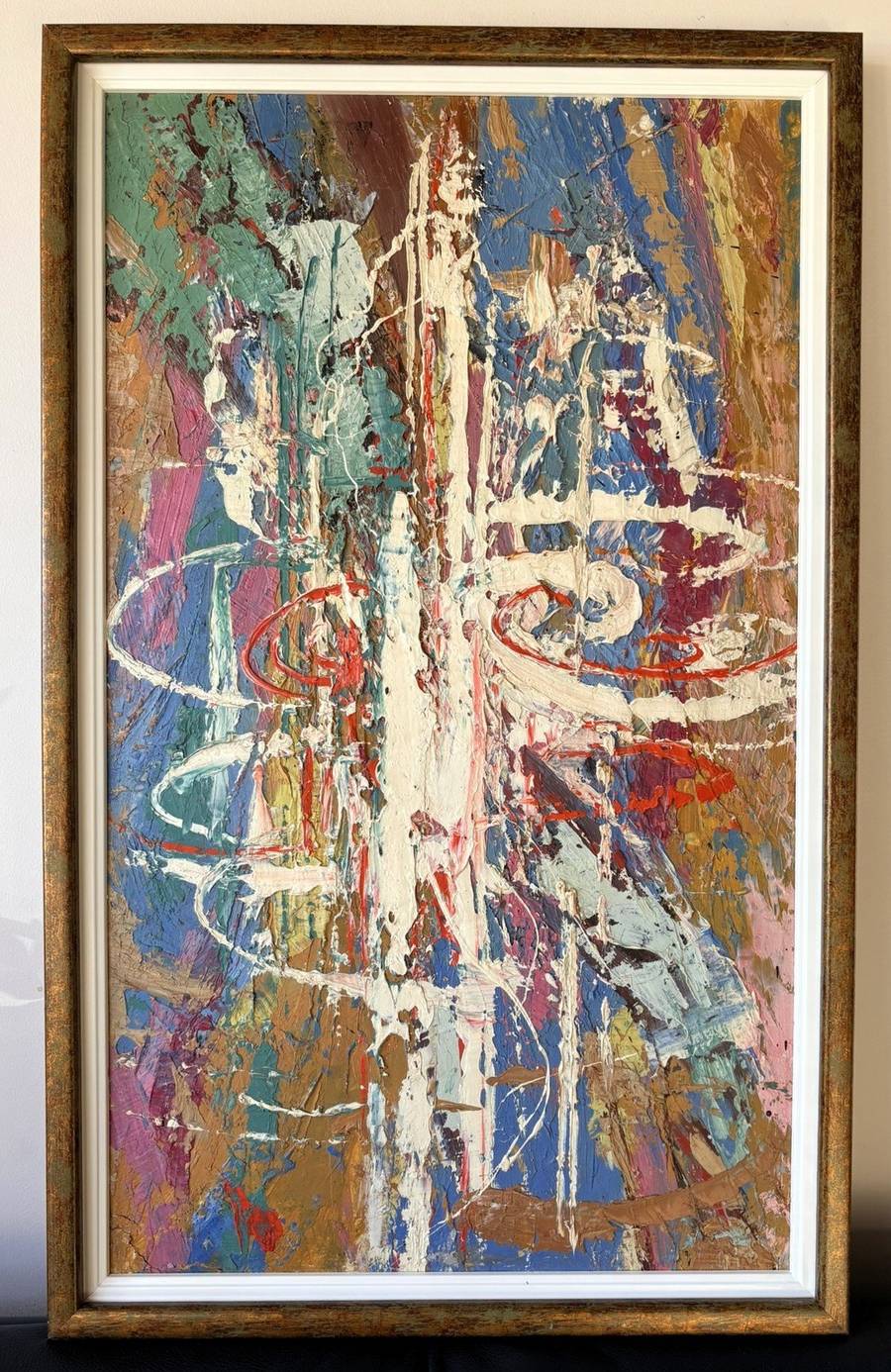
Broad areas of blue, green, ocher and violet meet denser white marks and red accents. The scale is intimate enough to examine closely. The activity inside it does not feel correspondingly small.
I read the title as an invitation to notice a process. We can look for the artist's decisions: an interruption, a layer that covers something, a mark that appears to move faster than its neighbor. These are observations and associations, not a recovered account of the order in which he painted.
Try following one white passage with your eyes. Where does it draw you next? Then begin with a dark area instead. Do you arrive at the same painting?
This is why I find the usual demand to explain abstraction slightly unfair. We rarely demand that a melody identify the person walking down a street. We accept that its relationships can mean something without becoming a report. A painting can ask for the same opportunity.
That does not mean any explanation will do. The color, scale and placement still exist. Your reading has to meet them somewhere.
How did Kropivnitsky encounter abstract expressionism?
Kropivnitsky developed his abstract language in the late 1950s and early 1960s, after two Moscow exhibitions – at the 1957 World Festival of Youth and Students and the American exhibition of 1959, where Jackson Pollock was shown – brought Western abstraction into direct view.
The Kozlov collection identifies both as decisive encounters for his generation. His response was not simply to import a fashionable surface. He spoke of the "factor of chance" in painting, the collection records, and still insisted: "control, of course, is necessary."
That tension is more interesting than the familiar contest over who influenced whom. Influence is a beginning, not a verdict. Two people can hear the same music and go home with different rhythms in their heads.
Kropivnitsky's Composition of 1961 in the Kozlov collection offers a useful comparison with Awareness of Action. Its balanced black-and-white structure is disturbed by splatters of red and green. According to his contemporaries, the collection notes, he usually finished a painting in a single session. A painting that looks immediate can contain quite exact balancing acts.
How would you distinguish an accident that belongs in the painting from one that weakens it? The artist has to make that decision while the surface is still changing. The viewer makes it later, with the considerable advantage of a finished object.
I suspect that apparent ease is often what conceals the difficulty. We see a mark that took a second. We do not see everything that made the artist recognize that this was the second to stop.
Why did Kropivnitsky return to figures?
By the mid-1960s Kropivnitsky's abstract phase had come to an end, and he moved toward strictly balanced heraldic compositions and surreal figurative painting, rather than remaining within one fixed method.
The Kozlov collection connects that turn with his growing interest in metaphysics. The surviving paintings matter more than forcing an entire career across a single calendar line.
An artist changing direction can make the market uncomfortable. Categories prefer dependable occupants. A painter may prefer a new problem.
There is also no requirement that recognizable figures make a painting less mysterious. A strange body or an emblem can be as difficult to explain as a field of marks. The question moves from what is represented to what kind of world could contain it.
Would you consider that a retreat from abstraction, or an extension of the same search by other means? I would want to put paintings from the two periods beside each other before deciding. A career is easier to misunderstand when its chapters are kept in separate rooms.
What are five less familiar facts about Lev Kropivnitsky?
Five details show how many kinds of work Kropivnitsky carried alongside painting:
1. His family was the core of Lianozovo. His father, mother and sister were artists, and Oskar Rabin was his brother-in-law.
2. He designed museum displays. From 1957 he worked at the Art Fund's decorative design workshops, with Nikolai Vechtomov and Rabin among his colleagues, on exhibition spaces and museum displays – a striking parallel life for a painter whose own experiments did not fit official expectations.
3. He wrote as well as painted. He was a poet and the author of articles on the history of art, besides making paintings and prints.
4. He was, for a decade, an official artist too. The Kozlov collection records his membership of the USSR Union of Artists from 1973 to 1983.
5. His paintings still travel. His Composition of 1961 was bought at Pierre Bergé & Associés in Paris in June 2021 and shown in 2026 in the exhibition Two Avant-Gards. A painting can acquire new neighbors long after its maker's death.
What did Lev Kropivnitsky's paintings sell for?
The highest price an auction house itself publishes for Kropivnitsky is $75,000, for Logic Out of Galaxies (1963), oil on canvas, 130 by 81 centimeters, marked "SOLD: $75,000" in Collector Fine Art Auctions' catalog of its April 22–30, 2022 sale, against an estimate of $12,000–15,000.
The house does not say whether that figure includes its premium. And the history is untidy. The same title, with the same date and size, appears as lot 114 of a sale at Ford Art Auctions in Wilmington on December 14, 2019, in the Gazette Drouot listing. That is an offering; its result is not published. I would not attach the $75,000 to the 2019 sale without a record connecting them.
Higher figures are recorded by ARTinvestment, the Russian art-market database: $90,915 at Cannes Enchères in 2011, and $91,419 at MacDougall's in London in 2007, which it gives as his record. Those houses' own pages do not show the results today, so I name the database rather than link a sale. When MacDougall's in London offered his Virgin and Child (1966) on November 29, 2007, its estimate was £15,000–20,000; the house does not publish the result.
A securely documented recent sale is more modest: Untitled (1967), oil on canvas, sold for $15,120 including buyer's premium at Doyle in New York on December 6, 2023, against an estimate of $2,000–4,000. Doyle's page also describes the painting's condition. These details belong to the same object as the price, and I would not remove them simply because the final figure makes a tidier headline.
I find the distinction worth preserving. An offering, a published sold figure and an independently reconciled auction history are three different things. None becomes more reliable because we repeat it confidently.
The Doyle painting is also later than the short early abstract period. That matters when comparing it with Awareness of Action. Sharing an artist's name does not erase the differences between two paintings. Which comparison would you trust more: the closest date, the closest visual language, or the most complete ownership history?
Where can you see Lev Kropivnitsky's paintings?
You can see Kropivnitsky's paintings through museum and collection catalogs, above all the AZ Museum's English-language pages and the Anton Kozlov collection, which publish works from both his abstract and his figurative periods.
AZ Museum publishes examples across several decades, allowing the abstract and figurative chapters to be compared.
Anton Kozlov collection records its 1961 Composition, with provenance, dimensions and exhibition history.
A collection page and a temporary exhibition are different forms of access; check the institution's current program before planning a visit.
At CoArt Market, Awareness of Action (1962) is in our Nonconformists showroom. Every object there carries a cryptographic certificate of authenticity that records its path from owner to owner, and we are building a market for fractional ownership of Blue Chip art and collectibles, a core part of the system we are working on now.
For a final look, forget the price comparisons and the names of movements. Stand in front of those colors, or bring the photograph close enough to examine them. If nobody had told you the painting was an act of independence, what would its own marks have told you?
Sources
- Anton Kozlov collection, Lev Kropivnitsky, biography by Galina Shubina: kozlovcollection.com/en/artist/kropivnitsky/
- Anton Kozlov collection, Lev Kropivnitsky, Composition, 1961: kozlovcollection.com/en/artwork/578/?context_id=1&context_type=route
- AZ Museum, Lev Kropivnitsky: museum-az.com/en/artists/lev-kropivnitskiy/
- Collector Fine Art Auctions, April 22–30, 2022 catalog, lot 145: Logic Out of Galaxies, "SOLD: $75,000": www.cfaauctions.com/upcoming-april-auction-2023-1
- Gazette Drouot, Ford Art Auctions, Wilmington, December 14, 2019, lot 114: www.gazette-drouot.com/en/auctions/102901-fine-european-paintings--26-furnitures
- MacDougall's, London, November 29, 2007, lot 307: Virgin and Child: macdougallauction.com/en/catalogue/view?id=1629
- Doyle, Doyle+Design, New York, December 6, 2023, lot 43: Untitled, 1967: www.doyle.com/auction/lot/lot-43---lev-kropivnitsky/?au=7951&ef=&et=&ic=False&lot=1367396&sd=0&so=0&st=&sto=0
- CoArt Market, Lev Kropivnitsky, Awareness of Action: coart.market/showcase/nonconformists-awareness-of-action-qGJkcLp1